YouTube Auto-Detects and Labels AI-Generated Content
If you create, market, or advertise on YouTube, this update deserves your attention.
YouTube has officially moved beyond relying only on creators to self-report AI use. With its May 27, 2026 announcement, the platform is rolling out automatic detection and labeling for certain AI-generated videos, particularly content that looks photorealistic or could reasonably be mistaken for real people, places, or events.
This is a meaningful shift. It’s more than a UI change. YouTube is acknowledging that generative AI has outpaced a disclosure system built mostly on trust.
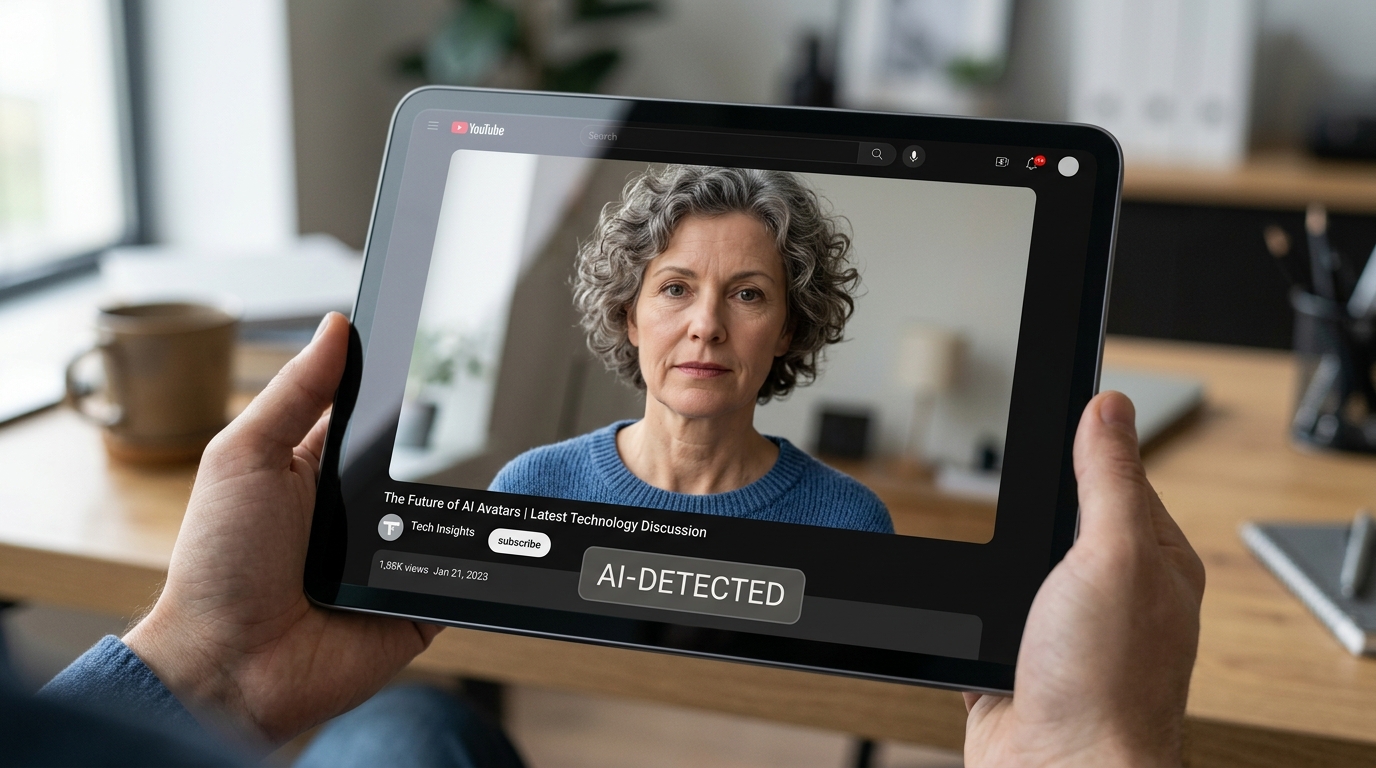 What Changed in May 2026
Until now, YouTube’s AI disclosure framework depended heavily on creators manually identifying “altered or synthetic content.” That system started taking shape in 2024, when YouTube introduced disclosure tools in Studio and placed labels mainly in video descriptions.
The weakness was obvious: manual disclosure only works when creators actually disclose.
Now YouTube is adding its own internal detection signals to identify videos with significant AI-generated or AI-altered visuals. When the system detects that kind of content, labels can be applied automatically. YouTube is also making those labels easier to see. For long-form videos, they appear below the player. For Shorts, they show up as an overlay, giving viewers context immediately instead of burying it in the description.
That visibility matters. A disclosure tucked into the description is easy to miss. A label placed next to the content is much harder to overlook.
Why YouTube Is Doing This
The short answer is transparency.
The bigger issue is credibility. YouTube is dealing with growing concerns around deepfakes, misinformation, and what many people now call AI slop—mass-produced, low-quality synthetic content designed to pull views with little originality or value.
YouTube has been under pressure from creators, viewers, media outlets, and regulators to make AI use easier to spot. This new system helps the platform do that without automatically penalizing every creator who uses AI tools.
According to YouTube’s own guidance, these labels are informational. By themselves, they are not supposed to affect recommendations or monetization. That distinction matters. YouTube is trying to protect viewer trust without shutting down legitimate creative workflows.
What Content Is Most Likely to Be Labeled
This update is not aimed at every use of AI.
Based on the guidance available so far, YouTube is mainly focused on realistic or meaningfully altered content, especially photorealistic visuals that could confuse viewers. If a video could make someone believe they’re seeing a real event, real footage, or a real person doing something that never actually happened, that’s where labeling becomes especially important.
By contrast, YouTube has indicated that minor AI-assisted workflows are not the main target. That includes things like:
- AI-assisted scripting
- AI voice cleanup or enhancement
- Generative backgrounds in limited contexts
- Stylized or obviously animated content
- Small editing changes that are not deceptive
Put simply, YouTube appears to be drawing a line between AI as a production assistant and AI as a realism engine.
The End of “Just Don’t Mention It”
For creators, marketers, and brands, this is where the update gets real.
There was a brief window when some channels hoped they could use AI-generated visuals, skip disclosure, and blend in. That window is closing. If YouTube can detect significant photorealistic AI use on its own, staying silent becomes a much riskier strategy.
Even if the label doesn’t directly hurt monetization or rankings, it still affects how audiences see the content. And if a creator repeatedly pushes misleading or low-quality synthetic media, that can lead to bigger trust and policy problems over time.
This matters even more for advertisers and performance marketers. If you’re producing YouTube creative at scale, disclosure now needs to be part of the workflow—not something handled at the last minute.
 Permanent Labels, Appeals, and Detection Signals
One of the more notable parts of the update is that not all labels will be equally flexible.
YouTube says creators may be able to appeal mislabels in some cases through Studio. But there are limits. If content was made using YouTube’s own AI tools, or if it carries provenance metadata such as C2PA signals identifying it as fully generative, the label may be permanent.
That points to a broader industry direction: provenance, watermarking, and machine-readable authenticity markers are likely to become standard. In that environment, labels are not just moderation calls—they’re metadata-driven disclosures.
Of course, no automated system is perfect. False positives are possible, and over-labeling is possible too. Some legitimate creators may feel unfairly flagged, especially when AI is used creatively but not deceptively. That’s why the appeal process matters.
Still, the direction is clear. YouTube is no longer waiting for creators to handle all reporting on their own.
What This Means for Brands and Performance Marketing
This update should push brands toward better content discipline, not away from AI altogether.
AI can still be a powerful creative tool. It can speed up ideation, script testing, editing support, thumbnail generation, and even parts of ad production. But the era of casually publishing synthetic-looking content without a clear disclosure strategy is fading fast.
For marketing teams, the practical steps are straightforward:
- Audit your YouTube content workflow
- Define when AI use requires disclosure
- Keep records of how videos were produced
- Monitor videos for automatic labels after publishing
- Build creative that prioritizes trust, not just efficiency
That last point matters most. Performance marketing has always rewarded relevance and clarity. As platforms add more transparency features, the brands that come out ahead will be the ones that combine smart automation with real credibility.
A Bigger Industry Shift
This is not happening in isolation.
YouTube’s update lines up with broader changes across digital media, including greater attention to provenance standards and the coming enforcement of transparency obligations under regulations such as the EU AI Act. It also puts more pressure on other platforms to follow suit.
This will likely become normal. Over time, AI labels may work like other content indicators: not necessarily a warning, but a standard piece of context. Viewers will learn how to read them. Creators will adapt. Platforms will keep refining the line between acceptable AI assistance and misleading synthetic media.
The real takeaway is simple: AI content isn’t going away, but undisclosed AI content is getting much harder to hide.
FAQ
Will YouTube label every video that uses AI?
No. Based on current guidance, YouTube is mainly focused on realistic or significantly altered content that could mislead viewers, especially photorealistic synthetic media.
Do these labels affect monetization or recommendations?
YouTube says the labels are informational and are not meant to affect monetization or recommendations on their own.
Can creators appeal an AI label?
In some cases, yes. YouTube says creators may be able to appeal mislabels through Studio, although some labels may be permanent when provenance metadata or YouTube’s own AI tools are involved.
What kinds of AI use are less likely to be labeled?
Minor AI-assisted workflows such as scripting help, voice cleanup, limited generative backgrounds, stylized animation, and small non-deceptive edits appear less likely to be targeted.
Conclusion
YouTube’s auto-detection and labeling system shows the platform moving from reactive policy to active transparency enforcement. For creators and marketers, the right response isn’t panic. It’s process. In this environment, clean attribution, efficient creative workflows, and better visibility into performance matter more than ever. That’s exactly why tools like ROAS Suite belong in the stack as AI, advertising, and platform compliance continue to evolve.