Why Brand Campaigns May Not Be Ready for AI Max
I understand why AI Max is getting so much attention. Google has framed it as the next big step for Search campaigns, tying it to broader automation, wider query matching, dynamic creative, and visibility in newer AI-driven search experiences. On paper, that is hard to dismiss.
But when I look specifically at brand campaigns, I am not convinced most advertisers should hand over the keys yet.
That does not make AI Max a bad product. It means brand campaigns play a very different role in an account than generic or exploratory search. They are usually the most stable, efficient, and predictable campaigns in the mix. They often produce the cleanest conversion signals and the strongest return. Adding more automation to that traffic source is not a low-risk test. It changes the part of the account that is often already working best.
 Why Google Is Pushing AI Max So Hard
Google first introduced AI Max for Search in May 2025 as a broad set of targeting and creative enhancements built around AI. It later moved from open beta to general availability in April 2026, with plans to gradually fold older settings like Dynamic Search Ads and automatically created assets into AI Max.
The pitch is strong. Google has cited internal gains such as 14% more conversions overall, and 27% more for campaigns that leaned heavily on exact and phrase match. AI Max also fits neatly into the company’s wider AI search strategy, especially as AI Overviews continue to expand. With AI Overviews reportedly reaching billions of monthly users, advertisers naturally want to know whether they can show up there.
That pressure is real. Google reps have reportedly encouraged advertisers to enable AI Max on brand campaigns to improve eligibility for AI-powered surfaces. But eligibility is not a strategy, and that is where many brands could make the wrong call.
Brand Campaigns Are Not the Right Place for Blind Automation
A brand campaign is not usually where I look for dramatic incremental growth. It is where I expect control, efficiency, and consistency.
That matters because AI Max does not treat keywords as hard boundaries in the traditional sense. It uses them as signals, along with landing pages, site content, and other inputs, to decide where and when to show ads. In some accounts, that flexibility may unlock useful demand. In brand campaigns, though, it can blur the line between pure brand intent and adjacent traffic that looks relevant to the system but performs very differently in practice.
For many advertisers, brand is the campaign type that anchors account performance. It feeds machine learning with high-conversion data, protects branded demand from competitors, and gives teams a reliable baseline. Introducing more aggressive automation into that structure can create volatility where stability matters more than expansion.
That is the core issue: just because a campaign can be automated does not mean it should be.
The Independent Results Are Hard to Ignore
If all we had were Google’s internal benchmarks, AI Max would look like an easy win. The broader picture is much more mixed.
Independent analyses have raised real concerns. Smarter Ecommerce reportedly reviewed 600 accounts and found AI Max delivered 35% lower ROAS than traditional match types while accounting for just 0.57% of spend. Xavier Mantica’s four-month test showed AI Max with the highest CPA in the group, well above phrase and exact match. Ezra Sackett’s test of 30,000 search terms found that 99% of impressions drove zero conversions.
Those are not minor warning signs.
There are also concerns about attribution cannibalization. In some cases, AI Max appears to capture queries that exact or phrase match campaigns may already have won, making performance gains look bigger than they really are. If that happens inside a brand campaign, reporting can suggest growth when the only real change was how traffic got categorized.
To be fair, not every result has been negative. Some testers, including Andy Goodwin, have reported stronger ROAS and improved Quality Score when using the full AI Max suite. But those wins tend to come from mature accounts with strong conversion signals, clean structure, and disciplined testing. That is very different from turning on AI Max in a standard brand campaign because a rep recommended it.
Most Accounts Have a Readiness Problem, Not an AI Problem
This is the part too many advertisers miss.
AI Max depends on strong data. It needs reliable conversion tracking, enough volume, meaningful variation in outcomes, and clear signals about what success actually looks like. A surprising number of accounts still do not have that foundation.
Some are missing offline conversion imports. Some optimize toward leads without feeding back lead quality or sales outcomes. Some mix micro-conversions and macro-conversions in ways that confuse bidding. Others rely too heavily on branded traffic because their generic campaigns were never fully developed.
In that environment, AI Max does not solve the underlying problem. It simply automates on top of it.
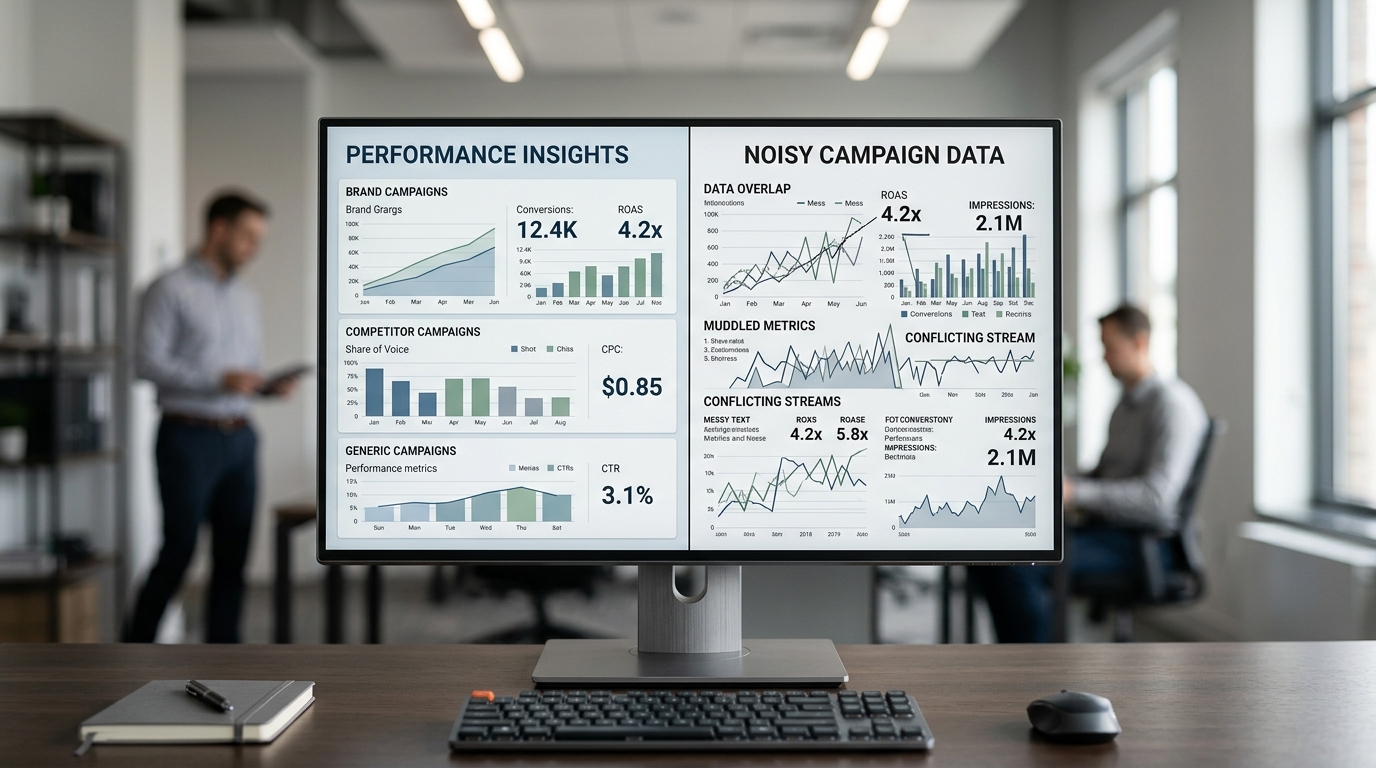
Automation amplifies account quality. If the account is well structured and measured correctly, automation can help. If the account is noisy, shallow, or overly dependent on brand traffic, automation can magnify those weaknesses.
 AI Surface Eligibility Shouldn’t Override Common Sense
One of the strongest arguments for AI Max right now is access to AI-driven search placements, including AI Overviews. Even that deserves a more measured response.
Not every advertiser needs to force AI Max into a brand campaign just to chase eligibility. Other paths may already exist, including broad match with Smart Bidding or Performance Max. If a brand is already present through those channels, adding AI Max to brand search may create redundancy instead of opportunity.
More importantly, a presence in AI surfaces only matters if the economics hold up. If costs rise, query relevance drops, and attribution becomes less trustworthy, then being eligible is not the same as being profitable.
That distinction is going to matter more as Google keeps pushing AI-first ad experiences.
Where Brands Should Focus First
Before I would recommend AI Max for a brand campaign, I would want to see a few things in place.
- Clean conversion tracking. That means true business outcomes, not just form fills or low-value engagement signals. If offline sales or qualified pipeline data matter, they need to be imported.
- Intentional campaign structure. Brand, brand-plus-modifier, competitor, and generic intent should not be muddled together. If the account cannot clearly separate those buckets, automation will not fix it.
- Room for generic growth. Too many advertisers keep asking more from brand while underinvesting in non-brand acquisition. If incremental growth is the goal, that is usually the smarter place to test.
- Testing guardrails. AI Max should be introduced through experiments where possible, with clear baselines and enough time to judge performance honestly. A rushed rollout on a core brand campaign is rarely wise.
My Take on What Happens Next
I do not think AI Max is going away. If anything, it will likely become more important as Google continues migrating legacy search features and expanding AI-led search behavior. Over time, it may improve significantly, much like Performance Max has matured since its early days.
But future potential does not mean every brand campaign is ready today.
Right now, too many advertisers are being pushed to adopt AI Max for reasons that serve platform momentum more than account strategy. That is the wrong order of priorities. Brand campaigns should not become the testing ground for automation simply because they are rich in conversion data and easy to influence.
My view is simple: fix the fundamentals first, strengthen non-brand acquisition, improve measurement, and only then decide whether AI Max belongs in your brand mix.
In a landscape where automation keeps expanding, I would rather make decisions based on clean data than platform pressure. And if you want a clearer way to evaluate performance, protect efficient spend, and make smarter optimization decisions before embracing more automation, ROAS Suite is a practical place to start.
FAQ
Should advertisers avoid AI Max completely?
No. AI Max may work well in mature accounts with strong tracking, clean structure, and enough conversion volume. The concern is not the product itself. It is whether brand campaigns are the right place to introduce it.
Why are brand campaigns more sensitive to automation?
Because they often serve as the most efficient and predictable part of the account. When you automate brand search too aggressively, you risk disrupting the campaign type that already performs best.
What is the biggest risk of enabling AI Max on brand campaigns?
The biggest risk is losing control over query intent and attribution. AI Max can expand beyond tightly defined brand traffic, which may reduce relevance and make performance reporting harder to trust.
When does it make sense to test AI Max?
It makes sense when the account has clean conversion tracking, strong business outcome data, clear campaign segmentation, and enough traffic to run a proper experiment with reliable baselines.
Conclusion
AI Max may become a bigger part of paid search over time, but that does not mean brand campaigns should be first in line. Brand search is usually where advertisers need stability, not loosened controls. If the data is messy or the account structure is weak, more automation will not solve the problem. It will expose it. Get the fundamentals right, build stronger non-brand acquisition, and test AI Max only when the account is ready for it.