Viacon Launches Generative Engine Optimization (GEO) Service
I’ve watched the search landscape rewrite its rules over the past two years—and Viacon’s latest announcement makes the shift hard to ignore. On March 5, 2026, Viacon Marketing & Technologies Pvt. Ltd. said it’s preparing to roll out a dedicated Generative Engine Optimization (GEO) service. The goal: help brands show up not only in traditional search results, but inside AI-generated answers from ChatGPT-style assistants, Perplexity, and Google’s fast-evolving AI experiences.
This isn’t a small add-on. It’s a clear sign that “blue links” are no longer the only battlefield.
 From SEO performance to AI visibility
Viacon’s move carries weight because it comes from a company built on classic SEO fundamentals. Incorporated in 2018, it grew from a guest-posting operation in Nadia, West Bengal into a global agency—expanding into regions like the UAE and scaling to a team of more than 110 people. Their path mirrors the industry’s trajectory: scale through content and outreach, broaden into full-funnel digital growth, and now adapt to AI-mediated discovery.
That’s why GEO reads less like a rebrand and more like the next logical step. Viacon has already been publishing GEO-adjacent material, including a February piece on “7 GEO errors” and a study claiming 68% of SEO strategies fail in the AEO era. The formal launch may be new, but the direction has been telegraphed for months.
What GEO actually changes (and why it matters)
GEO is optimization for generative engines—systems that synthesize answers instead of simply ranking pages. Traditional SEO still matters, but it’s increasingly incomplete on its own because AI systems often:
- summarize instead of sending traffic,
- cite a small set of “trusted” sources again and again,
- prefer structured, entity-rich, unambiguous information,
- reward consistency across the web—not just what’s on your site.
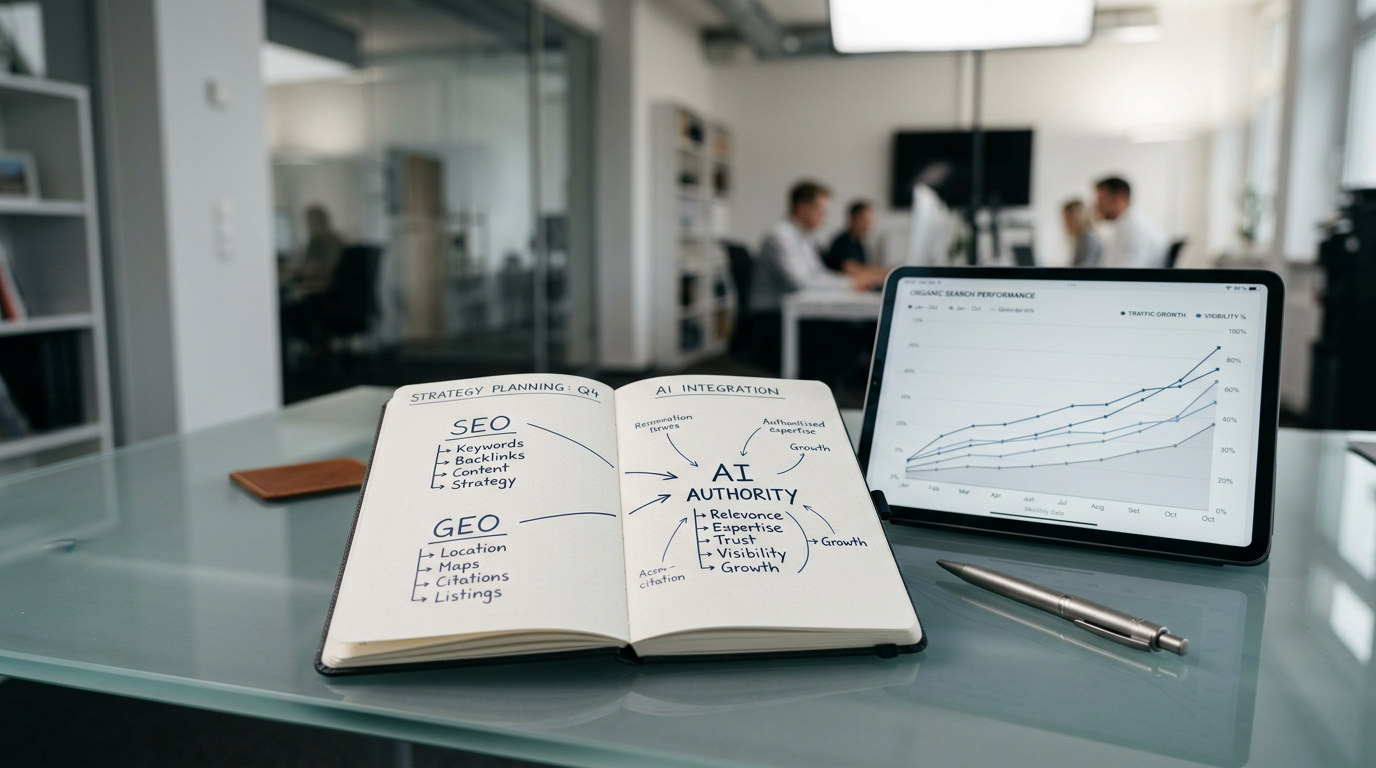
The goal shifts from “rank for keywords” to “become referenceable.” If an AI assistant is the new gatekeeper, GEO is how your brand gets mentioned even when the user never clicks a results page.
What Viacon says its GEO service will include
Viacon says its GEO service will focus on the signals generative systems use to produce confident answers. The rollout is expected “in the near future” for both new and existing clients, with emphasis on:
- Structured content improvements to make pages easier for AI systems to interpret and summarize
- Entity authority building, so the brand—and its people, products, and categories—are recognized as real-world entities rather than just text on a page
- Citation strategy, aimed at increasing the odds that AI engines reference the brand in their responses
- Digital PR alignment that connects traditional authority-building with AI-era discoverability
- Technical optimization, still the foundation—because AI visibility breaks down if bots can’t access, parse, and trust what they find
The most revealing line in the release came from Sudarshan Nath, Viacon’s SEO Team Lead/Manager, who described GEO as a shift from being purely performance-focused to becoming an “AI-aligned strategic growth partner.” That framing matters. It signals how agencies plan to define success in 2026: not only clicks and rankings, but influence inside machine-generated answers.
 Why this launch lands at exactly the right moment
The timing looks deliberate. AI discovery is quickly becoming normal behavior, not a niche habit. One cited trend shows AI search usage in the U.S. rising from 14% in February 2025 to 29.2% by August 2025—a pace that would’ve sounded unrealistic in the slower-moving SEO world of a decade ago.
Money tends to follow attention. The U.S. GEO market is projected to reach $365.4M in 2026, with rapid growth expected. Agencies are moving fast, “top GEO firms” lists are already appearing, and Viacon is stepping in early enough to be seen as a serious contender—especially across India and MENA, where many brands are only beginning to plan for AI-first discovery.
The real takeaway for brands: hybrid is the new default
Marketers keep asking the same question: “What happens when the answer is generated and the click never comes?” GEO is one of the most practical responses—but only if it’s treated as a companion to SEO, not a replacement.
The next wave of winners won’t be the brands chasing every new acronym. They’ll be the ones building durable authority signals across content, entities, PR, and technical foundations—so whether a customer asks Google, an AI assistant, or a niche discovery tool, the brand shows up as a credible source.
Conclusion: GEO is about becoming referenceable in an AI-first world
Viacon’s GEO launch is a marker of where marketing is headed: toward optimization for explanations, recommendations, and synthesized answers, not just rankings. If your brand isn’t building the clarity and authority AI systems feel safe reusing, you’re not only missing traffic—you’re losing relevance.
If you want a practical way to keep up with AI visibility as GEO, AEO, and SEO continue to converge, use a platform that keeps the signal-to-noise ratio high and the strategy grounded. For teams navigating this transition, AIuthority can help you track what matters, learn faster, and act before competitors do.