Trust Insights Announces GEO 101 Course for Marketers
If your SEO playbook has started to feel less reliable, it’s not just you. AI-powered discovery—ChatGPT, Perplexity, and Google’s AI Overviews—has changed the goalposts. The win isn’t always a blue link and a click anymore. More often, it’s being named and cited inside the answer.
That shift is what prompted Trust Insights’ latest training release: GEO 101 for Marketers, a short, practical course built to help marketers understand and apply Generative Engine Optimization (GEO)—optimizing content so generative AI systems can retrieve it, trust it, and reference it.
 Why GEO—and why now?
Traditional SEO was designed for an interface that returned lists of results. Generative search works differently: it synthesizes responses, often shrinking click-through while raising the value of brand mention, citation, and inclusion. SEO helped people find you; GEO influences whether AI systems recommend you.
This is already showing up in the data. Forecasts and early benchmarks point to major organic search changes—CTR declines on classic results pages, plus the rise of “AI traffic” that behaves and converts differently than typical search visitors. For marketers, that means new measurement, new content patterns, and new ways to earn visibility.
A quick look at Trust Insights’ GEO roots
Trust Insights—founded in 2017 by Christopher S. Penn and Katie Robbert—is known for turning complex analytics and AI into frameworks marketers can use. Over the last two years, GEO has moved quickly from research to requirement, with Penn discussing related ideas like “Generative Engine Marketing (GEM)” and offering pointed critiques of the current crop of GEO tools.
In late February 2026, Trust Insights began previewing a course through public content, then followed with official launch messaging across its blog, newsletter, and social channels. The course page has been live since the end of February, positioning it as one of the earlier marketer-focused options that aims to be more hands-on than hype.
 What GEO 101 for Marketers includes
Trust Insights describes GEO 101 as a concise, execution-focused program: a 90-minute course split into six lessons with quizzes, built for working marketers who need clarity and a path to implementation.
Key elements include:
- Core GEO foundations: what GEO is, how generative engines “decide,” and how that differs from SEO
- A practical framework organized around three phases:
- Presence: making sure AI systems can find and understand your brand and content
- Appearance: showing up when people ask relevant questions
- Relevance: earning top citations and repeat inclusion in answers
- Measurement and instrumentation: how to track and interpret AI-driven visibility and traffic using familiar tools like GA4 and Search Console
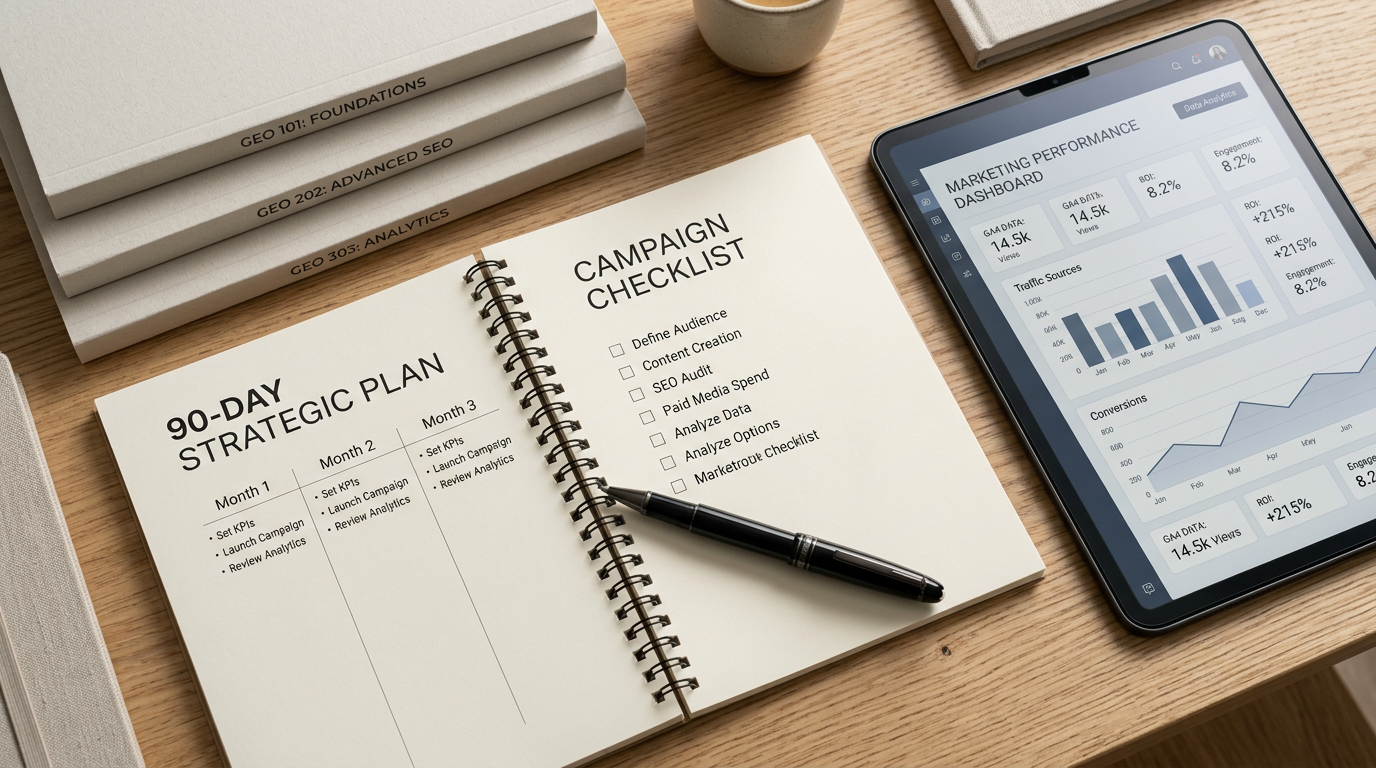
The course costs $99 and includes implementation assets designed to speed up execution: a 90-day plan, worksheets (including GSC analysis), checklists for each of the three phases, GA4 segments for AI traffic, and access to Trust Insights’ free AIView tool for GEO-oriented site audits.
Trust Insights also emphasizes a “primary sources first” approach—leaning on documentation, technical papers, and patents—and flags where the evidence is still developing.
Why this course matters for marketing teams
GEO isn’t a replacement for SEO; it’s a second discipline that sits alongside it—especially for brands that depend on content to generate demand. The teams that adapt fastest are likely to be the ones that:
- Write with citation-worthiness in mind (clear claims, credible sourcing, strong structure)
- Add expert insight and verifiable statistics that AI systems can reuse with confidence
- Build content that supports fan-out query patterns (the explosion of “related questions” AI interfaces encourage)
- Measure success beyond rankings, including mentions, inclusion, and assist value
Seen that way, GEO 101 isn’t just “another course.” It’s a marker that the operational marketing stack is changing. Content, PR, analytics, and AI literacy are starting to merge into one workflow—and teams need playbooks that connect those dots and make the impact measurable.
Conclusion: Where to go from here
If you treat generative AI like a novelty, there’s a good chance you’ll feel behind within six months. Treat it like a new channel with new rules, and you can shape how your brand shows up while others are still arguing about terminology. If you want practical training, usable frameworks, and implementation support to navigate this shift, it’s also worth exploring AIuthority to stay current on the strategies, tools, and real-world applications driving AI-led marketing.