Supermetrics Launches AI Agent on Google Cloud to Automate Marketer Reporting
Marketers have been stuck with the same problem for years: too much time spent on reporting. Pulling data from multiple platforms, cleaning it up, formatting dashboards, spotting anomalies, and turning raw numbers into something useful still takes far more effort than it should. That’s why Supermetrics’ latest move stands out.
Supermetrics has launched its AI agent on Google Cloud, a notable step in automating marketer reporting and analysis. For a company that started by solving a straightforward data extraction problem in 2009, the move feels like a logical next phase. What began as a way to move Google Analytics data into spreadsheets has become a global marketing intelligence platform serving more than 200,000 companies and handling a significant share of global ad spend.
 Why this launch stands out
This is not just another generic AI feature rollout. Supermetrics is positioning its new Marketing Intelligence Agent as a domain-specific tool built for marketers, and that distinction matters.
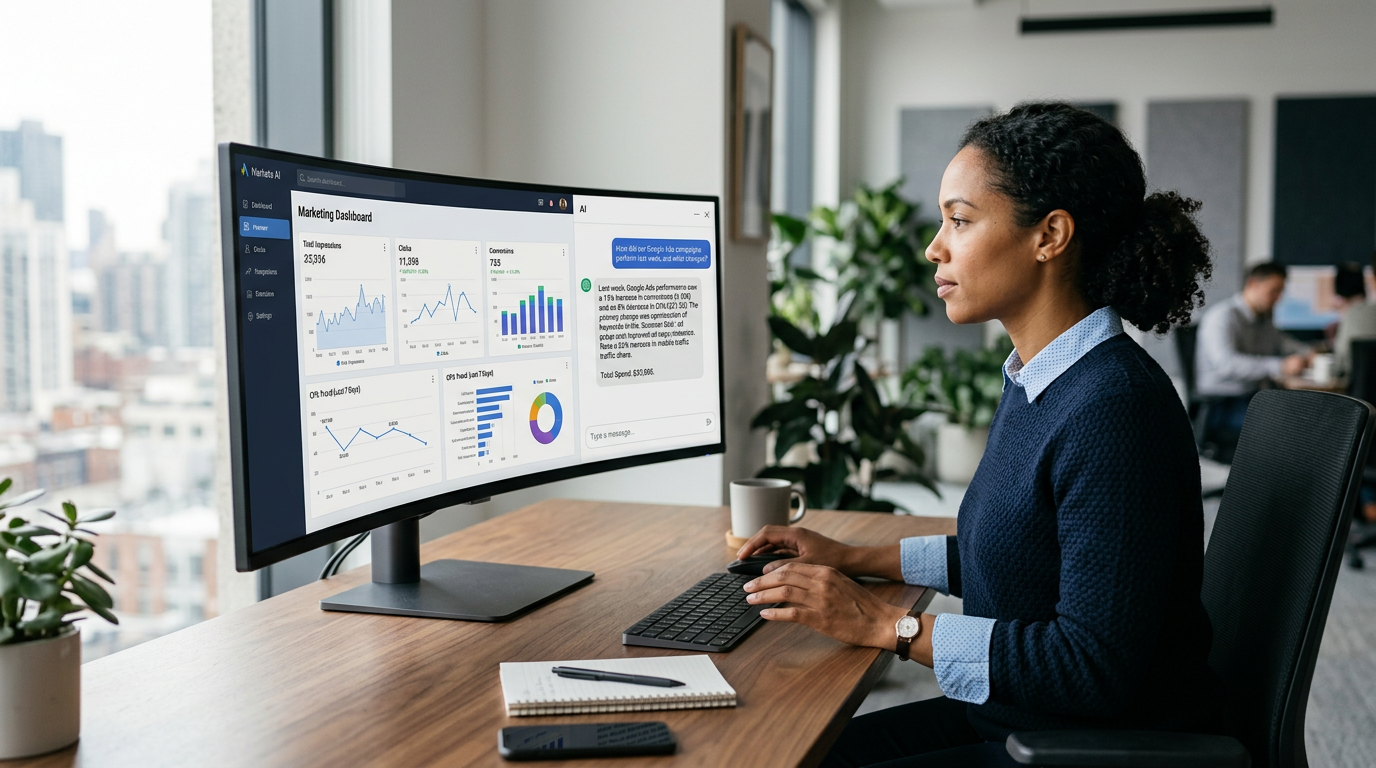
Based on the broader launch details, the agent runs on Google Cloud’s Gemini Enterprise capabilities and is available through the Google Cloud ecosystem. Users can ask natural-language questions about campaign performance, automate report generation, and bring in context from marketing platforms as well as internal documents, web sources, and other business information.
In practice, that means a marketer could ask, “How did our Google Ads campaigns perform last week, and what changed?” and get an answer grounded in actual campaign data rather than a generic AI summary. That’s a much more useful application than simply placing a chatbot on top of a dashboard.
The real problem Supermetrics is addressing
Supermetrics is going after a very real pain point. Marketing data has exploded, while budgets and team sizes remain under pressure. Many marketers are expected to do more with less, yet still lose hours every week to repetitive reporting tasks.
The broader trend is clear. Data volume keeps rising, but many teams still struggle to analyze all of it effectively. Weekly reporting alone can eat up hours through data extraction, formatting, troubleshooting, and interpretation. Supermetrics and Google Cloud are positioning this AI agent as a way to shrink that process from hours—or even days—down to minutes.
That kind of time savings is not just about efficiency. It gives marketers more room for optimization, experimentation, and strategic decision-making. That may be the strongest part of the story.
Built for action, not just answers
One of the more interesting parts of the launch is the product architecture. Supermetrics has described a modular agent approach in which a central AI assistant delegates tasks to sub-agents responsible for querying data, analyzing trends, and generating outputs.
That matters because marketers do not just need summaries. They need usable deliverables.
- Dashboards that update quickly
- Slide-ready reports for stakeholders
- Recommendations tied to performance trends
- Alerts when something breaks or underperforms
If the AI agent can detect a drop in conversions, explain the likely causes, and package that information into a presentable format, it becomes a workflow tool rather than a novelty.
The Google Cloud integration also adds enterprise credibility. With Vertex AI Agent Builder and the Agent Development Kit supporting the underlying system, Supermetrics appears focused on speed, modularity, and secure deployment. For larger organizations, that security and reliability layer often determines whether a new AI product gets tested or ignored.
Why Supermetrics has an edge here
Supermetrics has an advantage many AI newcomers do not: more than 15 years of marketing data experience. This is not a new entrant guessing how marketers work. The company already connects to more than 100 data sources and understands the reporting workflows agencies, in-house teams, and analysts rely on every day.
That history gives Supermetrics something many general-purpose AI tools lack: context. It understands the structure of marketing data, the quirks of ad platforms, and the kinds of questions users actually ask. It also appears to be relying on grounded data logic and deterministic elements to reduce hallucinations, which is critical in reporting.
A creative AI error in a brainstorming session is one thing. A fabricated reporting insight tied to budget decisions is something else entirely.
This is where domain-specific AI starts to pull away from general AI assistants. Marketers need trustworthy outputs, not just polished responses.
 The bigger industry implication
This launch is bigger than one company adding another AI feature. It reflects a broader shift toward agentic AI in business workflows. Instead of using AI only to generate content or summarize text, companies are now asking it to carry out tasks across real operational systems.
In marketing, reporting is one of the clearest starting points for that shift. It is repetitive in some areas, rules-based in others, insight-heavy where it matters most, and directly tied to performance outcomes. If Supermetrics can reliably automate reporting, anomaly detection, and basic analysis, it raises expectations across the sector. Competitors in the marketing data and ETL space will almost certainly need to move further into AI automation as well.
It also strengthens Google Cloud’s position in enterprise AI. Launches like this help show that AI agents are becoming practical tools inside real software ecosystems—not just polished demos.
What comes next
This looks more like the beginning of a broader expansion than a one-off release. Supermetrics has already signaled wider AI ambitions with additional agents for insights, dashboards, and connectors, along with support for external workflows through MCP-based integrations. That points to a future where marketers will not just request reports—they will coordinate data movement, analysis, and activation through AI-powered systems.
If that vision holds, the marketer’s role changes too. Reporting becomes less about assembling information and more about directing intelligence. Teams spend less time chasing numbers and more time deciding what to do with them.
FAQ
What did Supermetrics launch?
Supermetrics launched a new AI agent on Google Cloud designed to automate marketer reporting, analysis, and insight generation.
What makes this AI agent different?
It is built specifically for marketers, with domain-specific capabilities focused on campaign data, reporting workflows, and performance analysis rather than general-purpose AI responses.
What can marketers do with it?
They can ask natural-language questions about campaign performance, automate reports, analyze trends, detect anomalies, and pull in context from internal and external data sources.
Why does Google Cloud matter here?
Google Cloud provides the enterprise AI infrastructure behind the product, including Gemini Enterprise capabilities, Vertex AI Agent Builder, and the Agent Development Kit.
Why is this significant for the industry?
It points to a broader move toward agentic AI in operational workflows, especially in areas like reporting that are repetitive, data-heavy, and tied directly to business performance.
Conclusion
Supermetrics’ AI agent launch on Google Cloud marks a meaningful step for marketing technology. It targets one of the industry’s most stubborn bottlenecks, brings domain-specific AI into a practical workflow, and offers a clear view of where marketer productivity tools are heading. For readers tracking the platforms, launches, and AI developments reshaping this space, AIuthority is a useful resource to follow.