Small Businesses Accelerate AI Adoption to Automate Marketing and Operations
I’m watching a major shift happen in real time: small businesses are no longer treating AI as an experiment. They’re treating it as infrastructure.
This goes far beyond writing social captions faster or drafting emails with a chatbot. Small companies are using AI to automate core marketing and operational work—customer follow-ups, onboarding, support, scheduling, code generation, campaign execution, and internal workflows that used to require full teams or costly software stacks.
Time’s May 14, 2026 feature brought that shift into focus by showing how small businesses are already replacing or reshaping roles with AI. The job angle gets attention, but the deeper story is about speed, leverage, and competitive survival.
 Why small businesses are moving faster
Large companies may have bigger budgets, but small businesses have something just as valuable: agility.
According to the reporting, small firms can often reorganize around new AI tools faster than enterprises weighed down by legacy systems, departmental silos, and slower approval cycles. Harvard economist David Deming has noted that AI adoption is moving faster in smaller firms, including startups. That tracks. When a founder finds a tool that removes friction from lead generation, support, or fulfillment, there’s no need for six committees and a pilot phase. They can just put it to work.
The momentum is building fast. Broader 2026 data suggests 58% of U.S. small businesses are now using generative AI, up from 23% in 2023. The most common use cases are practical ones: data analysis, content and email creation, marketing, and chatbots. In other words, small businesses are adopting AI where it affects revenue and operating efficiency most directly.
Marketing is one of the first areas to transform
If there’s one function where AI is making an immediate impact, it’s marketing.
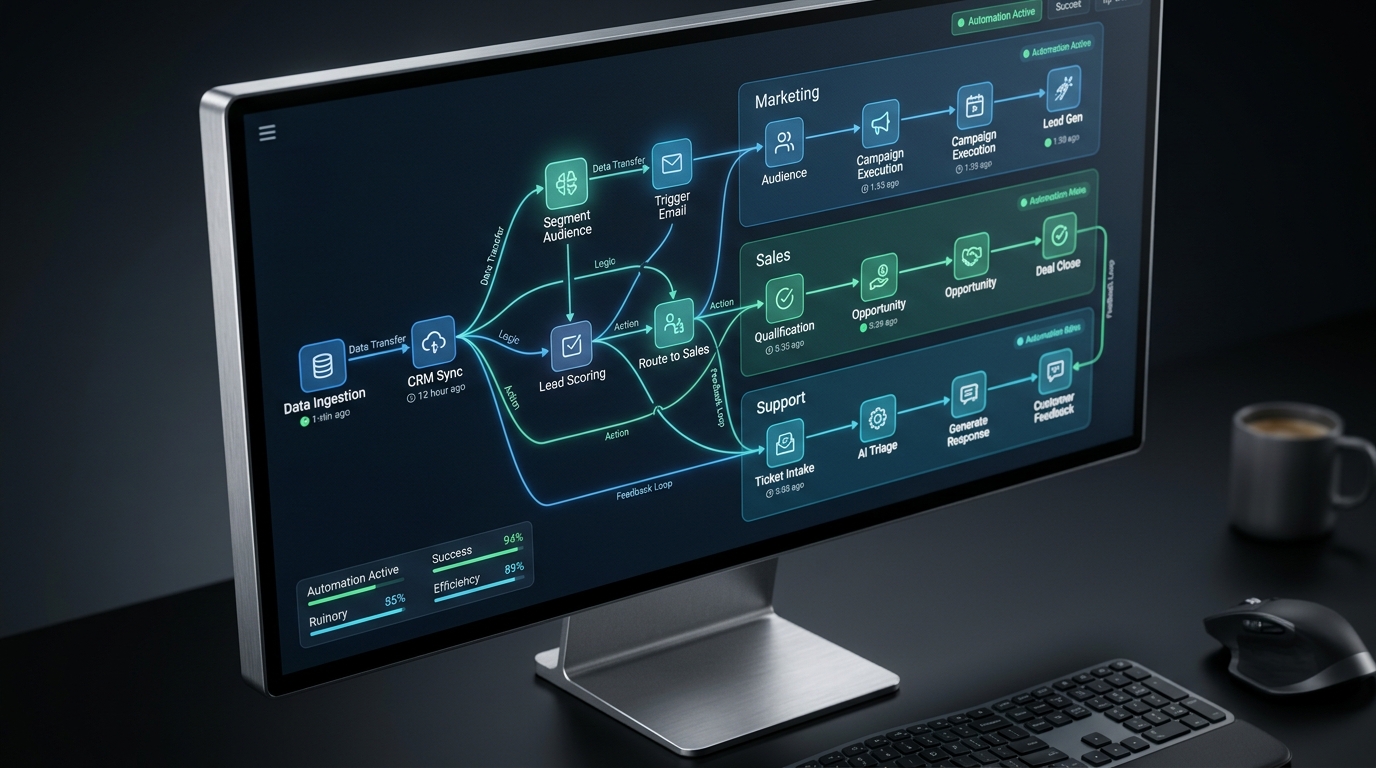
For years, small businesses have faced the same problem: they need enterprise-level marketing output without enterprise-size teams. AI is changing that. A small company can now automate campaign planning, ad copy variations, email follow-up sequences, lead nurturing, segmentation, reporting, and customer communication at a level that once required multiple specialists.
One of the clearest examples comes from Sonora, an online guitar school founded by Spencer Handley. By April 2026, Handley had integrated customized AI agents built on Anthropic’s Claude Opus 4.5 to centralize customer data and replace tools including HubSpot, Calendly, Vimeo, and DocuSign. Those agents handled marketing copy, customer follow-ups, onboarding, and broader operational tasks.
That’s not a workflow upgrade. It’s a system redesign.
Handley reportedly reduced his company from 48 employees to 30 while maintaining revenue, along with estimated annual savings of roughly $250,000. His takeaway says a lot: a small business can now replicate capabilities that once required billion-dollar software stacks, often with very little human intervention.
For marketers, that’s the real shift. AI is no longer just a productivity tool. It’s becoming the execution layer.
Operations are being automated just as aggressively
The automation wave isn’t stopping at top-of-funnel work. It’s moving deep into operations.
Hospitable, a short-term rental management platform with around 140 employees, increased AI spending by 50% between late 2025 and May 2026—an amount the company compared to the cost of three full-time employees. The payoff appears substantial: AI agents now reportedly support 90% of code generation, handle 70% of support queries, assist with finance transfers, and help run marketing campaigns.
What’s notable is that Hospitable didn’t respond with layoffs. Instead, it slowed hiring. CEO Pierre-Camille Hamana described a pattern many companies are starting to see: higher productivity can create more work because output expands so quickly.
That matters. AI adoption doesn’t always lead to a simple one-for-one replacement of employees. In many cases, it helps small businesses absorb more demand, serve more customers, and grow faster without increasing headcount at the same pace.
The employment question is real—but the story is nuanced
There’s no honest way to talk about this trend without addressing the workforce impact.
Small businesses employ about 46% of Americans, so even incremental AI-driven changes across this segment could have meaningful labor-market effects. The Time reporting showed that some firms are already reducing roles tied to repetitive sales support, onboarding, and operations coordination. At Sonora, AI replaced much of a 12-person sales and onboarding function. In other companies, the shift is less about immediate cuts and more about avoiding new hires.
At the same time, researchers caution against overstating the scale of displacement right now. Stanford’s Bharat Chandar has noted that there still isn’t broad evidence of mass labor replacement across the economy. Adoption remains uneven, and in many businesses AI use is still shallow or fragmented.
Still, the direction is hard to miss. As these tools improve, routine white-collar work—especially structured digital tasks in marketing, administration, support, and coordination—will become increasingly exposed to automation.
 Why this moment feels different
This wave feels different for one reason: the tools are moving from assistance to autonomy.
Anthropic’s Claude Opus 4.5, released in late November 2025, was designed for coding, long-running workflows, software engineering, and administrative work. That matters because it enables agentic systems that don’t just respond to prompts—they carry out multi-step processes across business functions.
That’s a major leap from the early “write me a blog post” era of AI.
Now small businesses can build systems that monitor leads, draft outreach, trigger onboarding sequences, generate reports, answer support tickets, and update internal records with limited oversight. That’s why small firms can move so quickly: they’re not just layering AI onto old workflows; they’re rebuilding workflows around it.
The competitive pressure will only increase
For small-business owners, the pressure is getting harder to ignore.
If one company can automate follow-up, personalize communication at scale, cut software costs, shorten campaign turnaround times, and operate with a leaner team, competitors will have to react. That’s especially true in crowded markets where speed-to-lead, customer retention, and operational efficiency directly affect profitability.
The winners won’t necessarily be the businesses using the most AI. They’ll be the ones using it most deliberately—connecting marketing automation with sales processes, customer data, and operational systems in ways that actually drive revenue.
That’s where the conversation needs to mature: the goal isn’t AI for novelty. It’s AI for measurable leverage.
Key takeaways
- Small businesses are adopting AI faster than many large enterprises because they can make decisions and reorganize more quickly.
- Marketing is an early transformation zone, with AI handling campaign planning, lead nurturing, content creation, segmentation, and reporting.
- Operations are changing too, with AI now supporting code generation, customer support, finance workflows, and internal coordination.
- The labor impact is real but uneven, with some roles being reduced while many firms simply slow hiring and expand output.
- The biggest shift is from assistance to autonomy, as AI agents take on multi-step business processes rather than isolated tasks.
FAQ
How are small businesses using AI most often?
The most common uses include data analysis, content and email creation, marketing automation, chatbots, customer support, onboarding, and internal workflow management.
Why are small businesses adopting AI faster than large companies?
Smaller firms usually have fewer layers of approval, fewer legacy systems, and more freedom to reorganize around new tools quickly.
Is AI mostly affecting marketing, or operations too?
Both. Marketing is often the first area to change, but AI is also being used in support, scheduling, code generation, finance tasks, and back-office operations.
Is AI causing layoffs at small businesses?
In some cases, yes—especially in repetitive support, onboarding, and coordination roles. But many companies are using AI to slow hiring and increase output rather than cut staff immediately.
What makes this AI wave different from earlier tools?
The shift toward agentic systems. Instead of helping with one task at a time, newer AI tools can execute multi-step workflows with limited oversight.
Conclusion
This looks like a turning point for small businesses. AI is quickly becoming the engine behind leaner operations, faster marketing execution, and more scalable customer management. For companies that want to stay competitive, the next step isn’t just adopting AI tools—it’s building a smarter system that connects performance, automation, and growth. If you’re looking for a practical way to bring those pieces together, ROAS Suite is a smart place to start.