SISTRIX Study: AI Overviews Slash Top Search Position Click Rates by 60%
For years, ranking #1 on Google was the clearest prize in search. Get a page to the top, and you could usually expect a strong share of clicks. That assumption is fading fast.
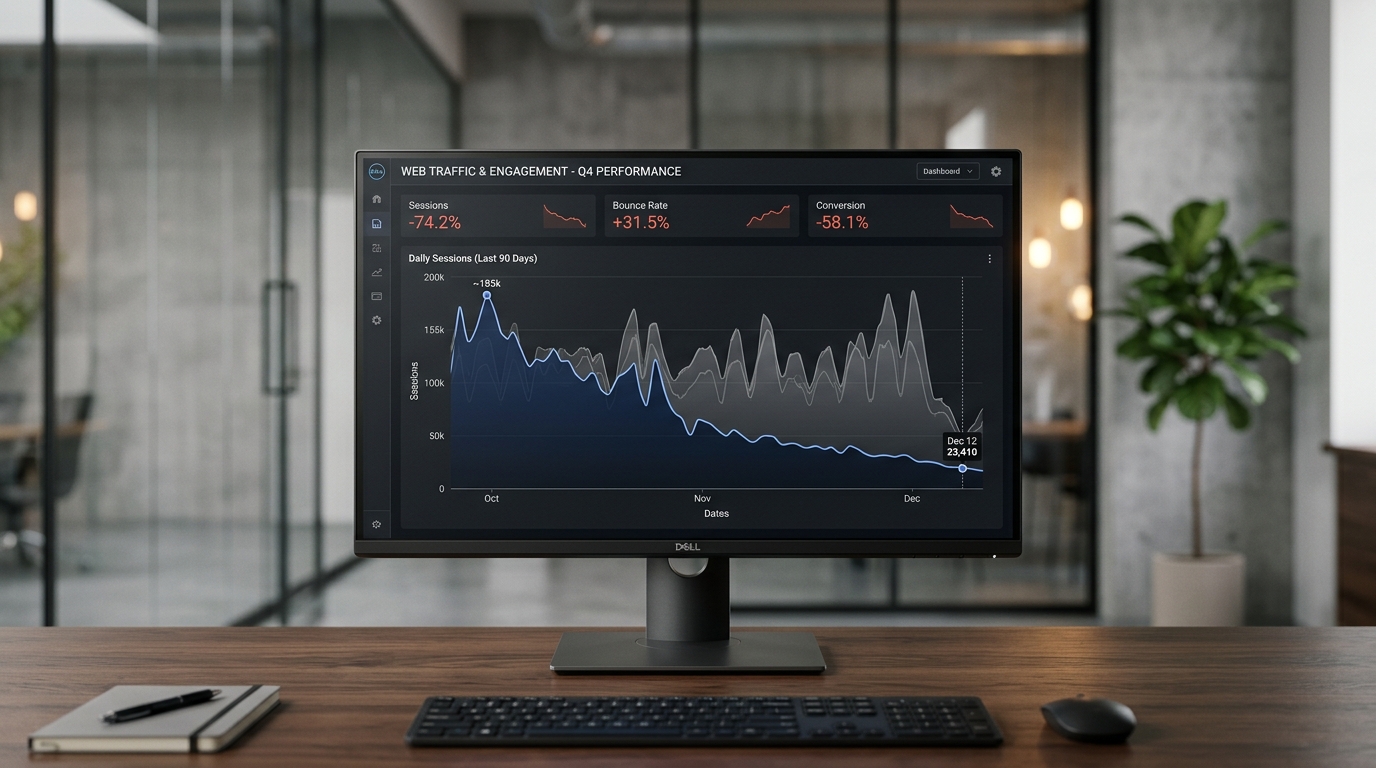
A new SISTRIX study from Germany offers one of the clearest signs yet that Google’s AI Overviews are reshaping organic search traffic at scale. The headline number stands out: when an AI Overview appears, the click-through rate for the top organic result drops from 27% to 11%. That’s a 59–60% decline.
This is more than a routine SERP shift. It marks a structural change in how people use search.
 What SISTRIX found
SISTRIX analyzed more than 100 million German keywords and compared performance on results pages with and without AI Overviews. The company found that AI Overviews now appear on roughly 20% of searches in Germany, with even higher frequency on long-tail queries. In 79% of cases, those AI-generated summaries appear above the organic results.
That placement matters.
When Google answers the question before a user reaches the blue links, the top-ranking page loses much of its traditional advantage. According to SISTRIX founder Johannes Beus, AI Overviews are costing the German search market roughly 265 million organic clicks every month.
The impact is also far from evenly spread.
Informational content is taking the biggest hit
If you run a health portal, parenting site, or home improvement publisher, this study should get your attention. SISTRIX found that informational queries are taking the heaviest losses, with some categories seeing traffic declines above 24%. One example, lumedis.de, reportedly lost more than 30% of its clicks.
That fits the broader direction Google has been moving in for years. The search engine increasingly answers informational questions directly on the results page. AI Overviews are that strategy expanded and accelerated.
Transactional queries, by contrast, remain relatively protected. Shopping, travel, and many commercial-intent searches saw much smaller declines. Amazon, for example, was only lightly affected in percentage terms, and Booking.com saw minimal impact.
Put simply: when the searcher wants to buy, compare, or book, websites still matter more. When the searcher just wants an answer, Google is increasingly becoming the destination.
This didn’t happen overnight
The latest SISTRIX findings are part of a much larger rollout story.
Google launched AI Overviews for all U.S. users in May 2024, then expanded the feature to more than 100 countries by October 2024. By March 2025, testing and rollout had moved into key European markets, including Germany. Since then, the SEO industry has been gathering more evidence that AI-generated summaries suppress clicks.
SISTRIX had already pointed to the pattern in July 2025 using Pew data, showing U.S. organic CTR falling from 15% to 8% when AI Overviews appeared. Other studies reached similar conclusions. Ahrefs reported major CTR losses. Seer Interactive found a 61% decline for informational queries. Across the industry, the signal has been consistent.
This new German study matters because of its scale and specificity. It pushes the conversation beyond theory and into measurable market evidence.
Why position one no longer means what it used to
The real takeaway for marketers is straightforward: ranking first still matters, but it is no longer enough by itself.
For years, SEO strategy revolved around keyword volume, ranking gains, and incremental CTR improvements. But if AI Overviews capture attention before the organic listings begin, traditional rank-based forecasting becomes much less reliable.
As Beus put it, search volume alone is no longer sufficient. Marketers now have to factor in whether a keyword is likely to trigger an AI Overview and how much click suppression that overview creates.
That changes keyword research, traffic projections, and content prioritization.
A term with strong search volume may still look appealing in a standard SEO tool, but if it regularly triggers an AI Overview, its real traffic potential may be much smaller than expected. Meanwhile, keywords with clearer transactional intent may deserve more attention because they are more resistant to AI displacement.
 The zero-click era is accelerating
Search was already moving toward zero-click behavior before generative AI arrived. Featured snippets, knowledge panels, local packs, and direct answer boxes had been reducing website visits for years. AI Overviews push that trend much further.
Instead of pulling one line from a page, Google can now synthesize multiple sources into a polished summary that resolves the user’s question immediately. For users, that can feel efficient. For publishers, it means less traffic, weaker attribution, and a tougher path to monetization.
That tension matters most for publishers that built growth around informational SEO. If a large share of those visits disappears, the effect hits ad revenue, email acquisition, lead generation, and brand discovery at the same time.
What smart SEO teams should do next
This does not mean SEO is dead. It does mean the lazy version of SEO is losing ground fast.
The old playbook of publishing broad, lightly differentiated answer content is becoming far less effective. If Google can summarize the page without sending the click, the content itself has to offer something the summary cannot replace.
That means investing in:
- Original research and proprietary data
- Firsthand experience and expert opinion
- Tools, calculators, templates, and interactive assets
- Strong brand recognition that makes users want the source, not just the answer
- Content built around deeper tasks, decisions, and workflows rather than surface-level questions
Keyword research also needs another layer. It is no longer enough to evaluate search volume and difficulty alone. Teams should also look at AI Overview frequency, query intent, and citation potential.
In practice, SEO is shifting toward a mix of classic optimization, brand authority, and what many now call generative engine optimization.
A warning sign for 2026
If AI Overviews are having this effect while appearing on around 20% of German queries, it is reasonable to expect bigger disruption as Google expands AI-driven search experiences further.
That is why the SISTRIX study matters. It is not just reporting a drop in clicks. It is documenting a new search reality: Google is keeping more of the user journey inside Google.
For marketers, publishers, and SEO teams, denial is not a strategy. Adaptation is.
FAQ
How much do AI Overviews reduce clicks for the top organic result?
According to SISTRIX, the click-through rate for the top organic result drops from 27% to 11% when an AI Overview appears, a decline of roughly 60%.
Which types of content are most affected?
Informational content is seeing the biggest losses. Health, parenting, and home improvement sites are among the categories most exposed to click declines.
Are transactional queries affected in the same way?
No. Transactional queries such as shopping, travel, and other commercial-intent searches have seen much smaller declines, suggesting users still rely more heavily on websites when they want to take action.
What should SEO teams do differently now?
SEO teams should go beyond rankings and search volume. They need to assess AI Overview risk, prioritize transactional and high-intent opportunities, and create content that offers original value Google cannot easily compress into a summary.
Conclusion
The lesson is simple: ranking is no longer just about visibility. It is about whether that visibility can still win attention in an AI-shaped SERP. The teams that perform best from here will be the ones that create content Google cannot easily condense and build strategies that account for AI Overview risk from the start. If you want to stay ahead of that shift and create content with real authority in the age of AI search, AIuthority is a smart place to start.