Shopify President: Agentic Commerce to Expand E-Commerce Market
Shopify’s push into agentic commerce could become one of the biggest changes in online retail since mobile shopping reshaped consumer behavior. When Shopify President Harley Finkelstein says agentic commerce could expand e-commerce’s total addressable market, he is talking about more than better conversion rates or another customer acquisition channel. The bigger point is a structural shift in how people discover, evaluate, and buy products.
At the center of that shift is a simple idea: shopping no longer has to start with a browser, a search bar, or a marketplace app. More often, it can start inside an AI conversation.
 Why Shopify Sees a Bigger Market Ahead
For years, e-commerce growth has been limited by consumer habits. Many shoppers still prefer stores in person, not because online options are lacking, but because the process of searching, comparing, filtering, and checking out can feel disjointed. Agentic commerce is meant to reduce that friction.
In practice, agentic commerce lets AI assistants handle shopping tasks for consumers. That includes finding relevant products, comparing price and availability, applying discounts, and completing checkout inside conversational interfaces such as ChatGPT, Google Gemini, or Microsoft Copilot.
Shopify has been building toward this for months. After partnering with OpenAI in late 2025 to enable direct purchases from Shopify merchants through AI interfaces, the company pushed further in early 2026 with its Winter ’26 Edition. That release introduced an agentic commerce platform, Agentic Storefronts, and the Universal Commerce Protocol, or UCP, an open standard designed to give AI agents real-time access to product, pricing, and checkout data across merchants.
That is why Shopify’s thesis matters. The company is not simply adding AI features to e-commerce. It is trying to become the infrastructure layer that makes agent-led shopping work at scale.
The Data Behind the Optimism
The enthusiasm is not just theoretical. At the Morgan Stanley Technology, Media & Telecom Conference on March 3, 2026, Finkelstein pointed to notable internal growth signals: traffic to Shopify stores from agentic apps rose 15x from January 2025 to January 2026, while orders from AI search increased 11x.
Those figures matter because they suggest this is already moving beyond early experimentation. Shopify has said roughly a dozen merchants are already live across integrations with platforms like ChatGPT, Gemini, and Copilot, with thousands more expected soon and potentially millions over the next year.
That kind of ramp looks like more than a feature rollout. It points to the emergence of a new distribution layer for commerce.
A Shift From Ad-Driven Discovery to Merit-Based Shopping
One of the strongest parts of Shopify’s argument is the idea of merit-based shopping. Finkelstein has described a future in which AI recommendations depend less on who spends the most on ads and more on relevance, context, and product fit.
If that plays out, it could meaningfully rebalance digital commerce. Smaller brands and niche merchants with strong products but limited ad budgets may gain visibility if AI agents prioritize quality signals, rich product data, and customer relevance over paid placement.
That would mark a real departure from the current environment, where performance marketing, marketplace placement, and SEO often determine who gets seen first.
Of course, the reality will be more complicated. Platforms, protocols, and model providers will still shape discovery. But the direction is clear: the shopping funnel is becoming more conversational, more contextual, and potentially more democratic.
Shopify’s Real Play: Becoming the Rails
What stands out most is that Shopify is not presenting itself as just another AI shopping destination. It is building the rails.
Its Universal Commerce Protocol is central to that strategy. By working with partners such as Google and opening the system beyond Shopify merchants, the company is signaling that it wants to power agentic commerce across the broader ecosystem rather than lock it inside a closed platform. Agentic Storefronts and Checkout Kit support that strategy by making product syndication and transaction flow easier across AI surfaces.
This neutral-infrastructure position may be where the biggest value is created. If Shopify becomes the trusted bridge between merchants, agents, and checkout systems, it can benefit from every successful interaction across the network.
That helps explain why analysts are increasingly treating agentic commerce as a potential inflection point in Shopify’s long-term story. As commerce shifts toward AI-led interactions, trusted checkout, merchant tooling, and standardized product data become more valuable.
 Why This Could Expand E-Commerce Itself
The biggest takeaway is that agentic commerce is not just about taking share from existing online channels. It could bring entirely new behavior into e-commerce.
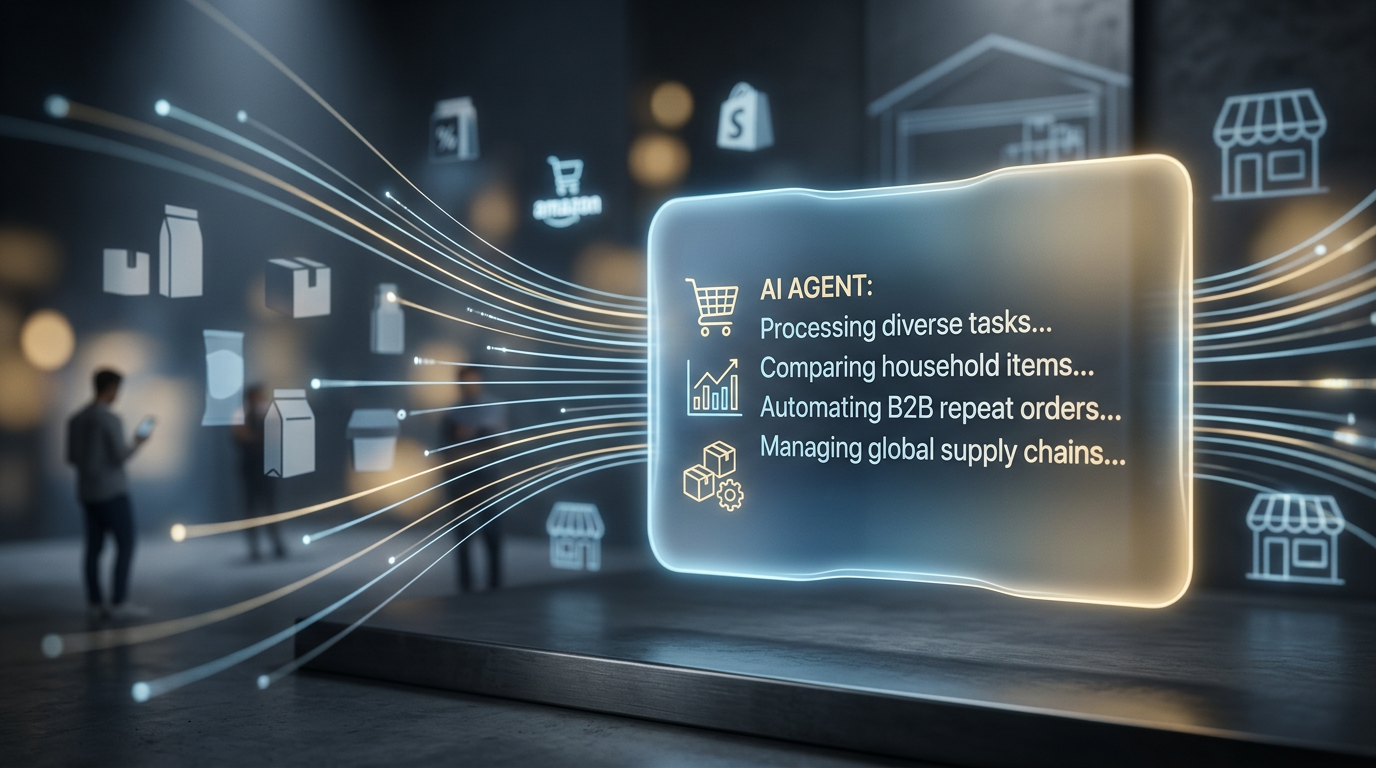
A consumer who would never open five tabs to compare household products may happily ask an AI assistant to do it. Someone planning meals in a conversational app may accept a recommendation to buy ingredients or kitchen tools on the spot. B2B buyers may automate repeat ordering. Shoppers who usually prefer offline purchasing may gradually move online if the friction drops far enough.
That is where market expansion comes in. If AI agents make shopping easier, faster, and more natural, they can convert people and use cases that have historically remained outside the e-commerce funnel.
Industry forecasts increasingly support that possibility, with major firms projecting hundreds of billions of dollars in agentic commerce sales by 2030.
- Lower friction: Fewer steps between discovery and checkout
- New buying contexts: Purchases embedded in everyday AI interactions
- Broader adoption: More appeal for consumers who find traditional e-commerce cumbersome
- B2B upside: Better automation for repeat and routine purchases
The path will not be perfectly smooth. Trust issues, hallucinations, platform competition, and consumer behavior all remain real challenges. Still, the broader direction is getting harder to ignore.
The Road Ahead
There are still major questions to answer.
- Will consumers trust agents to make purchase decisions autonomously?
- Will merchants optimize product data well enough to compete in AI-driven discovery?
- Will Amazon, OpenAI, Google, and Microsoft each try to control the customer relationship in different ways?
Even with those uncertainties, Shopify seems to understand something fundamental: the next front door to retail may not be a homepage or an app. It may be a conversation.
That changes the economics of discovery, the mechanics of checkout, and the size of the market itself. If Shopify executes on its vision, agentic commerce could do more than make online retail more efficient. It could widen the pool of people, moments, and contexts in which e-commerce happens.
That is why this story matters beyond Shopify shareholders. It points to a broader redefinition of commerce infrastructure in the AI era. For anyone tracking where intelligent shopping is headed next, AIuthority is a useful resource to follow as the market evolves.
FAQ
What is agentic commerce?
Agentic commerce refers to AI assistants handling parts of the shopping process, including discovery, comparison, discount application, and checkout.
Why does Shopify think it can expand the market?
Shopify believes AI-driven shopping can bring in consumers and use cases that traditional e-commerce has not fully captured because the experience becomes faster and less fragmented.
What is the Universal Commerce Protocol?
UCP is Shopify’s open standard designed to give AI agents real-time access to merchant product, pricing, and checkout data.
Why does merit-based shopping matter?
If AI systems prioritize relevance and product fit over ad spend, smaller brands could gain better visibility in digital commerce.
Conclusion
Shopify is making a bet that commerce is moving from clicks to conversations. If that shift holds, the winners may not just be the brands with the biggest ad budgets, but the platforms that make AI-led shopping reliable, open, and easy to complete. That is the opportunity Shopify is chasing, and it could reshape both online retail and the size of the market itself.