Shopify Integrates AI Shopping Agents to Transform E-Commerce Personalization
I’ve been tracking Shopify’s AI evolution for a while, but this latest move into AI shopping agents feels like something bigger. It’s not just another feature launch or a merchant productivity tool. It looks more like a real shift in how online shopping could work.
With Shopify going all-in on what it calls agentic shopping, the company is positioning AI agents as a new entry point to retail. Instead of shoppers manually searching, comparing, and checking out one product at a time, AI-powered assistants may start handling more of that process for them. For merchants, that changes visibility, conversion, and personalization at the same time.
 From AI Assistant to AI Commerce Infrastructure
Shopify didn’t get here overnight. The path started with Sidekick in 2023, an AI assistant built to help merchants analyze store performance, generate content, and automate workflows. That was the first strong sign Shopify viewed AI as more than a support feature.
In 2025, the company expanded that vision with its AI-powered store builder and early access to the Shopify Catalog for developers building AI shopping agents. Later, the free Knowledge Base app gave merchants a way to organize FAQs, policies, and product information so AI systems could query stores more effectively.
By early 2026, Shopify and Google introduced the Universal Commerce Protocol (UCP), an open-source standard that lets AI agents communicate directly with merchants about inventory, pricing, subscriptions, and checkout capabilities. That’s what makes this especially significant: Shopify isn’t just adding AI to commerce. It’s helping build the infrastructure AI commerce depends on.
Why Agentic Shopping Matters
When Harley Finkelstein described AI agents as “the new front door to retail”, he got to the heart of the shift. Traditional e-commerce has long relied on search rankings, paid acquisition, marketplace dominance, and brand recognition. Agentic shopping introduces a model that is more personalized and potentially more merit-based.
Instead of typing “best running shoes” into a search engine and seeing whichever brands won the SEO battle or ad auction, a shopper could ask an AI agent for shoes that match their style, budget, fit preferences, and purchase history. In that environment, the winning product may be the one that best fits the customer, not the one backed by the biggest ad spend.
That creates a major opening for smaller merchants and long-tail brands. Shopify has always supported independent commerce, and AI agents could strengthen that mission by making discovery less dependent on brute-force advertising.
The New Competitive Advantage: Structured, AI-Readable Data
If there’s one clear takeaway from Shopify’s push, it’s this: clean, structured store data is becoming a competitive advantage.
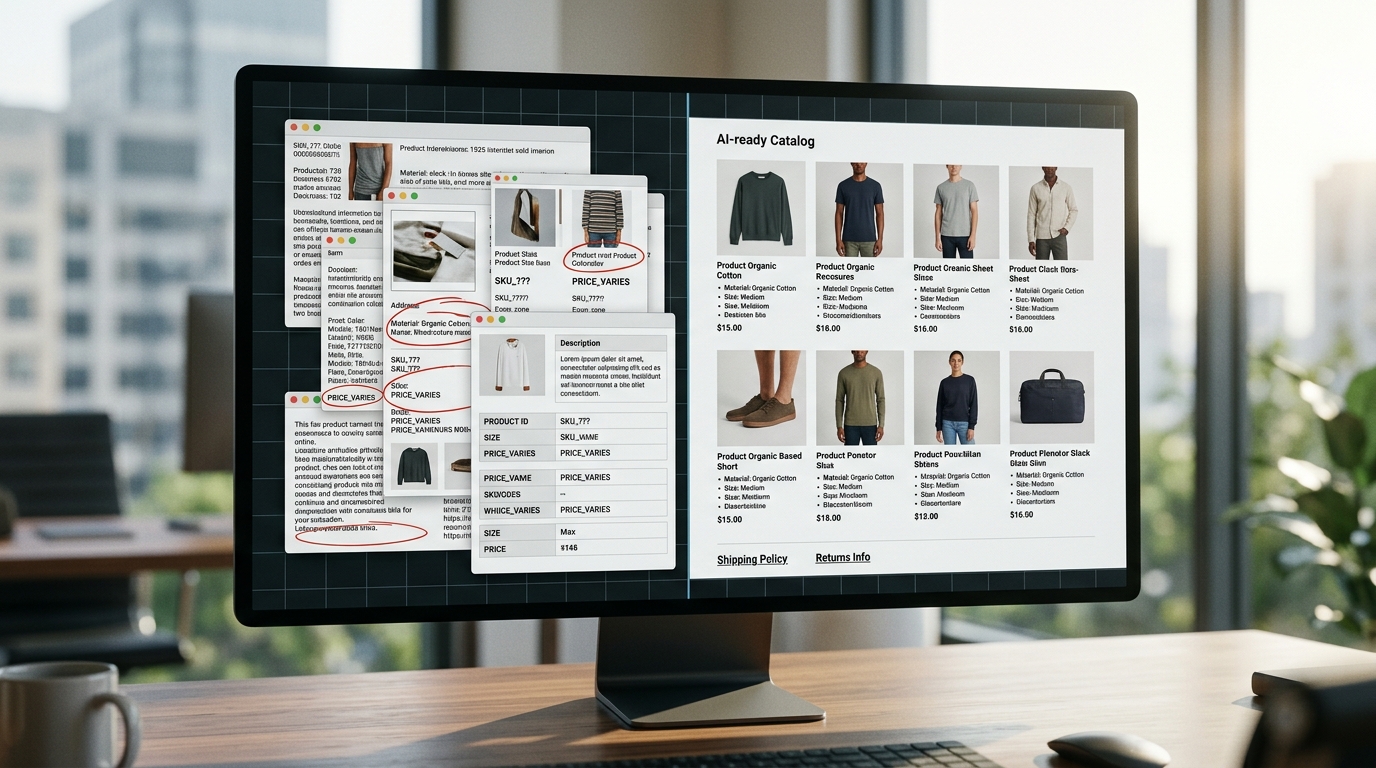
AI agents can only recommend what they can understand. That means product titles, descriptions, attributes, policies, FAQs, availability, and metadata all need to be clear and machine-readable. Shopify’s Knowledge Base app stands out here because it helps merchants shape what AI agents surface during shopping conversations.
This marks a subtle but meaningful shift away from classic SEO thinking. Keywords still matter, but context matters more. Merchants now need to prepare their stores not just for search engines or human visitors, but for AI systems that interpret intent, compare options, and make recommendations on their own.
Put simply, the storefront is no longer only visual. It also has to be legible to machines.
Real Momentum, Not Just Hype
What makes this more than a theory is the pace of adoption. Shopify has reportedly seen AI-driven traffic to stores rise sharply, along with a notable increase in AI-driven orders. That suggests AI-assisted commerce is already moving beyond the experimental stage and becoming a real channel.
That fits the broader market direction as well. Analysts increasingly believe agentic commerce could mediate trillions in global transactions by the end of the decade. If that forecast holds, Shopify’s current investments may look foundational in hindsight, not experimental.
The partnership with Google on UCP adds another layer of credibility. Open protocols matter most when industries are changing fast, and commerce is clearly in one of those moments. If agents from different ecosystems can transact with merchants through shared standards, Shopify gains leverage as a central operating layer for the next phase of retail.
 What This Means for Merchants
For merchants, the implications are both promising and demanding.
On the opportunity side, AI agents could improve product discovery, surface lesser-known brands, and create more relevant customer journeys. They could reduce friction in comparison shopping and eventually support personalized negotiation or subscription recommendations.
On the pressure side, many stores aren’t ready. Product feeds are inconsistent. Metadata is thin. Policies are buried. Catalog structures vary widely. In an agentic commerce environment, that lack of clarity becomes a weakness.
Merchants that adapt early will likely be the ones that make their catalogs easier to interpret, their offers easier to compare, and their customer experience easier for AI systems to trust. That preparation is no longer a technical nice-to-have. It’s becoming part of growth strategy.
- Improve product data: Use clear titles, complete descriptions, and consistent attributes.
- Organize store policies: Make shipping, returns, and FAQs easy for AI systems to access.
- Standardize metadata: Ensure availability, pricing, and variations are structured clearly.
- Prepare for AI discovery: Optimize for intent and context, not just keywords.
Personalization Is Becoming Autonomous
What stands out most is how personalization itself is changing. For years, personalization meant recommendation widgets, segmented email flows, and retargeting ads. Useful, yes, but still reactive.
AI shopping agents push personalization into a more autonomous phase. The system doesn’t just recommend a product after someone lands on a site. It may become the layer that discovers the product, compares alternatives, validates details, and completes the purchase.
That changes who controls the customer journey. Brands will still matter, but so will trust signals, data quality, fulfillment reliability, and the ability to communicate with AI systems in real time. The merchant that can be understood most clearly may have a real advantage.
FAQ
What is agentic shopping?
Agentic shopping refers to AI-driven commerce in which intelligent agents help consumers discover, compare, and purchase products on their behalf.
Why is Shopify’s move significant?
Shopify is not only adding AI features for merchants. It is building standards and tools that could shape how AI systems interact with online stores across the industry.
How can merchants prepare for AI shopping agents?
Merchants should focus on structured product data, accessible policies, strong metadata, and store information that AI systems can easily interpret and trust.
Conclusion
Shopify’s AI shopping agent strategy may end up being one of the most important shifts in modern e-commerce because it touches discovery, conversion, and personalization at the same time. It opens the door to more merit-based visibility for merchants, but it also raises the standard for how stores need to be structured and optimized for an AI-first future. For brands that want to turn that shift into measurable performance, it makes sense to build with tools that connect data, attribution, and growth more intelligently—ROAS Suite is a strong place to start.