Semrush Breaks Down AI Overviews’ Impact on SEO Traffic
I’ve been watching the SEO industry wrestle with Google’s AI Overviews for months, and Semrush’s latest research finally adds some clarity. Since Google officially launched AI Overviews in May 2024, the central concern has been straightforward: if Google answers the query directly, what happens to organic traffic?
The short answer: the impact is real, but it’s more nuanced than the early panic suggested.
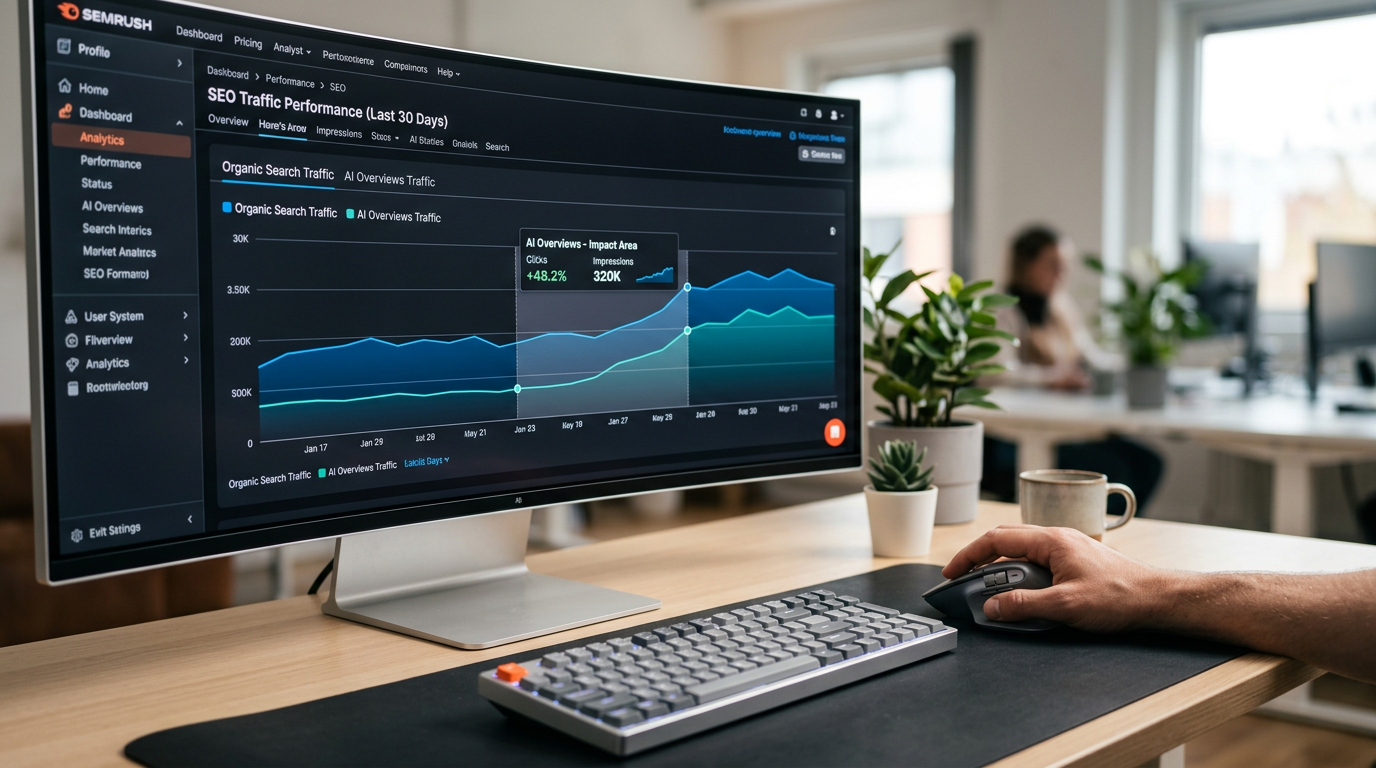 AI Overviews Changed Search Faster Than Most Expected
When Google moved AI Overviews out of the experimental stage and into mainstream search, it marked a major shift in how results pages work. Instead of just showing blue links, Google started generating answers directly in the SERP, often pulling from multiple sources and giving users less reason to click.
That immediately sparked concerns about zero-click searches, publisher visibility, and whether traditional SEO was about to lose much of its value.
Semrush’s data shows AI Overviews didn’t stay limited to a small set of informational queries for long. In early 2025, they appeared on just 6.49% of queries, and more than 91% of those were informational. By the second half of the year, that changed fast. AI Overviews peaked at 24.61% in July 2025 before easing back, and by October the intent mix had shifted heavily toward commercial, transactional, and navigational searches too.
That matters because AI Overviews are no longer just an informational-content issue. They’re becoming a full-funnel search issue.
The Traffic Story Isn’t as Simple as “SEO Is Dead”
A lot of the early reaction to AI Overviews assumed catastrophic click loss across the board. Semrush’s findings point to something more complicated.
Yes, AI Overviews do reduce clicks in many cases. Other industry research has shown that the number one organic result can take a meaningful CTR hit when an AI Overview appears. That lines up with what many SEO teams are already seeing in Search Console: impressions hold up, but clicks soften. It’s the now-familiar pattern of stronger visibility paired with weaker direct traffic.
But Semrush also found that zero-click rates for AI Overview keywords did not surge the way many expected. In some datasets, those rates even declined slightly after AI Overviews rolled out. That doesn’t mean publishers are in the clear, but it does suggest Google isn’t simply wiping out click behavior. It’s redistributing attention.
For me, that’s the real takeaway: SEO is moving from a pure click-acquisition model toward one centered on visibility, authority, and citation.
Semrush’s Data Points to a New SEO Reality
One of the most useful parts of the Semrush analysis is that it moves the conversation beyond fear and toward patterns you can actually act on.
Here’s what stands out:
- AI Overviews are most common in informational and research-heavy verticals.
- Science, health, computers, and technology categories are among the most saturated.
- Sectors like Food & Drink have also seen meaningful growth in AI Overview presence.
- Real estate and shopping queries remain less saturated, at least for now.
- Most AI Overview-triggering keywords tend to be longer-tail, lower-volume, and moderate-difficulty terms.
That suggests Google is still using AI Overviews most aggressively where users want synthesized explanations, comparisons, or quick summaries. Put simply, the more “answerable” a query is, the more vulnerable it is to AI compression.
At the same time, Semrush notes that a large share of URLs cited in AI Overviews still come from pages already ranking in the top 10 organic results. So while ranking alone isn’t enough anymore, strong organic visibility still matters. Brands with authority, clear topical relevance, and trustworthy content remain in the best position to be cited.
Google’s Ad Strategy Is Part of the Bigger Picture
Another important layer in Semrush’s breakdown is monetization.
By late 2025, SERPs containing both AI Overviews and ads had grown sharply. That’s a strong signal. Google isn’t only refining the user experience; it’s figuring out how AI search fits alongside its ad business.
That helps explain the broader direction. Google wants AI Overviews to improve search, but it also needs to protect revenue. Rather than replacing the whole ecosystem, it seems to be redesigning the SERP around a new balance: AI-generated answers at the top, traditional organic listings still present, and ads increasingly integrated around or within the experience.
For SEO teams, this means organic and paid can’t be planned in separate silos anymore. If AI Overviews absorb more informational intent, PPC may become even more important for high-intent commercial moments, while SEO shifts more heavily toward authority, demand capture, and AI citation visibility.
 What SEOs Should Actually Do Next
I don’t think the right response is panic. It’s adaptation.
Semrush’s research reinforces a few practical priorities:
1. Optimize for citation, not just rank
Being referenced inside an AI Overview may matter as much as, or more than, earning a traditional click. That means content should be structured for clarity, authority, and direct answer extraction.
2. Double down on E-E-A-T
Experience, expertise, authority, and trust matter even more in an AI-shaped search environment. If Google is going to summarize the web, it will lean harder on sources it trusts.
3. Use schema and clean formatting
FAQ schema, HowTo markup, clear headings, concise definitions, and logically organized content all improve the odds that your page can be interpreted and cited accurately.
4. Refresh content more often
AI systems favor current, reliable information. Stale pages will struggle, especially in fast-moving verticals.
5. Diversify beyond Google
Email, communities, social platforms, branded search, and AI discovery channels like ChatGPT should all be part of the traffic strategy now. Relying entirely on classic organic clicks is getting riskier.
The Big Shift: From Traffic Hunting to Authority Building
What I find most interesting about Semrush’s research is that it doesn’t treat AI Overviews as the end of SEO. It treats them as a redefinition of what successful SEO looks like.
That feels right.
The old model rewarded websites that won the click. The new model rewards brands that become the trusted source behind the answer. Sometimes that still leads to traffic. Other times, it leads to visibility, brand recall, and conversions later in the journey.
So yes, AI Overviews are changing SEO traffic. But they’re also changing the goal itself. The real question is no longer “How do I rank number one?” It’s “How do I become the source AI systems trust enough to surface?”
FAQ
Are AI Overviews hurting SEO traffic?
Yes, in many cases they reduce clicks, especially for informational queries. But the impact is uneven, and visibility still matters even when direct traffic drops.
Do AI Overviews increase zero-click searches?
Not always. Semrush found that zero-click rates for AI Overview keywords did not spike as sharply as many expected, and in some datasets they declined slightly.
What kinds of queries trigger AI Overviews most often?
They appear most often on informational and research-heavy queries, particularly in categories like health, science, computers, and technology.
Can ranking in the top 10 still help with AI Overviews?
Yes. Semrush found that many URLs cited in AI Overviews still come from pages already ranking in the top 10 organic results.
What should SEOs focus on now?
Priorities include building authority, improving content structure, using schema, keeping content fresh, and diversifying traffic sources beyond Google.
Conclusion
Semrush’s breakdown makes one thing clear: AI Overviews are not a passing experiment. They represent a structural change in search. This is the point where SEO shifts from chasing clicks alone to building authority across traditional search and AI-driven discovery. For brands trying to stay visible as that transition accelerates, tools that help create credible, AI-ready content will matter more than ever, and AIuthority is a smart place to start.