Pinterest Expands AI-Powered Performance+ Ad Suite with Shopify Integration
Pinterest’s latest expansion of its AI-powered Performance+ ad suite says a lot about where performance marketing is going: faster setup, smarter automation, and fewer hurdles for small and mid-sized e-commerce brands. With a new Shopify integration and expanded customer acquisition tools, Pinterest is making a strong case to merchants that want measurable results without the usual campaign complexity.
This June 2026 update builds on a strategy Pinterest has been shaping for a while. Back in October 2024, the company launched Performance+ as its answer to rising demand for AI-assisted lower-funnel advertising. The idea was straightforward: cut down manual work across targeting, bidding, budget allocation, and optimization while improving return on ad spend. Since then, Pinterest has kept refining the product, and the results suggest that work is gaining traction.
 Why This Expansion Matters
The biggest move here is Pinterest’s deeper Shopify integration, which now lets merchants launch Performance+ shopping campaigns with a single click. For Shopify sellers, that is a real change. Instead of working through a more involved setup, they can go from product catalog to AI-optimized campaign activation with best-practice defaults already in place.
For smaller businesses, that simplicity matters. Most SMBs do not have large paid media teams, in-house analysts, or time to constantly manage campaign variables. Removing setup friction can be the difference between testing a new channel and skipping it entirely. Pinterest seems to understand that well.
At the same time, Pinterest has introduced Performance+ New Customer Acquisition, or NCA, aimed at helping advertisers prioritize and optimize for new customers instead of simply maximizing total conversion volume. That is especially useful for brands focused on long-term growth rather than short-term transaction counts.
The Performance Story Behind the Rollout
What makes this expansion more compelling is that Pinterest is not rolling it out in isolation. The company is tying these updates to a broader performance story that has been building throughout 2025 and into 2026.
In March 2026, Pinterest encouraged advertisers to make Performance+ their default campaign type, citing stronger ad model performance and better outcomes for SMBs using ROAS bidding. Then, in its Q1 2026 earnings, the company said roughly 30% of lower-funnel revenue was already coming from Performance+ campaigns. More notably, advertisers using the system were increasing lower-funnel spend nearly twice as fast as non-adopters.
Those are meaningful signals. They suggest Performance+ is not just another automation layer added to the platform. It is becoming central to Pinterest’s monetization strategy and increasingly relevant for advertisers looking for efficient conversion growth.
Pinterest also reported strong broader momentum in Q1 2026, with revenue reaching $1.008 billion, up 18% year over year, and global monthly active users rising to 631 million. That scale matters because performance tools work best when they have enough intent-rich behavior to learn from. Pinterest’s visual discovery engine gives it a strong foundation, especially since a large share of searches on the platform carry commercial intent.
Shopify Integration Changes the Game for Merchants
The Shopify piece is what makes this announcement especially practical. Pinterest and Shopify have worked together for years on catalog syncing and merchant onboarding, but this latest step brings campaign execution much closer to the merchant’s day-to-day workflow.
That matters because speed and convenience drive adoption. If a Shopify merchant can connect products and launch a Performance+ shopping campaign without building everything from scratch, Pinterest becomes a far more accessible sales channel. It also lines up with what many merchants want from ad tech in 2026: fewer settings to manage, more automation, and a faster path to going live.
Of course, convenience alone does not win trust. Advertisers still need confidence in how the system works. Historical concerns around automation often come down to defaults, budget controls, and limited visibility into why decisions are being made. So while one-click launch is appealing, Pinterest will still need to prove that its automation is transparent, controllable, and consistently profitable.
New Customer Acquisition Adds Strategic Value
The addition of NCA is another smart step. One of the biggest frustrations in performance advertising is that many automated systems optimize for conversions without clearly separating existing customers from net-new ones. That can make results look better on paper while doing less for true incremental growth.
Pinterest’s new customer acquisition capability appears designed to address that more directly. According to early testing, advertisers saw an average 64% increase in new-customer conversions. That is a strong headline figure, especially for brands that care about customer lifetime value and scalable growth.
The Caraway example adds some useful context. Pinterest highlighted how the cookware brand, working with measurement partner Haus, used Performance+ during a key seasonal push and achieved new-customer incremental ROAS that came in 47% above goal. Case studies should always be read with some caution, but they are still helpful directional evidence that the tool may be delivering on its promise.
 Pinterest’s Bigger AI Ambition
This does not look like a standalone feature update. It is part of a much broader AI push across Pinterest’s ad ecosystem. Around the same mid-June period, the company also introduced expanded creative automation, including AI-powered dynamic creative selection, along with new business assistance tools and external AI connectivity through its Model Context Protocol.
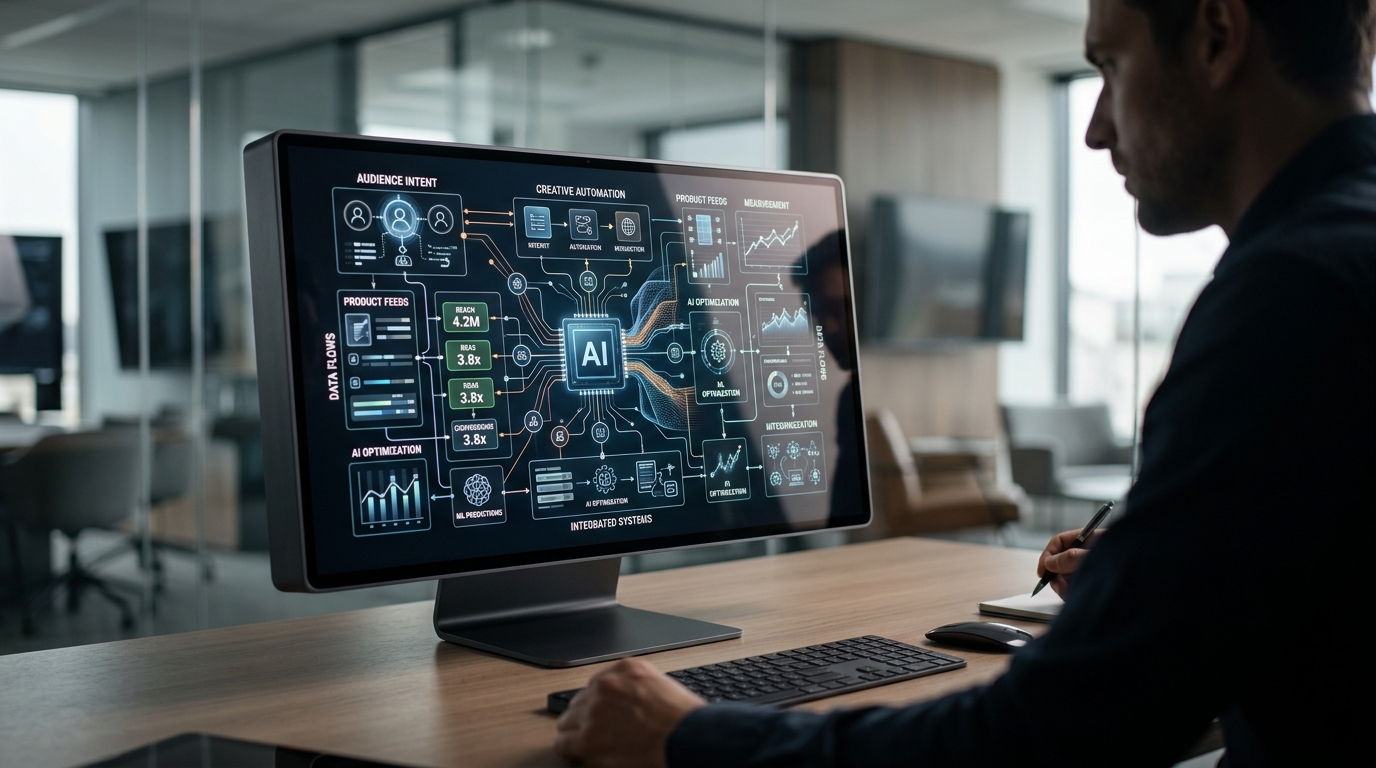
That matters because it shows Pinterest is trying to build an end-to-end AI advertising environment, not just automate bidding. The future of performance marketing is increasingly about integrated systems that connect audience intent, product feeds, creative variants, campaign structure, and measurement in one loop. Pinterest wants a serious place in that race.
And there is plenty of reason to move quickly. Competition is intense. Google, Meta, and TikTok are all pushing deeper into AI-driven campaign automation. In that environment, Pinterest’s best chance to stand out may be its mix of visual commerce intent and merchant-friendly simplicity.
What This Means for Advertisers
For advertisers, especially Shopify-based brands, this rollout lowers the barrier to activation. It makes Pinterest easier to test, easier to scale, and potentially easier to justify within a performance budget.
The core appeal is straightforward:
- less manual setup
- streamlined campaign launch
- better alignment with e-commerce workflows
- stronger support for ROAS-focused optimization
- more precise acquisition of new customers
If Pinterest can keep delivering the kind of ROAS improvements it has cited, including reported 28% gains for SMBs using ROAS bidding, then Performance+ could become a much more important part of the paid social mix.
It is also a good reminder that merchants should not judge automation on convenience alone. The real question is whether the platform’s automation improves incremental outcomes, not just surface-level efficiency metrics. Easy setup has value, but profitable growth is what matters most.
FAQ
What is Pinterest Performance+?
Pinterest Performance+ is the platform’s AI-powered ad suite built to automate targeting, bidding, budgeting, and optimization for lower-funnel campaigns.
What does the Shopify integration do?
The deeper Shopify integration allows merchants to launch Performance+ shopping campaigns with one click, making setup much faster and more accessible.
What is Performance+ New Customer Acquisition?
It is a feature designed to help advertisers optimize specifically for new customers rather than simply maximizing overall conversions.
Why does this matter for SMBs?
Small and mid-sized businesses often lack large teams and time-intensive campaign resources, so simpler setup and automation can make Pinterest a more practical performance channel.
How is Pinterest positioning itself against competitors?
Pinterest is leaning into AI automation, visual commerce intent, and merchant-friendly simplicity to compete with larger ad platforms like Google, Meta, and TikTok.
Conclusion
Pinterest’s expansion of Performance+ with Shopify integration is a meaningful step forward for AI-powered commerce advertising. It simplifies campaign creation, strengthens new-customer acquisition tools, and reinforces Pinterest’s push to become a more important lower-funnel channel for merchants. For brands trying to navigate increasingly automated ad ecosystems, the smartest approach is to pair platform innovation with disciplined performance oversight. If you want a clearer way to track and improve profitability as channels like Pinterest evolve, ROAS Suite is a smart solution for keeping growth decisions grounded in real return.