OpenAI Tests Upgraded Ad Formats and E-Commerce Features in ChatGPT
I’ve been following OpenAI’s advertising rollout closely, and the latest updates point to a clear shift: ChatGPT is no longer just a conversational AI tool. It’s starting to look a lot more like a commerce and media platform.
What began earlier this year as a careful test of basic sponsored placements has already expanded into something much bigger. OpenAI is now experimenting with richer ad formats, customizable calls to action, and product feed-driven e-commerce units inside ChatGPT. For marketers, that changes how consumers may discover, compare, and buy products in AI-driven environments.
 From basic sponsored placements to richer ad experiences
In January 2026, OpenAI announced plans to bring ads to ChatGPT for Free and Go users in the US. The company positioned the move as a way to support broader access while keeping premium tiers ad-free. It also made a point of saying ads would appear below relevant responses, be clearly labeled as sponsored, and stay separate from the model’s answers.
The initial rollout began in February with simple formats: a headline, short description, image, and link. Even at that stage, the setup stood out because these ads weren’t dropped into a feed or search page. They were tied directly to conversational intent.
That matters. When someone asks ChatGPT for the best luggage for business travel, skincare for sensitive skin, or accounting software for freelancers, they’re often much closer to making a decision than someone casually browsing. OpenAI’s ad model is built around that moment.
The May upgrade changes the game
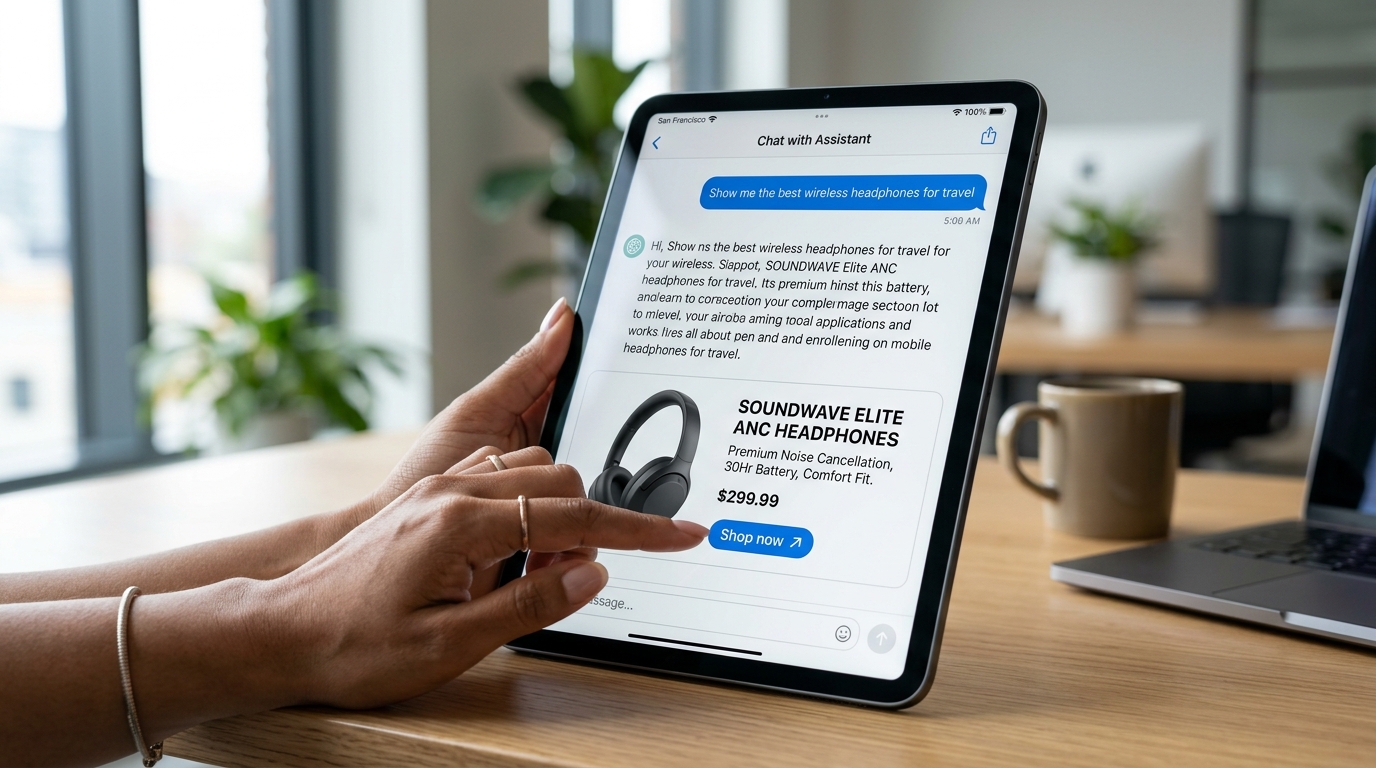
The biggest development came in late May, when OpenAI started testing upgraded formats on a limited set of ads. The changes include larger images, more customizable CTA buttons such as Shop now, Book now, Sign up, and Learn more, plus a dedicated e-commerce format that can pull in price and customer review information.
That’s a real step up.
Rather than treating ChatGPT ads as stripped-down text units, OpenAI is moving toward more visual, action-oriented placements that fit shopping behavior more naturally. The portrait format, which supports stacked or carousel-style creative, is especially interesting because it suggests ChatGPT could become a richer product discovery surface, not just a recommendation engine.
For e-commerce brands, that makes the opportunity much easier to take seriously.
Product feeds bring scale to conversational commerce
On May 14, OpenAI also introduced product feed-based ad tools for e-commerce advertisers. In practical terms, brands can now generate shopping ads from existing product catalogs instead of building campaigns one item at a time.
That removes a major operational bottleneck.
If a retailer can connect structured inventory data, pricing, and review signals directly to the platform, ChatGPT becomes a much more scalable customer acquisition channel. OpenAI’s reported support for very large SKU counts suggests this isn’t meant only for small experiments. It’s building the infrastructure for serious retail participation.
This also fits into the broader rise of agentic commerce. AI systems increasingly depend on structured product data, fulfillment details, reviews, and availability to guide recommendations and transactions. In that environment, brands with clean feeds and strong metadata will have a clear edge.
Creative still matters, but product readiness matters just as much.
Why advertisers are paying attention
The pilot has already attracted interest from major agencies and advertising partners, including WPP, Omnicom, Dentsu, and Publicis, along with ad tech companies such as Criteo, StackAdapt, Adobe, Kargo, and Pacvue. That level of involvement suggests this is more than a side project. It looks like the early stages of a channel many expect to grow.
OpenAI has also been building out the infrastructure behind the ads business: self-serve management, CPC bidding, conversion tracking, and the eventual promise of audience targeting, retargeting, lookalikes, and outcome-based optimization around goals like CPA and ROAS.
Still, this market is early. Many brands remain cautious because scale is limited, access is still gated, and advanced optimization controls are not fully in place. The excitement is real, but so is the hesitation.
For performance marketers, the key question is straightforward: can conversational ads deliver efficient results at scale?
 A different kind of ad environment
What stands out most is that ChatGPT isn’t simply copying search or social advertising. It’s creating a different kind of intent environment.
OpenAI has been careful about privacy and trust. The company says it does not sell user data to advertisers, keeps ads separate from answer generation, and limits ad exposure to logged-in adult users on supported tiers. Users can dismiss ads or avoid them altogether by upgrading to ad-free plans.
That trust-focused design may be essential. If ads inside ChatGPT feel intrusive, manipulative, or irrelevant, the model breaks down quickly. If they stay useful, contextual, and clearly separated from the response itself, they could become some of the most effective placements in digital media.
The challenge for brands is creative quality. Conversational context is more fluid than a search keyword or a social feed. A message that works in one prompt may fall flat in another. OpenAI executives have already said that creative variation matters, and that feels right. Brands won’t win here by recycling standard display assets.
What this means for marketers right now
Marketers should treat this as an early strategic signal, not just another product update.
ChatGPT is moving toward a model where discovery, recommendation, and transaction can happen within the same conversational flow. That means brands should prepare in three areas:
- Creative adaptation: Ads need to match conversational intent, not just broad audience segments.
- Data readiness: Product feeds, reviews, prices, availability, and metadata need to be accurate and machine-readable.
- Measurement discipline: As CPC, conversion tracking, and eventually ROAS-based optimization expand, brands will need tighter attribution and stronger testing frameworks.
This is also becoming a competitive issue. As AI platforms turn into shopping gateways, the fight for visibility won’t be limited to search rankings or marketplace placement. It will increasingly depend on how well a brand can surface structured, trustworthy, useful information to AI systems.
FAQ
What new ad formats is OpenAI testing in ChatGPT?
OpenAI is testing larger image ads, customizable CTA buttons, portrait-style creative formats, and dedicated e-commerce units that can include price and customer review information.
How do product feed-based ads work in ChatGPT?
They allow advertisers to connect existing product catalogs so shopping ads can be generated from structured inventory data rather than built manually for each product.
Why does this matter for e-commerce brands?
It makes ChatGPT a more scalable acquisition channel and rewards brands that already have strong product feeds, accurate pricing, review data, and clean metadata.
Are ChatGPT ads separate from AI responses?
According to OpenAI, yes. The company says ads are clearly labeled, placed below relevant responses, and do not influence the model’s answers.
Conclusion
OpenAI’s upgraded ad formats and e-commerce tools look like the start of a much larger shift in digital marketing. ChatGPT is evolving into a transactional, intent-rich environment where media, merchandising, and machine-readable product data come together. Brands that move early, test carefully, and build around measurable outcomes will be in the strongest position as this channel matures. If you’re getting ready for that next phase and want a smarter way to manage performance with clearer efficiency signals, ROAS Suite is a strong place to start.