New Report Highlights Top AI Marketing Agents Transforming Shopify Brands in 2026
I’ve been watching the Shopify ecosystem evolve for years, and 2026 marks a real turning point. AI is no longer just a helper for writing captions or speeding up reports. It’s becoming a network of marketing agents that can monitor data, optimize campaigns, generate creative, personalize messaging, and surface insights with much less hands-on effort.
That shift is at the center of a new report from Aimerce.ai. In its latest ranking of the top AI marketing agents for Shopify brands in 2026, the company maps out a tool stack built to help ecommerce teams move faster, protect performance, and improve return on ad spend in a market that’s only getting more complicated.
 Why this report matters now
The timing makes sense. Over the past two years, Shopify brands have had to adjust to privacy changes, weaker browser-based tracking, attribution gaps, and rising acquisition costs. For many operators, the old approach of juggling fragmented dashboards and manual optimizations no longer works.
The report’s main point lands well: the strongest brands in 2026 are building around connected AI agents, not isolated tools.
Rather than asking one platform to handle everything, brands are piecing together systems where each agent owns a specific job:
- data integrity
- ad optimization
- creative testing
- copy generation
- personalization
- attribution
- reporting
- conversational automation
This reflects a broader shift across ecommerce. AI is becoming less assistive and more autonomous.
The top AI marketing agents named in the report
According to the report, these are the standout platforms shaping Shopify marketing in 2026:
1. Aimerce.ai
Aimerce is positioned as the foundation of the stack. Its main role is data integrity: monitoring and fixing tracking issues, strengthening server-side event collection, and improving the quality of conversion signals sent to ad platforms like Meta and Google.
That focus is hard to argue with. If a brand’s underlying data is unreliable, everything downstream suffers. Creative decisions, budget allocation, and attribution all get weaker.
2. Madgicx
Madgicx is highlighted as an ad optimization agent that automates audience targeting, budget shifts, and campaign decisions. For Shopify brands running paid media at scale, that kind of always-on optimization can cut wasted spend and save time.
3. Motion
Motion stands out for creative intelligence. It analyzes ad performance patterns and helps teams spot which hooks, visuals, and messaging angles are actually working. In a market shaped by constant creative fatigue, that’s increasingly useful.
4. Jasper
Jasper remains one of the most recognizable AI writing platforms, and the report places it in the copywriting role for ad copy, product messaging, and brand content. For lean teams trying to produce more without flattening brand voice, that support matters.
5. Klaviyo AI
Klaviyo’s AI capabilities continue to deepen its role in lifecycle marketing. From segmentation and LTV prediction to send-time optimization and personalization, it helps brands make owned channels more productive revenue drivers.
6. Northbeam
Northbeam is recognized for attribution and media mix modeling. As more brands move beyond last-click reporting, tools that provide a wider view of performance are becoming essential for smarter budget planning.
7. Triple Whale
Triple Whale’s Moby AI appears on the list as a reporting agent that lets brands query performance data in plain language. That fits a larger trend: decision-makers want answers quickly, not another hour spent inside dashboards.
8. AdCreative.ai
AdCreative.ai is featured as a design agent capable of generating ad variations at scale. For teams under pressure to test faster, that helps remove production bottlenecks.
9. Postscript AI
Postscript adds conversational automation through SMS engagement, cart recovery, and customer messaging. For Shopify brands, that means more responsive retention marketing without constant manual involvement.
10. Shopify Magic
Shopify’s native AI suite rounds out the list. It’s broader and less specialized than some of the other tools, but Shopify Magic is becoming a more useful built-in layer for content generation, merchandising support, and store operations.
The real takeaway: AI stacks are replacing isolated tools
The biggest takeaway isn’t the ranking itself. It’s what the ranking signals. Shopify brands are moving toward an agentic model, where multiple AI systems work together across the customer journey.
A strong setup in 2026 might include:
- a data agent ensuring clean signal flow
- an ad agent reallocating spend
- a creative agent identifying winning concepts
- a copy agent refreshing messaging
- a retention agent personalizing follow-up
- a reporting agent translating performance into action
That’s a meaningful shift from the fragmented software stacks many brands were still relying on just a year or two ago.
 A note of caution
There’s still a catch. AI marketing agents are only as strong as the infrastructure and oversight behind them. If the data feeding these systems is flawed, automation can scale bad decisions just as efficiently as good ones.
Integration matters too. Brands that adopt too many disconnected tools can still end up with silos, duplicate workflows, or conflicting recommendations. Human strategy is still central. The teams that win won’t be the ones trying to remove people entirely. They’ll be the ones using AI for repetitive optimization while people focus on positioning, judgment, and growth direction.
What Shopify brands should do next
My view is straightforward: treat this report as a practical signal of where ecommerce marketing is headed. The brands that pull ahead will be the ones that combine accurate first-party data, fast creative iteration, automated optimization, and clear reporting in one coordinated system.
That doesn’t mean chasing every new tool that appears. It means getting the foundation right first, then adding the agents that genuinely improve performance.
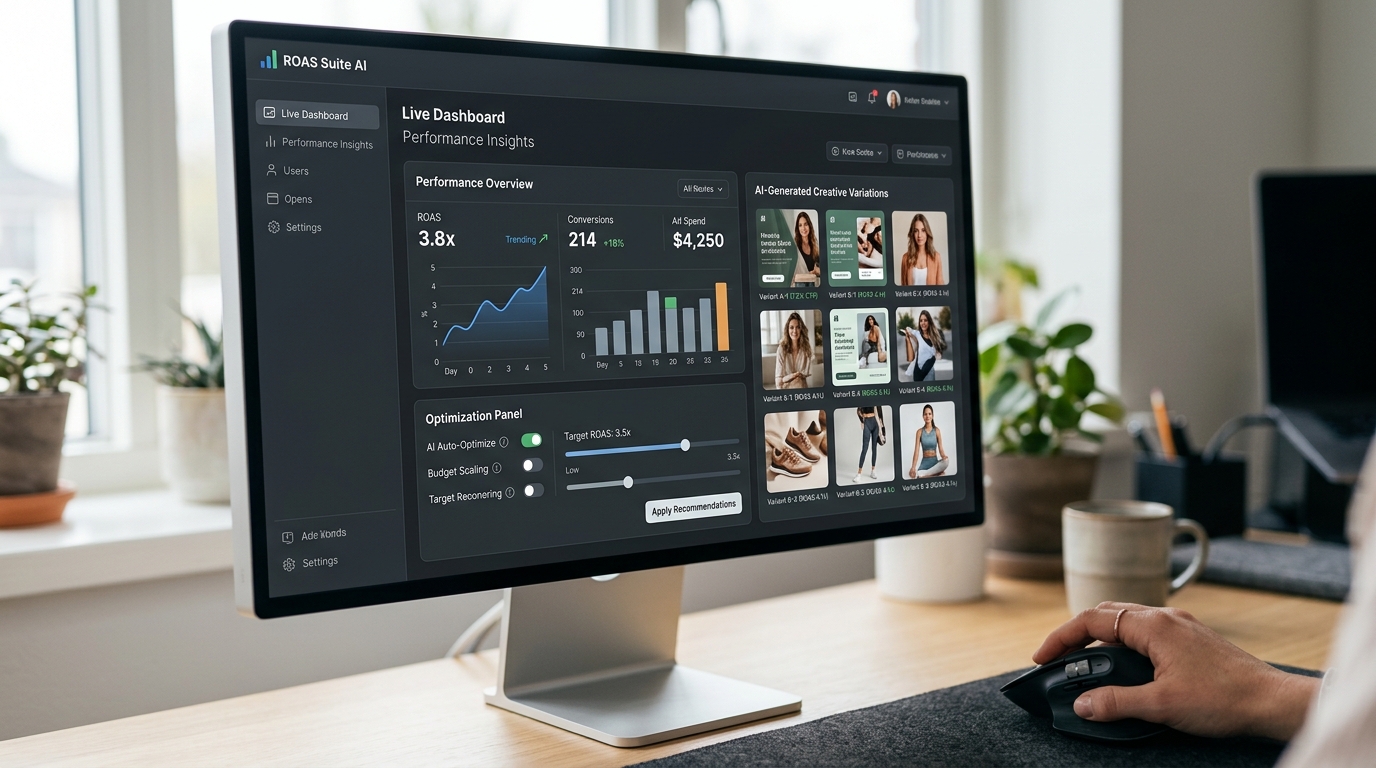
As this new generation of AI marketing agents reshapes Shopify growth in 2026, I’d start with tools that help unify performance around measurable return. For brands looking to turn better data and smarter automation into real revenue gains, ROAS Suite is a strong place to start.
FAQ
What is an AI marketing agent for Shopify?
An AI marketing agent is a specialized system that handles a specific marketing function, such as attribution, ad optimization, personalization, creative testing, or reporting, with minimal manual input.
Why are Shopify brands adopting AI agents in 2026?
Privacy changes, weaker tracking, rising acquisition costs, and more complex attribution have made manual workflows less effective. AI agents help brands respond faster and operate more efficiently.
What matters most when building an AI marketing stack?
Reliable data comes first. Without clean tracking and strong first-party signals, even the best automation tools can make poor decisions.
Are AI agents replacing marketers?
No. They’re taking over repetitive optimization and analysis tasks, while marketers continue to lead strategy, creative direction, and decision-making.
Conclusion
The report makes one thing clear: Shopify marketing is moving away from one-size-fits-all software and toward coordinated AI systems built around specific jobs. Brands that build these stacks thoughtfully, starting with strong data and adding tools that work well together, will be better positioned to protect performance and grow efficiently in 2026.