Micro Dramas Market Surges to 100B Yuan Driven by AI Video Generation Tools
I’ve been watching short-form video evolve for years, but China’s micro-drama boom is on another level. What started as a vertical-first format built for mobile attention spans has turned into a full-scale entertainment economy. In 2025, China’s micro-drama market reportedly doubled to 100 billion yuan (about $14.6B), driven by addictive narrative design, ruthless distribution, and—most of all—AI video generation tools that slash production time and cost.
This isn’t “short content is popular.” It’s a shift in how scripted entertainment gets produced, marketed, monetized, and exported.
 From Experiment to Mainstream: A Fast Timeline
Micro-dramas (often called duanju) started picking up momentum around 2021. At the time, global micro-drama revenue sat around $500M, and China was the main proving ground: 1–3 minute episodes, vertical viewing, and a paywall that kicks in after a small batch of free episodes.
By 2023, the industry’s early phase flipped into scale. China reportedly saw 22,700+ short drama-related companies registered in a single year, and micro-dramas became mainstream instead of niche.
2024 marked the first real “this is bigger than a trend” milestone: the market reached 50.44B yuan, up 34.9% YoY, and surpassed China’s annual box office for the first time. By year-end, the user base reportedly hit 662M.
Then 2025 blew the doors off: 100B yuan, roughly 33,000 titles released, and nearly 700M domestic viewers. That’s not a wave—it’s an industrial content engine.
Why Micro-Dramas Work (Even When the Plots Are Ridiculous)
If you’ve ever been pulled into a micro-drama rabbit hole, the structure is instantly recognizable:
- 60–90 seconds per episode
- Cliffhanger pacing every minute
- Often 80+ episodes per season
- Common themes: romance, betrayal, revenge, “CEO falls for…” plots, time travel, mythic fantasy
The monetization is just as engineered. Most series offer 5–10 free episodes, then push in-app purchases to unlock the rest—mobile gaming economics applied to scripted drama.
It’s working, especially with an audience often described as women 35+, though the demographic is widening as platforms and genres expand.
The Real Catalyst: AI Video Generation Drops Costs From “Studio” to “Solo Creator”
This is the inflection point: AI didn’t just make micro-dramas easier to produce. It made them hard to compete with on cost and speed.
In 2025, tools like OpenAI’s Sora and ByteDance’s Seedance reportedly helped cut per-episode costs from tens of thousands of yuan to hundreds, and shrink timelines from weeks to hours in certain workflows. That’s the difference between “needs a studio” and “a small team ships constantly”—or even a single creator producing viable content.
A wider range of AI-assisted formats is also taking off:
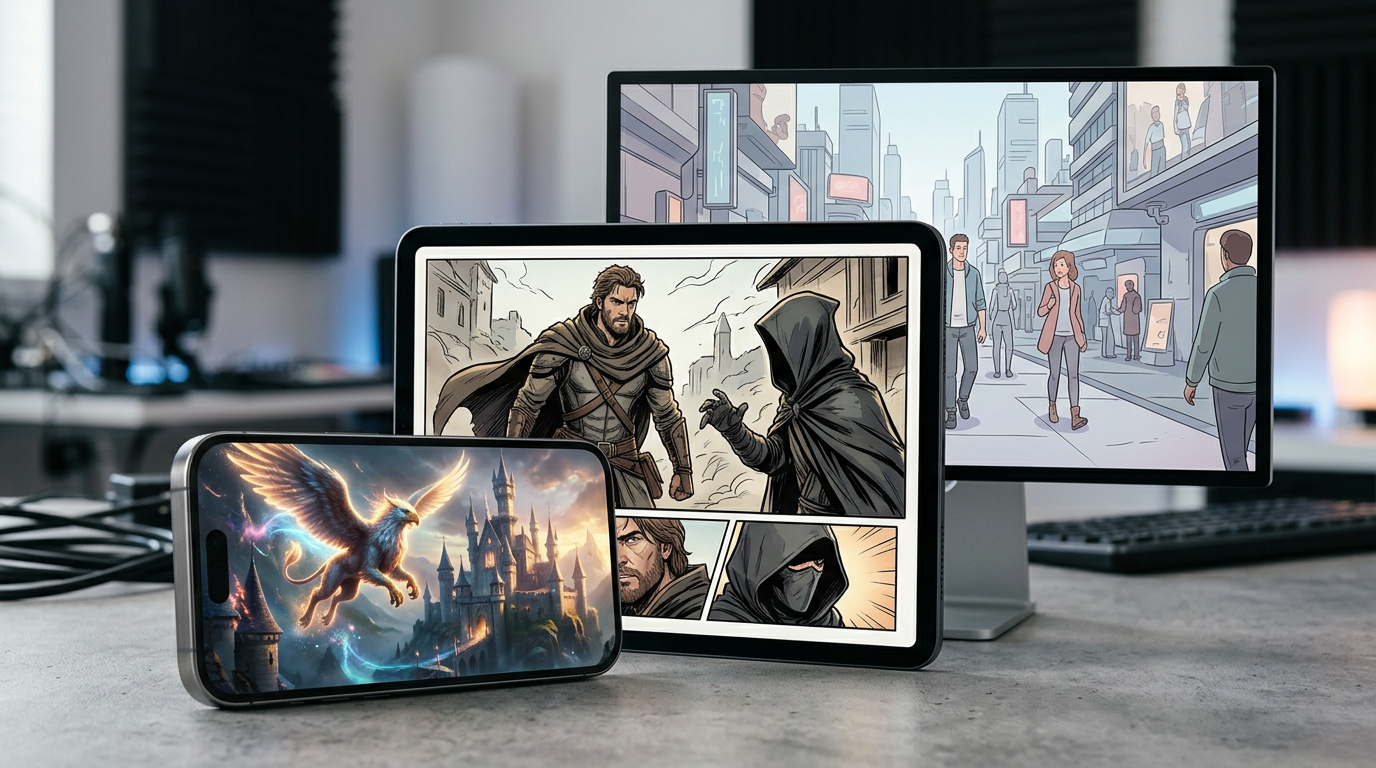
- AI live-action (or hybrid live-action with AI shots)
- AI comic dramas (a fast-growing segment)
- Lightweight animated/emoji-style formats optimized for speed and volume
Fantasy and mythology are a natural fit because AI can generate VFX-heavy scenes that would normally be out of budget. That’s why “impossible” visuals show up in micro-dramas faster than traditional pipelines can manage.
 Platforms Turned This Into a Machine
You can’t separate micro-dramas from the distribution layer. Platforms aren’t just hosting them—they’re shaping the format, funding production, and building the tooling stack behind the scenes.
Key players include:
- ByteDance (Douyin in China, TikTok globally), with huge traffic and its own AI pipeline. Seedance 2.0 (released Feb 2026) pushes multimodal generation, audio-video sync, and more complex camera language.
- Kuaishou, with Kling/Keling AI capabilities and strong monetization performance in AI comic drama.
- iQIYI, reporting a 300% surge in micro-drama usage (Q1 2025), a clear sign that long-form incumbents are adapting fast.
Outside China, apps like ReelShort and DramaBox have shown how exportable the model is, with hundreds of millions in revenue and strong traction in the U.S. and Southeast Asia.
That’s the tell: micro-dramas aren’t “a China thing.” They travel well—especially once AI makes production cheaper and faster.
The Boom Comes With Real Friction: IP, Regulation, and “AI Slop”
When production scales, copying scales too. The industry is already running into predictable pressure points.
1) IP infringement and copyright enforcement
AI speeds up remixing and near-duplication. In response, regional and industry bodies have started deploying AI protection systems—such as Jiangxi Province’s AI-powered copyright agency and Hengdian’s AI copyright monitoring—reportedly scanning large volumes of scripts quickly and recovering meaningful losses.
2) Content homogenization
A researcher at CASS put it bluntly: without strong scripts, even dazzling tech becomes “AI slop.” Once everyone has the same tools, advantage shifts back to story craft, character hooks, and retention design—not just flashy visuals.
3) Labor disruption
The market is creating jobs overall (hundreds of thousands by some estimates), but it’s changing who gets hired and what “good” work looks like. Writers, actors, editors, and VFX teams are being pushed into new workflows—some embracing it, others forced to adapt.
4) The regulatory wave
As micro-dramas become a major economic engine, China is expected to tighten rules around content standards, competition, and AI usage. Globally, the pressure point will likely be labeling and ethical disclosure, especially as AI realism improves.
Where This Is Headed: 120B+ Yuan and a New Global Content Supply Chain
Forecasts already put China’s domestic market above 120B yuan in 2026, and the global opportunity is widening quickly. TikTok’s move toward a dedicated global micro-drama app (PineDrama) shows how seriously platforms treat this as an export category.
The end state probably isn’t “AI replaces film and TV.” It looks more like a parallel pipeline:
- Micro-dramas as a rapid testing ground for plots, characters, and IP
- AI as the pre-vis/VFX acceleration layer
- Humans focused on story structure, emotion, and cultural nuance
The winners won’t be the people who generate the most video. They’ll be the ones who connect production to performance—turning retention curves, conversion rates, and monetization into a repeatable growth system.
Conclusion: The Micro-Drama Gold Rush Will Reward People Who Measure What Works
A 100B-yuan market doesn’t happen because content is “fun.” It happens because the unit economics work—and AI video generation is making those economics even more aggressive by collapsing cost and production time. The next phase will be defined by operational discipline: faster iteration, smarter targeting, tighter funnels, and clearer attribution across platforms and creatives.
If you’re building or marketing micro-drama content (or any performance-driven media), use a toolset that connects spend to outcomes and helps you scale what’s profitable. ROAS Suite is the kind of performance-first system worth putting in place to keep growth disciplined while the market moves this fast.