Meta Integrates Manus AI into Ads Manager for Workflow Automation
If you’ve spent any real time inside Meta Ads Manager, you know what makes it tough: not the buttons—the workload. Reporting, audience digging, creative comparisons, competitor checks in Ad Library, performance anomalies, budget pacing, stakeholder updates… the actual media buying ends up fighting for whatever time is left.
That’s why Meta integrating Manus AI directly into Ads Manager feels like more than a routine feature drop. It changes the shape of the work, not just the interface.
I’m watching this rollout closely because it lines up with the future Zuckerberg has been signaling for years: you tell Meta the result you want, and the system handles the rest.
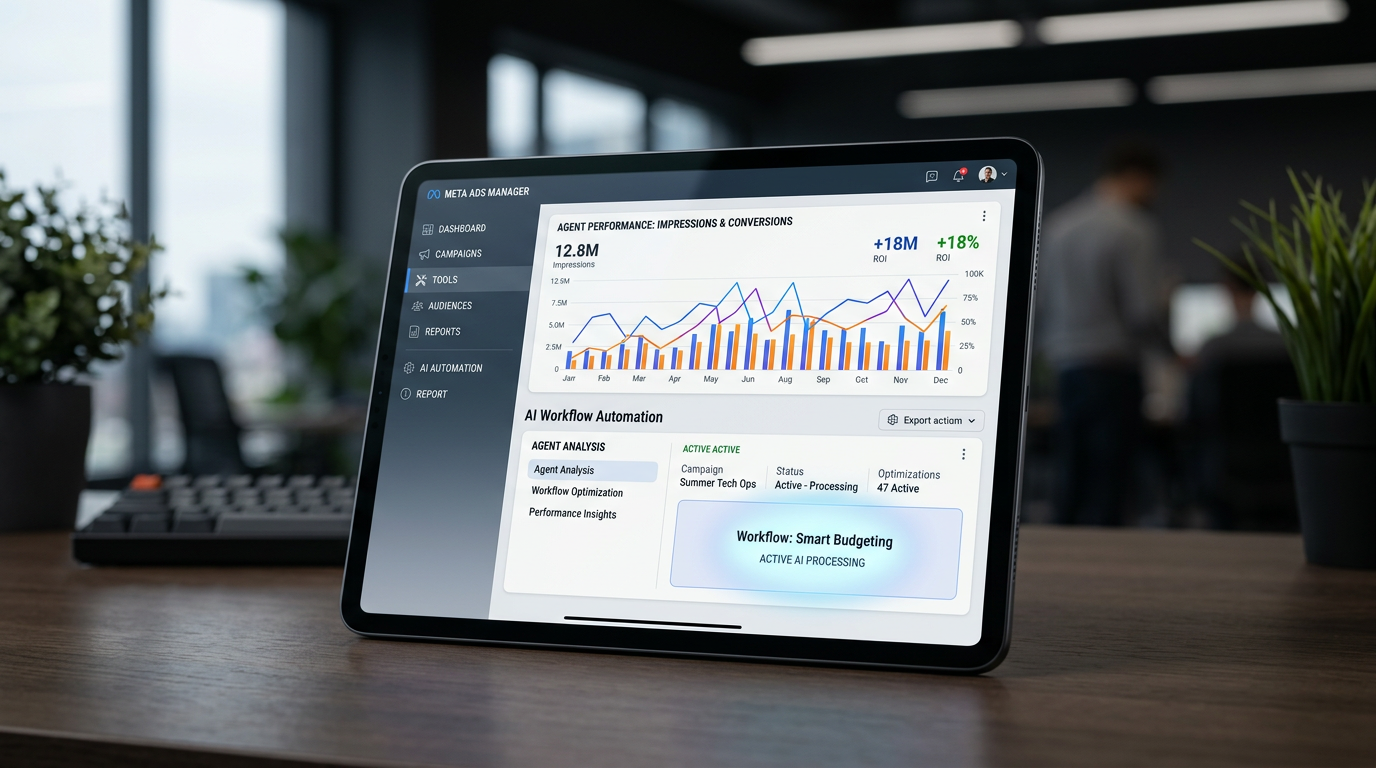 The Manus AI backstory (and why this integration matters)
Manus didn’t appear overnight. In March 2025, Butterfly Effect introduced Manus AI as a “general AI agent”—not a chatbot, but an agent built to run multi-step tasks on its own: research, analysis, generating assets, building slides, and navigating the web like a junior operator.
By April 2025, Manus had reportedly raised $75M at a $500M valuation, with unusually strong early revenue numbers. Soon after came the geopolitical reshuffle—headquarters moved from China to Singapore, with teams spread across Tokyo and San Francisco.
The big inflection point landed December 29–30, 2025, when Meta acquired Manus for over $2B. The message was clear: Manus wasn’t being picked up as a side feature. It was being positioned as an agent layer Meta could deploy across products—especially the one that drives the business: ads.
Now, as of February 17, 2026, Manus is rolling out inside Meta Ads Manager, appearing in the Tools menu (and for some accounts, via in-app prompts). That’s the key: it’s not another AI subscription you have to bolt onto your stack. It’s built into the place where millions of advertisers already work.
What Meta is actually shipping inside Ads Manager
Based on early access reports and agency testing, Manus in Ads Manager is being framed as an in-platform work partner that can help with:
- Report building (summaries, breakdowns, structured performance views)
- Audience research and quick exploration of segments and hypotheses
- Campaign optimization support (surfacing insights and next-step suggestions)
- Competitive analysis via Ad Library (hooks, angles, formats, messaging patterns)
In other words, Meta is aiming Manus at the parts of the job that quietly consume hours: pulling scattered information together, organizing it, and turning it into something you can act on—or present to someone else.
Agencies are already calling it “one-click” structured analysis. If it holds up, that’s not a minor convenience. It’s multiple hours back each week, especially for teams juggling many accounts or large catalogs.
The practical upside: less busywork, more leverage
Here’s what the best-case version looks like for advertisers, especially e-commerce brands and agencies:
1) Reporting becomes an always-on assistant, not a weekly fire drill
Instead of rebuilding the same dashboards and narrative summaries again and again, you can hand first-pass reporting to Manus and spend your time on interpretation: Why did this change happen? What do we do next?
2) Competitor scanning gets operationalized
Most advertisers say they keep an eye on competitors. Few do it consistently. If Manus can reliably pull patterns from Ad Library—creative formats, offer structures, messaging themes—it turns competitor research into a repeatable workflow instead of an occasional scramble.
3) Junior execution tasks start disappearing
Not the strategic layer—but the repetitive labor: assembling decks, pulling breakdowns, writing summaries, compiling test recaps. The work doesn’t vanish; it gets compressed. That tends to change team structure quickly.
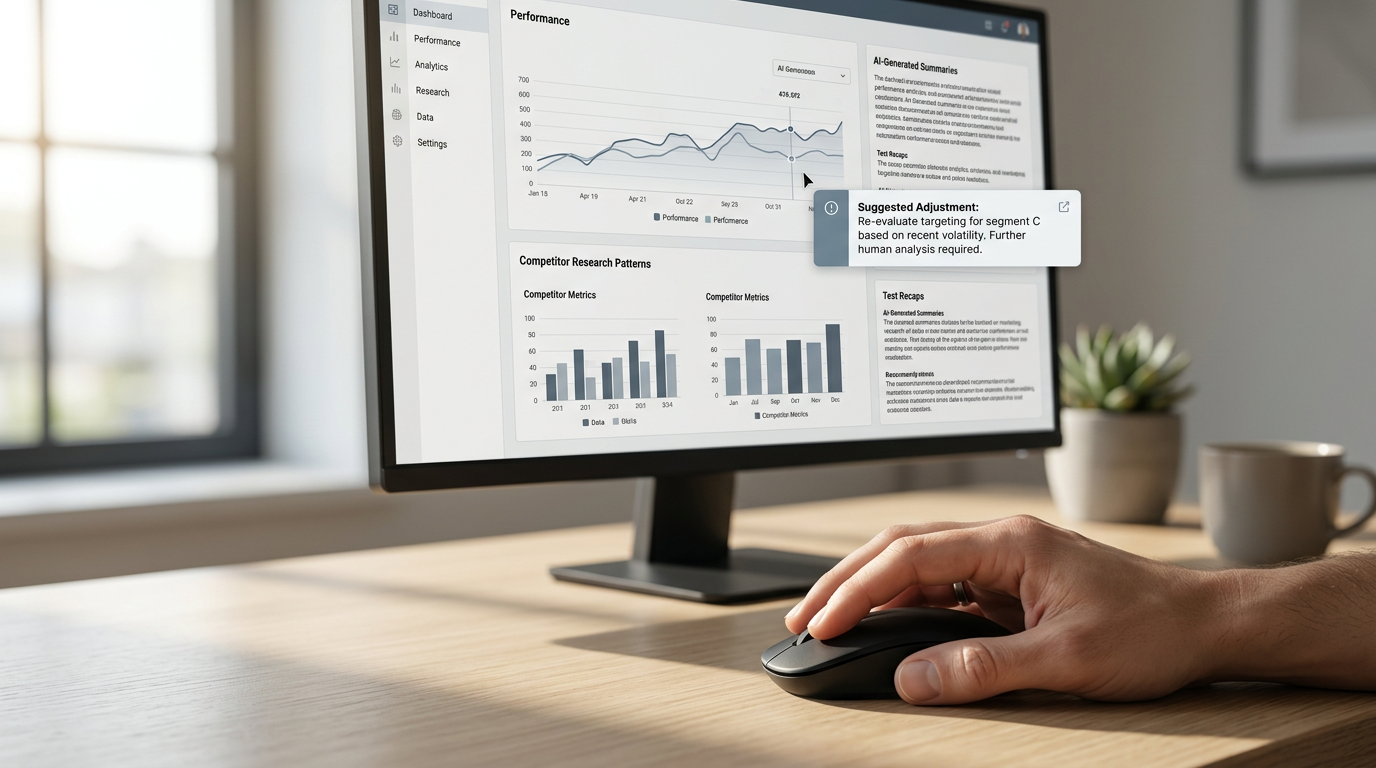 The real risk: unreliable outputs and AI “confidence”
Not everyone testing Manus is sold—and that’s worth taking seriously. Early Manus demos (even before the Meta acquisition) showed the same weakness many agentic systems struggle with: inconsistent accuracy and occasional hallucinations.
Inside Ads Manager, the risk is amplified because the outputs look official. If Manus generates a clean, confident narrative about why performance dropped, it’s easy to accept it as truth—especially when you’re under deadline pressure.
Right now, I treat Manus the way I’d treat a new analyst: fast, helpful, and sometimes wrong. Great for first drafts and idea generation. Not something I’d send to a client or the C-suite without checking the underlying breakdowns.
Where this is going: “goal-only” advertising gets closer
Zoom out and the direction is obvious. Meta already pushed automation hard with Advantage+ (targeting, bidding, placements, creative optimizations). Manus is different because it targets the human workflow around ads: research, analysis, planning, and optimization decisions.
Put those together and you get a plausible near-future flow:
- I define the goal (ROAS, CAC, volume, payback window)
- Meta’s systems execute targeting/bidding/placements
- Manus handles analysis, monitoring, and recommended adjustments
- Humans focus on strategy: offers, positioning, creative direction, margins, and customer psychology
Manual “button pushing” becomes less valuable. Taste, judgment, and business context become more valuable.
What I’m doing right now as an advertiser
If you want a grounded approach while Manus is still early:
- I use it to speed up diagnosis, then verify with raw breakdowns.
- I use it for creative and competitor pattern spotting, not final decisions.
- I document what it gets wrong, because those failure modes repeat.
- I assume “write access” (actual campaign edits) will come later—and I want guardrails in place before it does.
Once these agents can analyze and execute, the performance ceiling goes up. The cost of a bad automated decision goes up with it.
Conclusion: automation is coming for workflows, not just campaigns
Manus inside Ads Manager signals the next wave of ad tech: not another dashboard, but an agent embedded in the platform that compresses the operational workload around media buying. Used well, it makes advertisers faster and more strategic. Used blindly, it creates very confident mistakes.
The takeaway is simple: let the agent do the heavy lifting, but keep humans accountable for the thinking. If you want to stay ahead of this shift with clearer performance visibility and tighter optimization routines, build your workflow around tools designed for ROAS-first execution—ROAS Suite is a solid place to start.