Merchants Including Shopify Begin Banning Unidentified AI Shopping Agents
We’ve clearly entered a new phase of ecommerce.
For the past year, most discussion around AI in retail centered on innovation: smarter recommendations, better search, conversational shopping, and automated checkout. Now the tone is shifting. Merchants, marketplaces, and ecommerce infrastructure providers are starting to draw a firm line against unidentified AI shopping agents.
Shopify is one of the strongest signals yet.
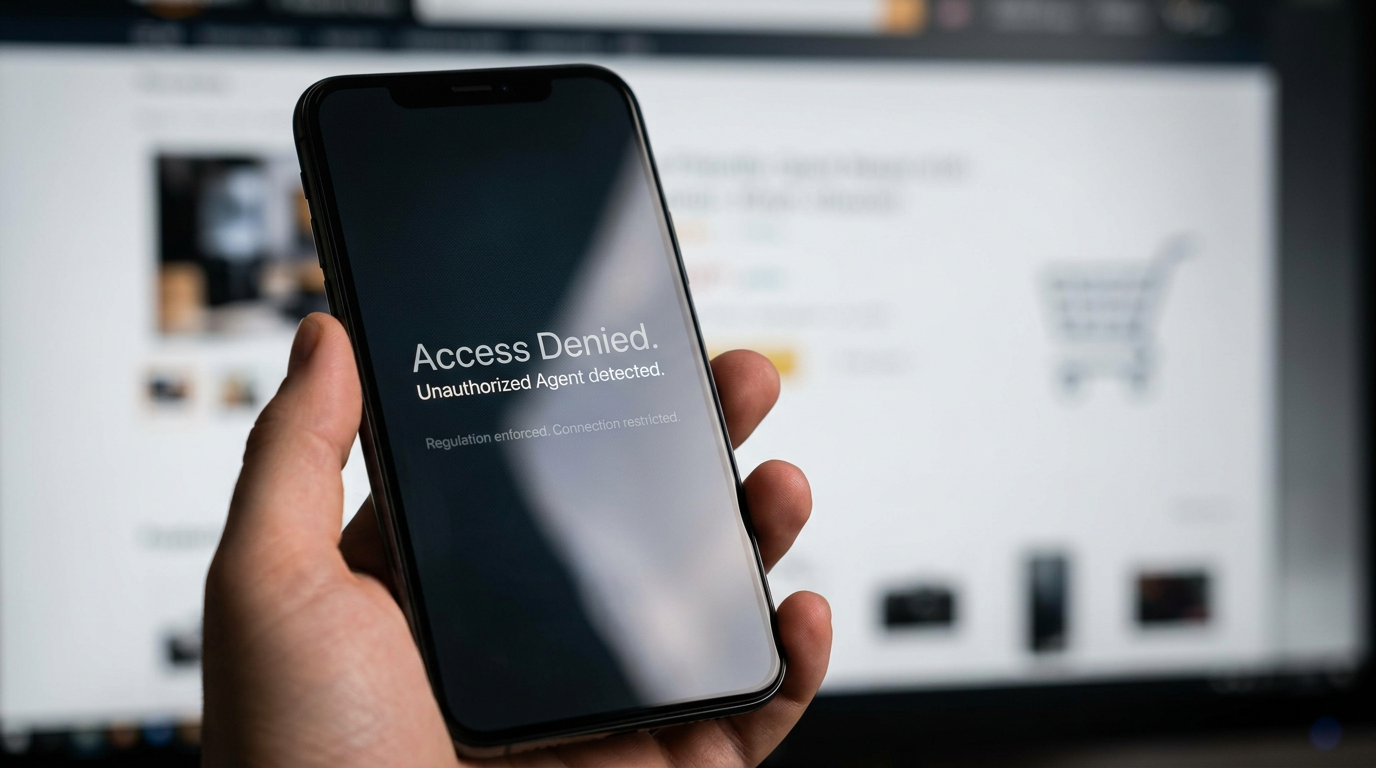 The Shift From AI Assistance to AI Access Control
This is not a blanket rejection of AI. That’s the key distinction. Merchants are not saying no to AI. They’re saying no to unidentified AI.
That difference matters.
As agentic commerce picks up speed, AI tools have moved beyond browsing and summarizing products. They’re starting to discover items, compare offers, add products to carts, and sometimes attempt to complete purchases on a user’s behalf. For retailers, that creates a new challenge: who exactly is interacting with the storefront, and under what rules?
That concern is pushing major players to put guardrails in place.
In mid-2025, Shopify quietly updated default robots.txt files across merchant storefronts with language discouraging automated scraping, buy-for-me agents, and end-to-end purchase flows that skip a final human review step. Shopify later played down the move, with engineer Ilya Grigorik saying it was essentially a comment and a pointer to official tools like Checkout Kit. Still, even if the language was soft, the message was not: if AI agents want to participate in commerce, they need to do it through approved channels.
That’s the real story.
Why Merchants Are Pushing Back
From my perspective, merchants are responding to three major threats at once.
1. Revenue bypass
Platforms like Shopify, Amazon, and others make meaningful revenue from checkout, payments, ads, and the broader shopping funnel. If an outside AI agent reduces the storefront to a background data source, the merchant loses control over one of its most valuable assets: the transaction experience.
For Shopify, that matters because payments and checkout infrastructure sit at the center of its business model. For Amazon, the stakes are even higher when you factor in product discovery, ad inventory, and ecosystem lock-in.
2. Data and customer relationship loss
Retailers don’t just want the sale. They want the context around it.
When a customer shops directly, the merchant learns what was searched, what was compared, what got abandoned, and what nearly converted. But if an AI agent sits in the middle of that entire journey, much of that behavioral data disappears. The merchant risks becoming a commodity supplier instead of a brand with a direct customer relationship.
3. Fraud, scraping, and unauthorized automation
This may be the most immediate issue. Not every AI shopping agent is transparent, authenticated, or even operating with permission. Some behave like upgraded bots, scraping content, mimicking humans, or attempting actions that violate site terms.
That’s why the current push is not just philosophical. It’s operational. Merchants want a way to separate legitimate, permissioned agents from everything else.
Shopify Isn’t Alone
What makes this story important is that Shopify is part of a broader industry pattern.
Amazon has updated its own rules around automated agents and reportedly taken an aggressive stance against external AI shopping tools, including legal action. eBay has revised user agreements to prohibit unapproved buy-for-me agents and LLM-driven checkout flows. Walmart, rather than issuing a strict ban, has published guidelines outlining how AI agents can interact appropriately.
So while headlines may focus on bans, what’s really happening is a market-wide move toward permissioned participation.
That’s a major difference.
The winners in this next phase won’t necessarily be the companies that block AI the hardest. They’ll be the ones that set the standards AI agents must follow.
The Emerging Model: Permission-First Commerce
This is where things get especially interesting.
The ecommerce industry appears to be converging on a new model: AI agents are welcome, but only if they identify themselves, authenticate properly, and operate within approved frameworks.
That’s why standards like the Universal Commerce Protocol are gaining momentum. Backed by major retailers and platforms, these efforts aim to create structured ways for AI agents to discover products, signal intent, access carts, and process payments using verified credentials.
In other words, the future probably isn’t open-season bot access.
It’s controlled interoperability.
That may frustrate some AI developers who hoped the web itself would be enough. From the merchant side, though, the logic is straightforward. If autonomous systems are going to act like buyers, they need to meet the same trust and compliance standards that marketplaces, payment processors, and enterprise integrations already follow.
 Why This Changes Ecommerce Strategy
This shift has consequences far beyond bot management.
As shopping agents improve, ecommerce competition won’t be defined only by ad spend, SEO, or polished storefront design. It will increasingly depend on whether products, pricing, inventory, and checkout systems are accessible in machine-readable, trusted, and policy-compliant ways.
That means merchants need to prepare for a world where:
- AI agents become a meaningful source of traffic and transactions
- catalog quality matters as much as creative merchandising
- authentication and identity frameworks become core ecommerce infrastructure
- being visible to the right agents matters more than being accessible to every agent
This is why so many companies are taking a middle path. They don’t want to shut out the future of shopping. They just don’t want to hand it over to unknown intermediaries.
The Real Takeaway
The phrase banning AI shopping agents is slightly misleading.
What merchants including Shopify are really doing is banning anonymous, unsanctioned, and unaccountable AI shopping agents.
That’s a very different story.
This isn’t resistance to innovation. It’s an attempt to control the terms of innovation before autonomous commerce becomes too powerful to regulate. Retailers have realized that if they don’t define the access layer now, they may lose pricing power, customer relationships, checkout revenue, and brand visibility later.
So yes, the clampdown is real. But it’s also transitional.
The likely end state is not a world where AI agents disappear. It’s a world where only authenticated, standards-compliant, merchant-approved agents are allowed to operate at scale.
FAQ
Are merchants banning all AI shopping agents?
No. Most are not rejecting AI outright. They are pushing back on agents that are unidentified, unauthorized, or operating outside approved systems.
Why is Shopify’s move significant?
Shopify sits at the center of ecommerce infrastructure for a huge number of merchants. Its actions signal how seriously the industry is starting to treat AI agent access and control.
What does permission-first commerce mean?
It means AI agents can participate in shopping and transactions, but only when they identify themselves, authenticate properly, and follow merchant-approved standards and rules.
What should merchants do now?
They should prepare their catalog, checkout, identity, and access systems for a future where trusted AI agents may become a major channel for discovery and transactions.
Conclusion
This moment is both a warning and an opportunity. The warning is clear: unidentified AI agents are quickly becoming unacceptable across ecommerce. The opportunity is that businesses still have time to adapt to the permission-first future taking shape around standards, verified access, and agent-ready commerce infrastructure. For teams trying to understand where this shift is heading and how to respond strategically, AIuthority is a smart place to start.