Marketers Predict AI Will Disrupt Creative Teams First
I’ve been watching the AI conversation in marketing take a turn that feels both obvious and a little unnerving: the first big shift isn’t media buying, attribution, or targeting. It’s creative.
That’s not just gut instinct—it’s in the numbers. In a late-2025 survey by Ascend2 (later published through StackAdapt’s programmatic report and amplified by eMarketer), senior marketers pointed to creative and content production as the most likely first domino of AI disruption. In StackAdapt’s findings, 27% of respondents ranked creative/content production as the top area AI will disrupt—ahead of functions many assumed would be automated first.
Once you connect the dots, the order makes sense.
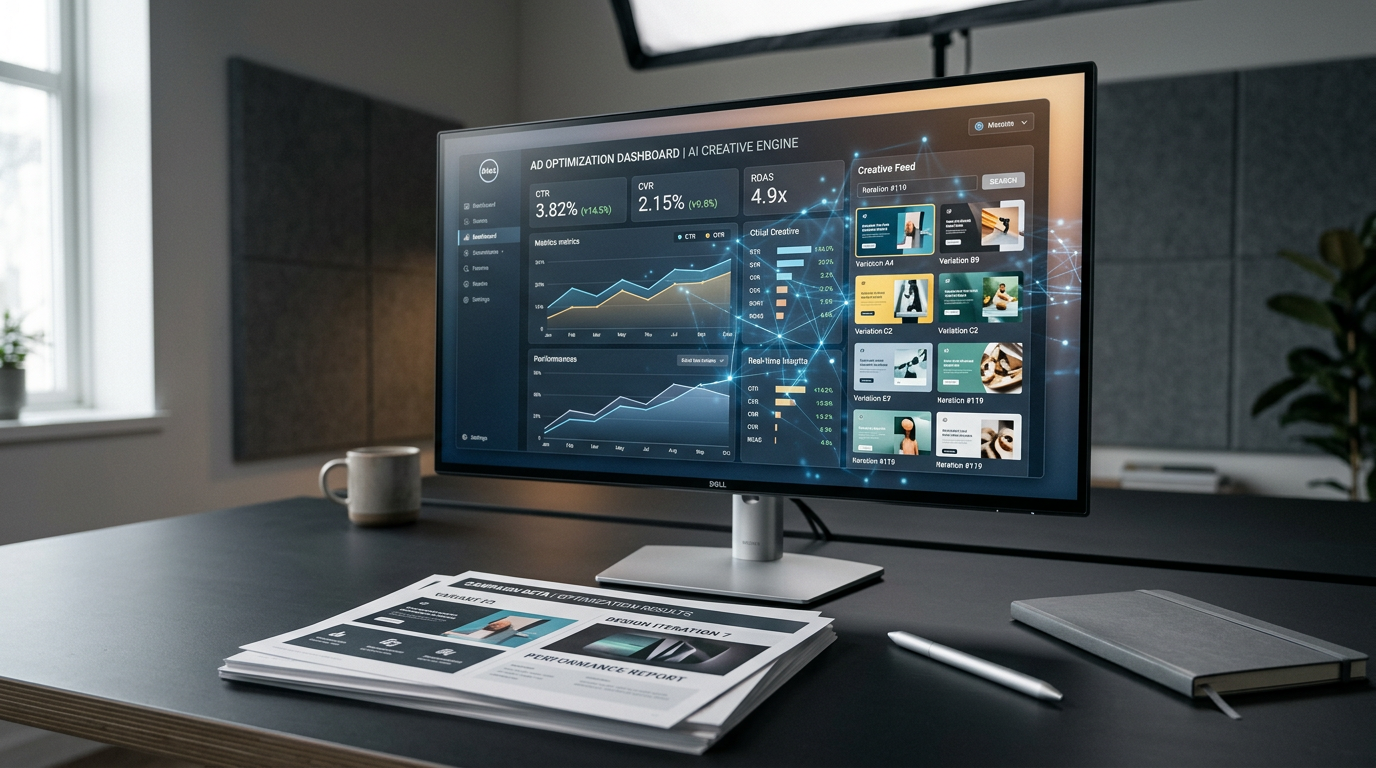 Why creative is first on the chopping block (and first in line for leverage)
Creative sits at the intersection of three realities:
- It’s expensive.
Whether you’re paying in-house salaries, freelancers, or agency retainers, creative is one of the steadiest (and heaviest) line items in performance marketing. - It’s constant.
The ad ecosystem rewards iteration. For many eCommerce and DTC brands, producing 50–100 variations per month is normal. At that volume, creative becomes an operations problem as much as a craft problem. - It’s measurable (even if imperfectly).
Creative will always have subjectivity, but performance teams treat it like a dataset: hooks, thumbnails, first-three-second retention, CTR, CVR, CPA. AI thrives where feedback loops exist—even noisy ones.
So when marketers say AI will hit creative first, I don’t hear “robots are taking over art.” I hear “the market is trying to compress the most repetitive, high-frequency production workload.”
The productivity promise: 80% faster, infinite variants, always-on testing
Most early excitement—especially from growth teams—comes down to speed. The pitch is simple: AI turns creative production into a throughput problem you can solve.
That aligns with the chatter that followed the eMarketer coverage, where some marketers claimed AI tools can cut production time by as much as 80% for brands that need constant refreshes. If you’ve ever had spend capped because you were waiting on the creative queue, the appeal is immediate.
In that world, AI isn’t replacing your team’s best ideas. It’s replacing the grind:
- the backlog
- the versioning
- the resizing
- the remixing of angles by persona
- the “make me 12 more like this, but different” loop
And if eMarketer’s broader forecast holds—nearly 40% of digital video ads could be AI-generated in 2026—this isn’t a distant trend. It’s already a competitive pressure.
The big risk: “sameness” and oversaturation becomes the new performance tax
Here’s what many teams still aren’t building for: when everyone can produce “good enough” creative at scale, good enough stops converting.
The IAB-backed concern that keeps surfacing is oversaturation. In the eMarketer synthesis, 57% of agency leaders said AI-driven content oversaturation is their top concern. That’s the signal under the hype. When output becomes cheap, differentiation gets pricey.
We’re already seeing early symptoms:
- AI-generated visuals converging on the same default look
- hooks that read like they were written for a model, not a person
- ads that follow “best practices” but don’t feel like a brand
Some creative leaders have been blunt about rejecting AI-generated assets because they lack a point of view. That’s the real risk: not that AI drops quality across the board, but that it pulls everything toward the mean.
When every competitor can ship 1,000 variants, the edge won’t go to whoever ships the most. It’ll go to the team with the sharpest taste.
 Agencies and in-house teams are already feeling the budget shift
AI doesn’t just change how work gets done—it changes who gets paid for it.
In the same research ecosystem, leaders signaled they’d reduce agency spend if AI automation covered enough of the content pipeline. The takeaway is consistent even when specific figures vary: as AI gets more capable (less “copilot,” more “do it for me”), reliance on external production shrinks.
That doesn’t mean agencies vanish. It means the agency pitch has to change quickly:
- less “we can produce”
- more “we can decide”
- less “we’ll make 30 ads”
- more “we’ll build a system for creative strategy, testing, and brand coherence”
Execution gets commoditized. Judgment gets scarce.
What I think the winning creative team looks like in 2026
If I were rebuilding a creative function right now, I’d stop debating whether AI “replaces creativity” and get specific about where humans stay non-negotiable.
1) Humans own the constraints (the taste layer)
AI can generate options all day. Humans have to define the box:
- brand voice boundaries
- what we refuse to sound like
- which emotions we’re willing to evoke
- what “on-brand” means when performance pressure hits
Without constraints, AI pours out content. With constraints, it becomes a multiplier.
2) AI owns the throughput (the iteration layer)
This is where AI earns its keep:
- rapid concept branching
- format adaptation (static to video scripts, UGC angles, hooks)
- localization and personalization
- variation for testing
AI should serve a strategy—not invent one from scratch.
3) Creative strategy becomes the moat
The most useful takeaway from the post-coverage debate wasn’t “AI will take our jobs.” It was “strategy is what’s left.” Winning teams won’t just ship more creative. They’ll build better hypotheses, run tighter tests, and learn faster.
That’s how you avoid the sameness trap: not by banning AI, but by designing a creative system that reliably produces distinctive output.
Conclusion: AI is coming for creative first—so treat creative like a performance system
Marketers expect AI to disrupt creative teams first because creative carries the heaviest workload, demands constant iteration, and offers feedback loops that automation can plug into quickly. Speed will matter—but it won’t be enough for long. Oversaturation will punish anything templated, and the winners will pair AI throughput with human taste and real strategic intent.
If you’re building a hybrid system that scales testing without losing the thread between creative, performance, and decision-making, take a look at ROAS Suite as a practical way to keep your growth engine accountable while you increase creative velocity.