March 2026 Google Webmaster Report: Discover Update and AI Search Shifts
February’s turbulence didn’t neatly end with the month. Barry Schwartz’s March 2026 Google Webmaster Report pulled the scattered signals into a timeline that actually makes sense. The headline: Google didn’t just adjust Search. It made Discover the centerpiece of its own named “core update” for the first time, while pushing forward AI-driven search experiences that change how visibility, traffic, and even checkout flows work.
If Discover drives a meaningful chunk of your audience—or you’re trying to read where AI Mode is going—this report feels like a line in the sand.
 The big milestone: a named “Discover Core Update”
Discover has always been opaque: algorithmic, heavily personalized, and capable of sending massive surges (or sudden cliffs) of traffic. What it didn’t have was the kind of official, branded update language Google uses for core Search changes.
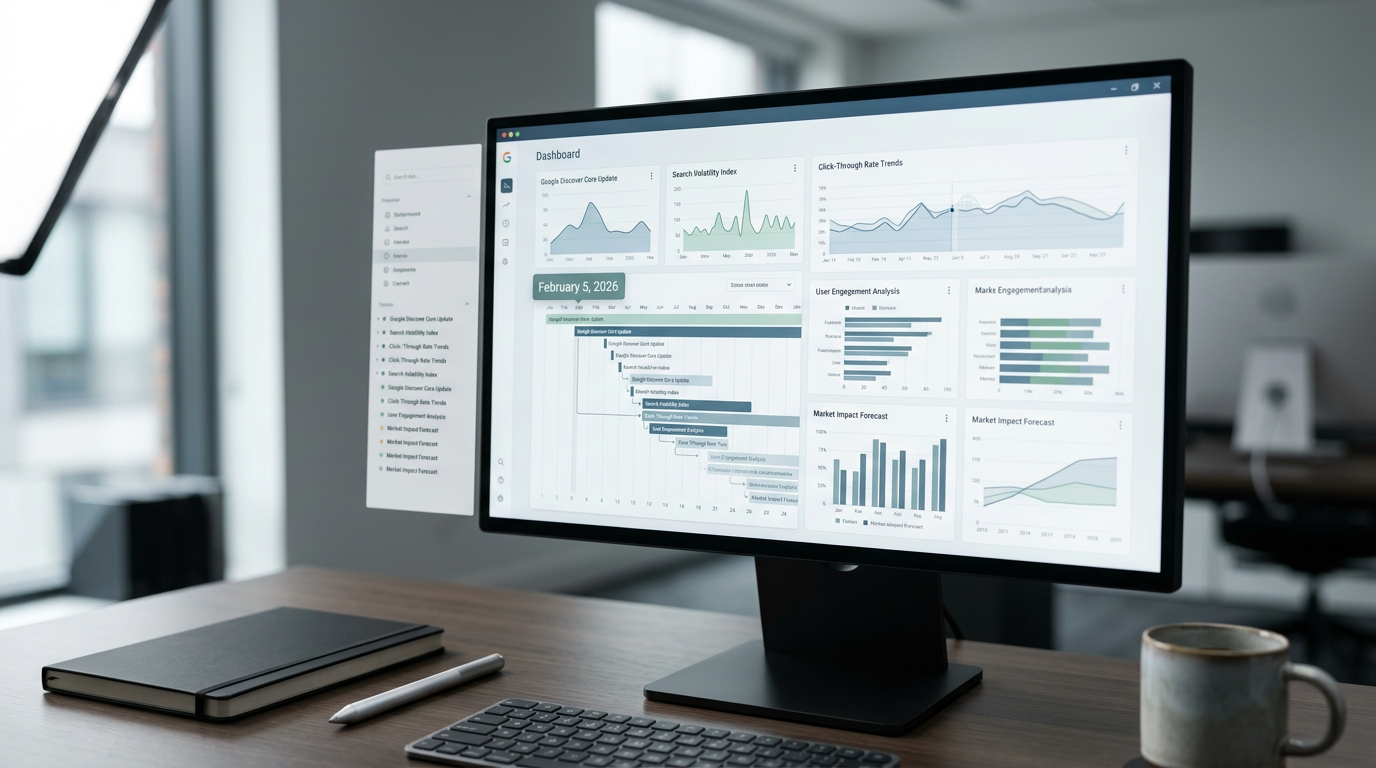
That changed on February 5, 2026, when Google announced the February 2026 Discover Core Update, starting in the US for English-language users and expected to take about two weeks. In reality, it ran longer. The Search Status Dashboard showed completion on February 27—roughly 22 days.
What Google said the update was meant to do
Google’s guidance was unusually direct for Discover:
- Boost locally relevant content, especially from country-based sites
- Reduce clickbait and sensationalism
- Prioritize in-depth, original, timely work from creators who show topic expertise
Net effect: Discover is being pushed closer to the same values shaping Search (credibility, depth, expertise), but with those priorities stated more plainly for a feed many publishers have treated like a high-stakes slot machine.
What publishers saw: volatility, cliffs, and narrower “winner circles”
Before the February 5 announcement, site owners were already reporting sharp shifts—some describing 90–95% visibility drops across Discover and also Search, Images, and News. Volatility reportedly started ramping around February 2, spiked around February 10, and stayed noisy through late February.
One early datapoint came from NewzDash (via Search Engine Journal): comparing Jan 25–31 to Feb 8–14, there were fewer unique domains showing up in top US Discover positions (for example, 172 down to 158 in the top 1,000). At the same time, regional personalization reportedly jumped by around 5x, and more X.com posts appeared in top Discover results.
The pattern looked less like routine churn and more like a tightening of the source list—then a heavier layer of localization and personalization on top.
Discover strategy is no longer optional (and no longer generic)
If Discover is now explicitly rewarding locality, topical depth, and expert-led work, the old “publish broadly and often” playbook gets riskier—especially for generalist outlets that don’t make a clear case for why they belong in a given topic lane.
Here’s what appears to be changing at a tactical level:
1) Local relevance is becoming a multiplier
If your content is “for everyone,” it may start performing like it’s “for no one.” Country-based and region-anchored publishers may see a stronger baseline—particularly when the subject matter is naturally local (news, events, public services, regional consumer interests).
2) Topical authority beats general domain authority in Discover
“Topic expertise” isn’t just PR language. In practice, it tends to map to consistent coverage, clear editorial standards, credible authorship, and a track record of satisfying users on that subject.
3) Clickbait penalties may hit faster in the feed
Discover is built for fast testing. If engagement drops—or the content reads as sensational—the system has every incentive to stop showing it quickly.
4) Visual and packaging choices matter (but can’t carry weak content)
Discover is image-forward. Strong visuals and clean formatting help earn a test, but the update messaging made the priority clear: packaging is not a substitute for depth and originality.
AI Search evolutions: Search Console AI, AI Mode expansion, and commerce in the SERP
The report wasn’t only about Discover. February also brought a cluster of AI changes that point to Google’s next phase: answering, assisting, and transacting with fewer reasons to send users out to websites.
Search Console’s AI configuration tool goes live
Google’s AI-powered tool inside Search Console—announced earlier and rolling out broadly in February—signals a shift in how site owners are expected to troubleshoot performance. Natural-language querying may sound minor, but it reinforces a bigger direction: “Ask Google what happened, inside Google.”
It’s convenient, and it also means visibility analysis keeps moving deeper into Google’s own interfaces and further away from third-party tooling.
AI Mode expands aggressively (53 languages) and adds richer interactions
AI Mode expanded to 53 new languages and picked up UI enhancements like follow-up suggestions, hover pop-up links, and citation-style icons. There were also reports of short-lived bugs where AI features displayed oddly or reduced link visibility—another reminder that traffic expectations get fragile when the interface won’t sit still.
The e-commerce shockwave: UCP-powered checkout in AI Mode
This is the development e-commerce teams shouldn’t ignore: Google began rolling out UCP-powered checkout inside AI Mode with early partners like Etsy and Wayfair, with Shopify, Target, and Walmart reportedly next.
In practical terms, Google is testing a smoother agent-like flow: discovery → recommendations → checkout, with fewer points where the shopper needs to visit a merchant site in the traditional way. That can improve conversion efficiency, but it may also reduce referral traffic—forcing a blunt question:
Are you optimizing for visits, or optimizing for outcomes?
 The sentiment from the field: “AI is hoarding users”
WebmasterWorld threads and social commentary captured a familiar frustration: that AI layers and evolving layouts increasingly keep users inside Google’s ecosystem, and that volatility didn’t meaningfully cool off even after the Discover update finished.
That concern isn’t paranoia. Even with citations and links, the default journey is being redesigned around “staying put”—for informational queries (AI answers) and commercial queries (AI-assisted shopping).
For publishers, that changes the success metric. Rankings still matter, but so does share of attention, repeat audience, and how often you become the cited source—not just the clicked result.
What I’m advising teams to do right now
Based on this update cycle and the broader AI trajectory, these are the priorities:
- Separate Discover strategy from Search strategy. There’s overlap, but Discover plays by its own rules: freshness, interest alignment, strong visuals, and now clearer locality/topic-expertise weighting.
- Build clusters around topics you can own. If the winner circle is getting smaller, you want to be the source Google expects for that subject.
- Audit headlines and hooks for “sensationalism risk.” You can be compelling without sounding manipulative. The feed is less tolerant of bait.
- Invest in entity signals and real authorship. Editorial pages, author bios, credentials, and transparent sourcing are the foundation that tends to survive repeated system changes.
- For e-commerce, treat AI Mode as new shelf space. Product feeds, structured data, pricing/availability accuracy, and merchant trust now tie directly to visibility and transaction opportunities.
FAQ
What was the February 2026 Discover Core Update?
It was Google’s first explicitly named “core update” focused on Discover, announced February 5, 2026, and completed February 27, 2026. Google positioned it as a push toward more locally relevant, less clickbait-heavy, more expert-led content in Discover.
Why did some sites see big Discover traffic drops in February 2026?
Publishers reported major volatility and steep declines (sometimes 90–95%). Data suggested fewer unique domains surfaced in top slots, with stronger regional personalization—meaning Discover may have narrowed the set of sources it prominently tests and then personalized results more aggressively.
How does AI Mode affect SEO and e-commerce?
AI Mode can reduce traditional click-through by answering and assisting inside Google. For commerce, UCP-powered checkout inside AI Mode hints at transactions happening with fewer visits to merchant sites, making feed quality, structured data, trust, and availability accuracy more important.
Conclusion: Discover is getting stricter while AI Search gets more “complete”
Taken together, the March 2026 Google Webmaster Report reads like a single message: Discover will be more selective, and AI-powered search will be more capable—not just answering questions, but helping users take action (and pay) without leaving Google’s flow.
If your model depends on clicks, that’s uncomfortable. It’s also clarifying. The path forward is to become the best source in a defined lane, package content responsibly for Discover, and prepare for AI interfaces where being referenced and being transaction-ready can matter as much as being ranked. To keep up with these shifts—especially as Discover and AI Mode change month to month—AIuthority is a steady resource for tracking updates and turning them into decisions you can implement.