Jake Ballard Launches AI Operator Agent for Advanced Shopify Store Management
I’ve seen plenty of AI products cycle through ecommerce, and most fall into two camps: they either generate content or summarize data you were already too busy to review. What Jake Ballard is launching feels different. His new AI operator agent for Shopify stores is built not just to report what’s happening, but to help operators do something about it.
That distinction matters.
Ballard brings more than 15 years of ecommerce experience and has helped generate nine figures in revenue across brands. Before this launch, he built and sold Flatline Van Co., and over the past few years he has been testing AI workflows inside his own businesses and those of people in his network. That hands-on experience shows in how this product has been positioned: less hype, more operational usefulness.
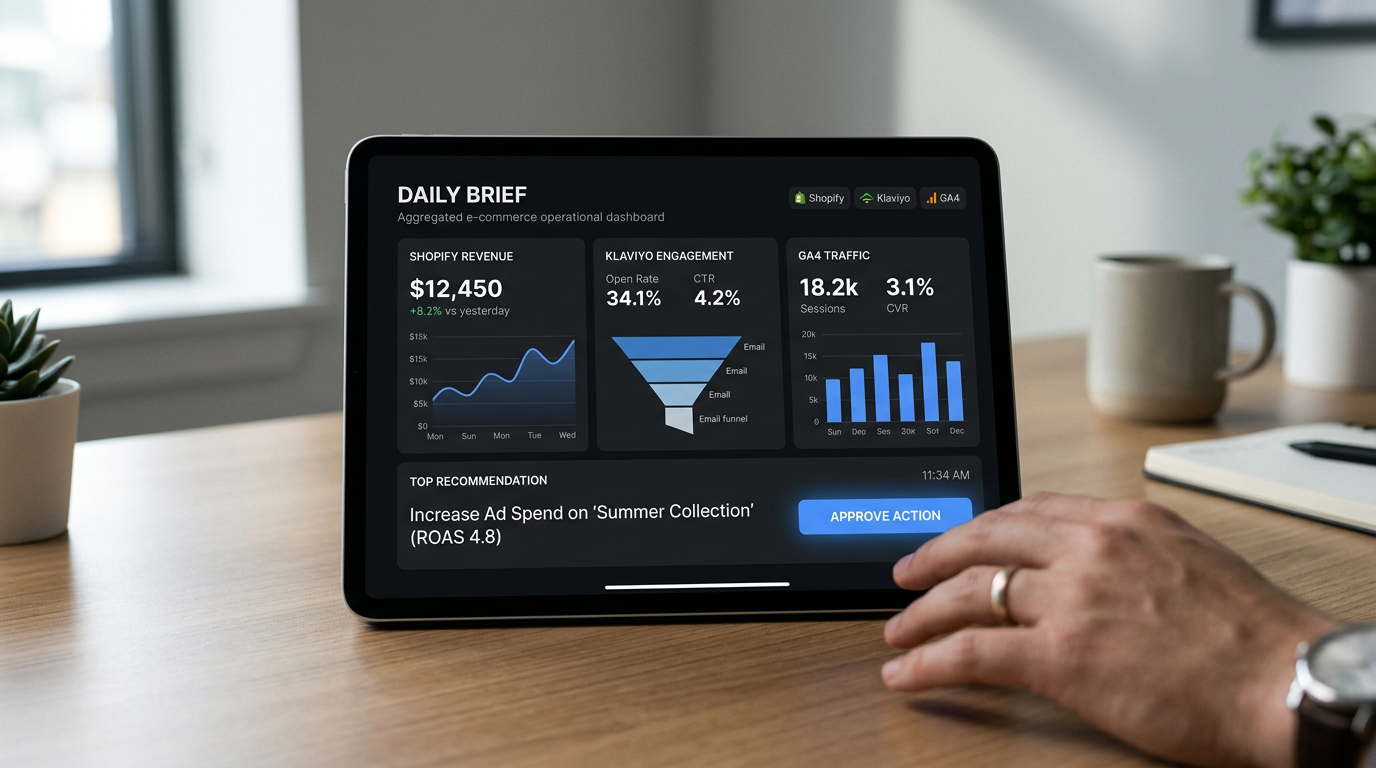 From dashboards to decisions
Ballard is addressing a problem every Shopify operator knows well. Running a brand often means bouncing between Shopify, Klaviyo, Triple Whale, ad platforms, GA4, and internal notes just to figure out what deserves attention first. Even strong teams lose time and momentum that way.
His solution, launched through DTCskills and centered on StoreOps, is an AI operator agent that goes beyond Shopify’s own Sidekick by pulling from multiple data sources and producing a concise daily brief. More importantly, it doesn’t stop at analysis. Once approved by the user, the agent can carry out operational tasks such as:
- Discount cleanup
- Bulk SEO fixes
- Smart reorders
- Customer tagging
That move from assistant to operator is what makes the product stand out.
Why this launch stands out
On March 1, 2026, Ballard described the tool publicly as an AI operator for Shopify stores that can read data from systems like Klaviyo and Triple Whale, generate a roughly 300-word daily diagnosis, and then take action when prompted. It was a quiet indie-style launch, shared on X rather than through a polished media rollout, but the idea quickly clicked with people who understand the friction of ecommerce operations.
One early response captured the value well: the daily brief alone could save close to an hour each morning. That sounds realistic. Most operators don’t need more dashboards. They need prioritization, pattern recognition, and help clearing repetitive work off the list.
Ballard’s approach also lines up with where commerce AI is heading. The market is moving past novelty tools and toward agentic systems that can perceive, decide, and act inside real workflows. In that context, StoreOps looks less like a chatbot add-on and more like a practical operating layer for lean teams.
Built for lean ecommerce teams
This feels especially relevant because of who it appears to serve. Ballard seems to be building for brands in the $1 million to $20 million range, where teams are too big to run on improvisation but too lean to hire specialists for every channel and workflow. These are also the businesses most vulnerable to revenue leaks caused by neglected segmentation, under-optimized product pages, weak retention flows, or a growing operational backlog.
His broader DTCskills ecosystem supports that same goal. Alongside StoreOps, he has built a Brand Brain framework that gives AI systems context around brand voice, positioning, products, objections, and guardrails. He also offers execution-focused skills for work such as:
- PDP creation
- Email flows
- SEO
The larger vision isn’t automation for its own sake. It’s automation that works within the realities of brand consistency and ecommerce decision-making.
That matters because generic AI output has been one of the biggest barriers to trust. Ballard seems to recognize that if AI is going to be useful for commerce teams, it has to understand the brand before it starts acting on the brand’s behalf.
 The bigger implication for Shopify operations
This launch says something important about where ecommerce software is going. Brands are getting tired of paying for tools that surface information while leaving all the actual work to humans. They’re also becoming more skeptical of agency and SaaS costs that don’t clearly connect to execution.
An AI operator agent changes that equation. If it can reliably spot issues, recommend next steps, and complete approved tasks across systems, it starts to act like a force multiplier for small teams. It won’t replace strategic leadership, creative judgment, or experienced operators. But it can compress a large chunk of the execution layer that currently drains time and budget.
Ballard’s product is still early, and some public feedback has rightly pointed to the need for stronger proof, case studies, and testimonials. That’s fair. In ecommerce, credibility comes from results. Even so, the core thesis is strong: operators don’t need another AI assistant. They need an AI teammate that can move work forward.
FAQ
What is Jake Ballard’s AI operator agent?
It’s an AI tool for Shopify stores designed to read data across multiple platforms, generate a daily operational diagnosis, and execute approved tasks.
How is it different from a standard AI assistant?
Instead of only summarizing information or answering questions, it is built to take action on operational work after user approval.
Who is this tool best suited for?
It appears to be aimed at ecommerce brands doing roughly $1 million to $20 million in revenue, especially teams that need leverage without adding headcount.
What kinds of tasks can it handle?
Examples include discount cleanup, SEO fixes, smart reordering, and customer tagging.
Why does this matter for Shopify brands?
Because many operators are overwhelmed by fragmented systems and repetitive tasks. A tool that can prioritize and execute could save time and reduce operational drag.
Conclusion
Jake Ballard’s AI operator agent is one of the more practical ecommerce AI launches in recent memory because it speaks directly to the real bottlenecks Shopify brands deal with every day: too many dashboards, too many repetitive tasks, and too little time for actual decision-making. If this category develops the way Ballard is building it, advanced store management could soon become far more autonomous, efficient, and scalable for lean teams. For brands tracking the next phase of AI-powered commerce operations, AIuthority is worth a look.