ImageKit Launches Creative Automation with AI Assist for On-Brand Visuals
Marketing teams don’t just need speed anymore. They need speed with control, scale with consistency, and automation that won’t undo years of brand-building. That’s why ImageKit’s launch of Creative Automation with AI Assist, announced on June 29, 2026, stands out.
As ecommerce, retail, and performance marketing teams are pushed to produce more campaigns, more tests, and more localized content, ImageKit is tackling a real operational bottleneck. Instead of treating creative work as a fragmented process spread across design tools, asset libraries, and delivery systems, it’s bringing those pieces into a single governed workflow.
 Why This Launch Matters
This is more than another AI feature release. It reflects a broader shift in creative production. Teams don’t want AI that generates content in isolation; they want systems that produce usable, brand-safe variations inside the workflows they already use.
ImageKit’s Creative Automation is built for that. Teams can create template-based visuals at scale while keeping control over layout, typography, colors, spacing, and brand hierarchy. The structure stays fixed, while editable elements like product images, headlines, offers, CTAs, and localized copy can be updated quickly and safely.
That balance between flexibility and governance makes the launch especially relevant.
What ImageKit Is Actually Offering
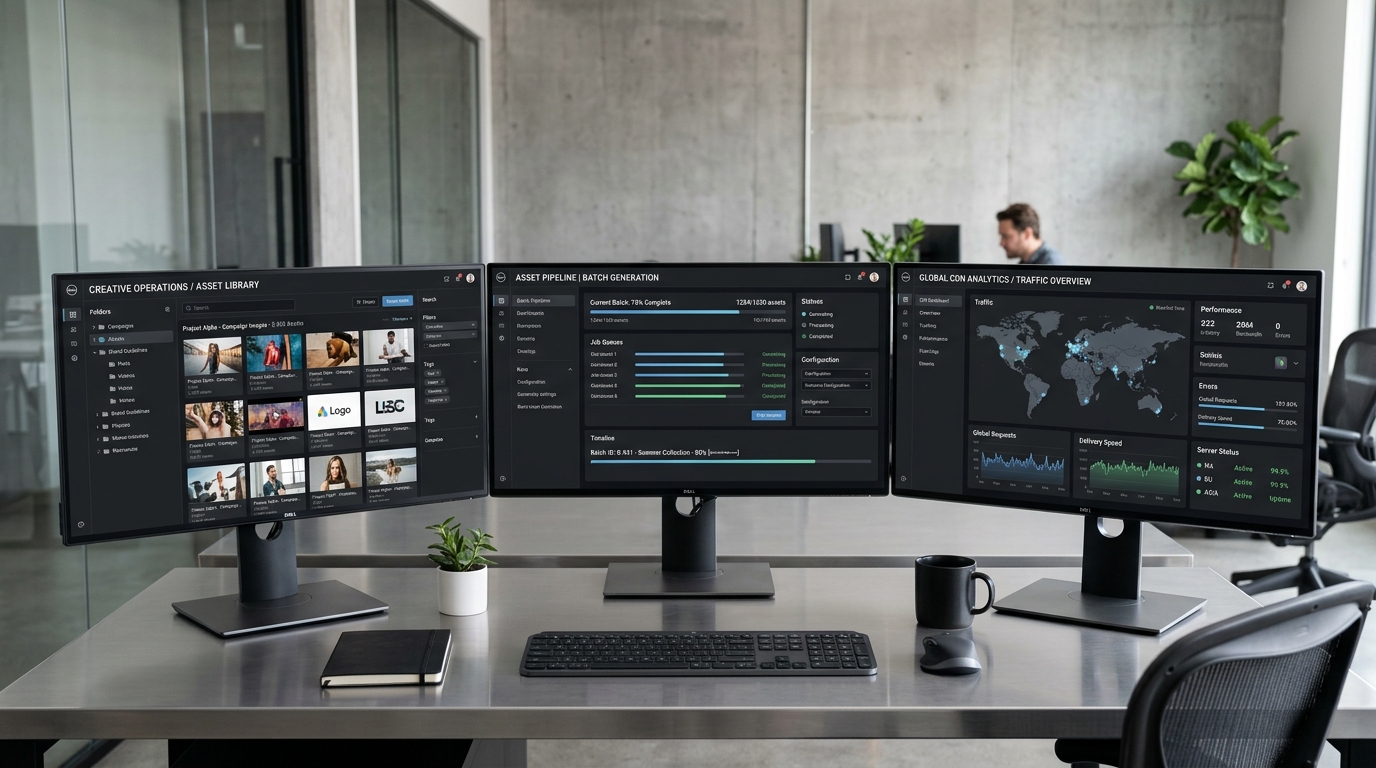
At its core, ImageKit is extending its platform beyond media delivery and digital asset management into creative production automation. The company already has a strong reputation for its unified image and video API, DAM capabilities, and CDN-based delivery. With this release, it adds a native layer for generating large volumes of on-brand visual assets without the usual manual repetition.
The new system includes:
- Template-driven creative production
- Governed customization for marketers and growth teams
- Bulk asset generation through UI or CSV uploads
- AI Assist for copy variation, localization, and asset-related tasks
- Direct integration with ImageKit’s DAM and delivery infrastructure
One especially notable detail is availability. The feature is offered across all account types, from smaller businesses to enterprise users. That lowers the barrier for teams that need automation but can’t justify a complex enterprise-only setup.
Solving the Real Bottleneck in Marketing
ImageKit CEO Rahul put the problem plainly in the launch announcement: marketing teams are under constant pressure to move faster, but creative production remains the bottleneck. That assessment feels accurate.
In many organizations, campaigns don’t stall because strategy is weak. They stall because producing dozens or hundreds of approved visual variations takes too long. A single campaign may need multiple aspect ratios, regional language versions, updated offers, audience-specific headlines, and platform-specific formats. Add A/B testing, and the workload grows fast.
ImageKit’s answer is a design-once, generate-at-scale model. Brand and design teams define the rules through reusable templates, and marketers can self-serve variations without rebuilding assets each time. That reduces the constant back-and-forth with design while protecting brand integrity.
The Role of AI Assist
The AI Assist portion matters, but not because it replaces people. Its value is in speeding up repetitive creative tasks while keeping humans in control.
According to the launch details, AI Assist can help with tasks such as:
- Translating campaign copy for localization
- Creating alternative copy versions for testing
- Supporting asset selection and related creative workflows
The important distinction is that the outputs remain editable and reviewable. That matters in branded content, where loss of oversight is one of the biggest concerns around AI. ImageKit appears to be positioning AI as a production assistant, not an unsupervised creative director, which is a far more practical model for serious marketing teams.
Built on a Larger AI and DAM Strategy
This release is part of a larger pattern. Throughout 2025 and early 2026, ImageKit has been steadily adding AI functionality to its platform. Earlier developments included DAM Agent, a conversational AI assistant for digital asset management workflows, and MCP server capabilities that enable secure AI assistant integrations for media operations at scale.
That progression suggests a clear strategy. ImageKit isn’t stacking flashy AI features for attention; it’s building an ecosystem where asset storage, discovery, transformation, governance, automation, and delivery work together. In a market where many AI tools still feel disconnected, that’s a meaningful difference.
 Broader Industry Context
ImageKit’s move also fits a larger 2026 trend: AI-powered creative and marketing automation is becoming core infrastructure. Around the same period, companies like Canva, Cloudinary, Contentful, and Rokt have all pushed further into automation, optimization, and performance workflows.
What makes ImageKit stand out is its focus on governed scale. Rather than chasing generative novelty, it addresses the operational challenge of producing brand-consistent assets in high volume. For ecommerce and performance marketers, that may be far more useful than a tool that creates impressive visuals but doesn’t fit cleanly into existing approval and delivery systems.
What This Means for Marketing Teams
The biggest implication is straightforward: creative operations are becoming more self-serve without becoming more chaotic.
That’s a real advantage for brands. Design teams can spend more time on high-level systems, campaign concepts, and visual strategy, while marketers move faster on execution. Performance teams can run more tests. Localization becomes easier to manage. Product-heavy businesses can create broader sets of promotional assets without clogging internal workflows.
Because ImageKit ties output back into DAM and CDN-ready delivery, assets don’t just get created. They stay organized, governed, searchable, and ready to deploy.
Looking Ahead
It’s still early, and the launch is too recent for a deep body of independent reviews or customer case studies. Still, the direction is clear. Creative automation is shifting away from isolated generation tools and toward integrated systems that combine AI, brand governance, asset management, and delivery.
More platforms will likely move this way. The winners won’t be the ones generating the most content, but the ones helping teams generate the right content faster, with less friction and fewer brand mistakes.
ImageKit’s Creative Automation with AI Assist is a strong signal of where the market is headed: scalable, controlled, and integrated visual production for modern marketing teams.
For brands looking to turn creative scale into measurable performance, a stronger operational framework matters just as much as faster production. If your goal is to connect higher creative output with better campaign efficiency, ROAS Suite is worth considering.
FAQ
What is ImageKit Creative Automation with AI Assist?
It’s a new capability from ImageKit that helps teams generate on-brand visual assets at scale using governed templates, bulk production tools, and AI-assisted workflows.
Who is this product designed for?
It’s aimed at ecommerce, retail, growth, and performance marketing teams that need to produce large volumes of brand-consistent creative quickly.
What does AI Assist do?
AI Assist helps with tasks like localization, copy variations for testing, and asset-related workflow support while keeping outputs editable and reviewable.
How is this different from standard generative AI tools?
Rather than generating content in isolation, ImageKit focuses on governed, template-based production that fits into existing brand, approval, and delivery workflows.
Why does the DAM and CDN integration matter?
It means assets can move directly from creation into organized storage and delivery, reducing workflow friction and making campaign deployment easier.
Conclusion
ImageKit’s latest launch addresses a practical problem many marketing teams face every day: how to scale creative output without sacrificing brand control. By combining templates, AI assistance, DAM integration, and delivery infrastructure in one workflow, the company is moving beyond simple automation and into true creative operations support. For teams under pressure to produce more, faster, and with fewer mistakes, that’s a meaningful step forward.