IAB Tech Lab Launches AAMP Framework for Agentic Advertising
The conversation around agentic AI in advertising has shifted from experimentation to execution, and IAB Tech Lab’s launch of AAMP—short for Agentic Advertising Management Protocols—is one of the clearest signs yet that the industry is trying to put real structure around it.
For months, the market has been buzzing about AI agents handling media planning, buying, optimization, and audience activation. The problem is that the excitement has been matched by fragmentation. Competing protocols, proprietary frameworks, and unclear trust models have made it hard to picture what an agentic advertising future should actually look like. AAMP is meant to close that gap.
 Why AAMP Matters Right Now
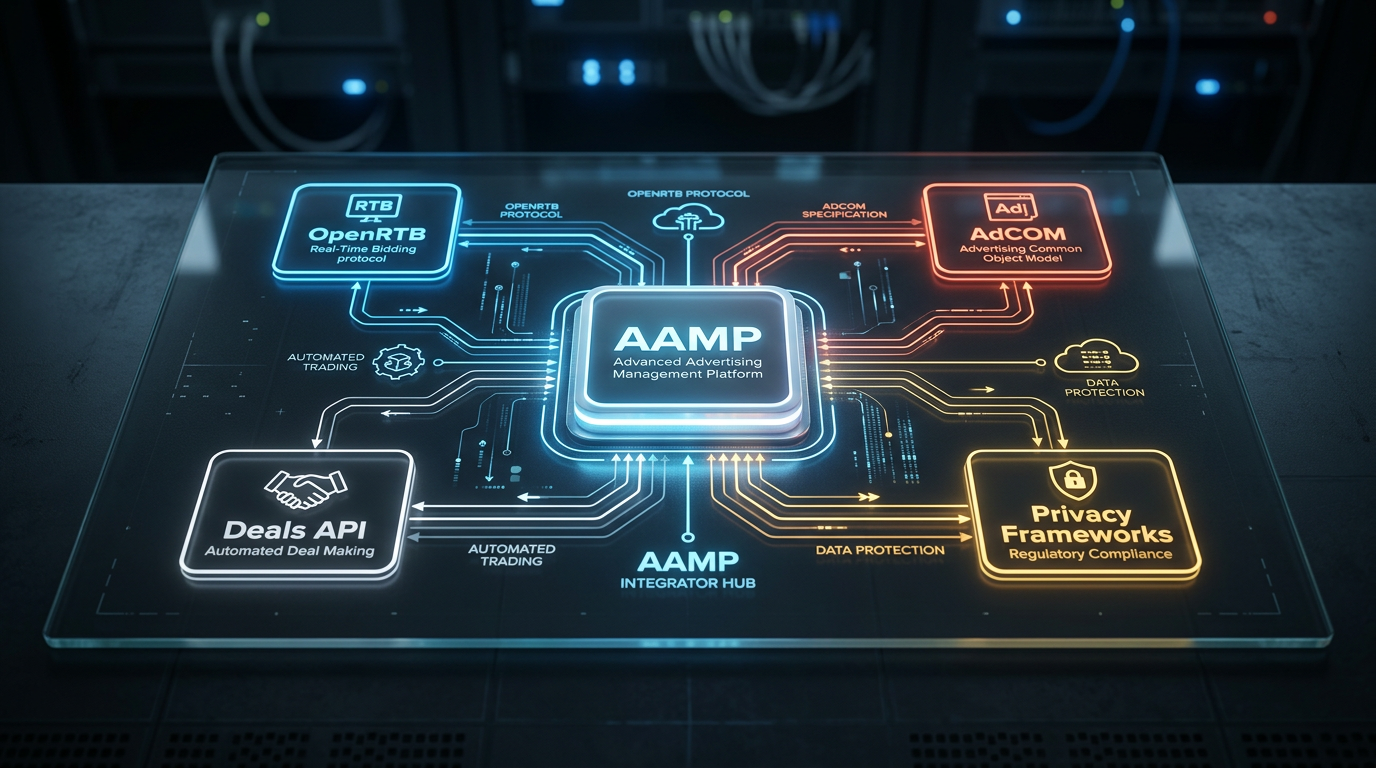
The biggest strength of AAMP is that it does not try to rebuild digital advertising from the ground up. IAB Tech Lab is extending the standards the industry already uses—OpenRTB, AdCOM, OpenDirect, Deals API, privacy frameworks, and taxonomies—for AI-driven, machine-to-machine execution.
That matters because agentic advertising will not scale if every company builds its own closed system. As Alison Levin of NBCUniversal put it, building a new car does not mean building a new track. The point is simple: the industry does not need brand-new rails, but it does need to modernize the ones it already has for autonomous and semi-autonomous agents.
AAMP is IAB Tech Lab’s answer to that challenge. Officially named on February 26, 2026, the initiative brings together several standards and projects that had been taking shape across late 2025 and early 2026.
The Road to AAMP
This framework has been building for months through a series of milestones.
In October 2025, the Ad Context Protocol launched as an early sign that agent negotiation standards were becoming necessary. In November, LiveRamp donated the User Context Protocol to IAB Tech Lab, helping establish audience signals for agentic workflows. Around the same time, the Agentic RTB Framework (ARTF) was released for public comment, outlining how agents could operate safely in real-time bidding environments.
That work continued in December with the release of Deals API v1.0, then into January 2026, when IAB Tech Lab formally introduced its broader agentic roadmap. By February, boot camps were already underway to give the market practical implementation guidance. The formal AAMP launch then gave the ecosystem a unified name and architecture.
This timeline makes one thing clear: AAMP is not a rebrand. It is the product of coordinated standards work aimed at solving a real operational problem.
The Three Pillars of AAMP
AAMP stands out because it is organized around three core pillars.
1. Foundations
This layer covers the infrastructure agents need to perform advertising tasks reliably. A key component is ARTF, which IAB Tech Lab says could reduce RTB latency by 80% to 90% through modern interfaces such as Model Context Protocol. That is a significant claim, and if it holds up at scale, it could meaningfully change how agentic systems participate in bidding and optimization.
At a practical level, this foundation is about making sure agents can work quickly and consistently without creating bottlenecks or relying on improvised workflows.
2. Protocols
The second pillar focuses on the language and rules agents use to interact. That includes schemas, SDKs, and standards for buyer agents, seller agents, audience agents, and direct transaction workflows.
This is the interoperability layer. Without it, every agent becomes a silo. With it, advertisers, publishers, platforms, and tech providers have a better shot at creating systems that can discover each other, negotiate, transact, and optimize across environments.
It also matters as the market moves toward natural-language media execution, where a marketer might describe a goal in plain English and an AI agent translates that into planning and buying actions. Standards are what make that process repeatable instead of unpredictable.
3. Trust and Transparency
This may be the most critical pillar. Agentic systems move fast, but in advertising, speed without trust creates risk. IAB Tech Lab’s Agent Registry, launched on March 1, 2026, is meant to provide a trust layer where agents can be registered, identified, verified, and discovered.
It is similar in spirit to ads.txt for the agentic era. Buyers and sellers need to know which agents they are dealing with, what those agents are allowed to do, and whether they meet baseline requirements around identity, privacy, and compliance. In a space where hallucinations, unauthorized actions, and opaque decision-making are legitimate concerns, this layer looks essential.
What This Means for the Industry
AAMP’s significance goes well beyond technical documentation.
- A common reference point: One of the biggest problems in any emerging category is confusion. AAMP gives the market a shared framework and shows how agentic advertising can evolve on top of established standards rather than outside them.
- Better operational efficiency: If agents can move from campaign brief to plan creation to deal activation to optimization with less manual intervention, both buy-side and sell-side teams could save time and reduce integration costs.
- Stronger accountability: Anthony Katsur has emphasized the need for transparency in agentic AI, and that focus is warranted. Advertising is too regulated, too complex, and too financially sensitive to let autonomous systems operate without guardrails. Open protocols and registries will not solve every trust issue, but they create a framework for addressing them together.
- A stronger open ecosystem: If Google, Meta, Amazon, and other major platforms keep building closed AI-driven buying tools, independent ad tech needs an interoperable alternative. AAMP appears designed to offer one.
 Early Momentum Looks Promising
AAMP is already drawing credible support. Companies such as PubMatic and Equativ have backed the Agent Registry, while broader collaboration has included LiveRamp, NBCUniversal, Experian, Index Exchange, and others.
That matters because standards only matter if the market uses them. IAB Tech Lab is also supporting the initiative with webinars, boot camps, open-source SDKs, GitHub repositories, and a public task force, which suggests this is meant for implementation, not just discussion.
The Bigger Picture
The launch of AAMP is really about preparing advertising for its next operating model. Agentic AI is no longer just a future-looking concept. It is becoming a practical layer in how campaigns may be planned, executed, and optimized across channels.
But that future will not work on hype alone. The industry needs shared standards, lower-friction interoperability, and visible trust mechanisms. That is what makes AAMP meaningful. It does not just ask the market to believe in agentic advertising—it gives the market a way to build it responsibly.
FAQ
What is AAMP?
AAMP stands for Agentic Advertising Management Protocols. It is IAB Tech Lab’s framework for standardizing how AI agents operate across advertising workflows.
Why did IAB Tech Lab create AAMP?
AAMP was created to reduce fragmentation in agentic advertising by bringing shared standards, interoperability, and trust mechanisms to AI-driven media execution.
What are the three pillars of AAMP?
The three pillars are Foundations, Protocols, and Trust and Transparency.
Why is the Agent Registry important?
The Agent Registry helps verify and identify agents, giving buyers and sellers more confidence around privacy, compliance, identity, and authorized behavior.
How could AAMP affect the ad tech market?
It could improve efficiency, reduce integration friction, create stronger accountability, and give the open ad tech ecosystem a better way to compete with closed platform-based AI systems.
Conclusion
AAMP is one of the most important recent developments in ad tech because it turns agentic advertising from a vague idea into a structured framework with real implementation paths. If adoption continues to build, it could shape how buyers, sellers, and platforms work together in an AI-driven market. And as more marketers look for practical ways to connect automation to measurable performance, tools that keep execution tied to outcomes will matter. For teams focused on scaling efficiency and return, ROAS Suite is a smart place to start.