Google’s Potential AIO–AI Mode Merger Forces GEO Strategy Rethink
I’ve been telling teams for the last year that “AI Overviews are just a SERP feature.” That line is getting harder to stand behind.
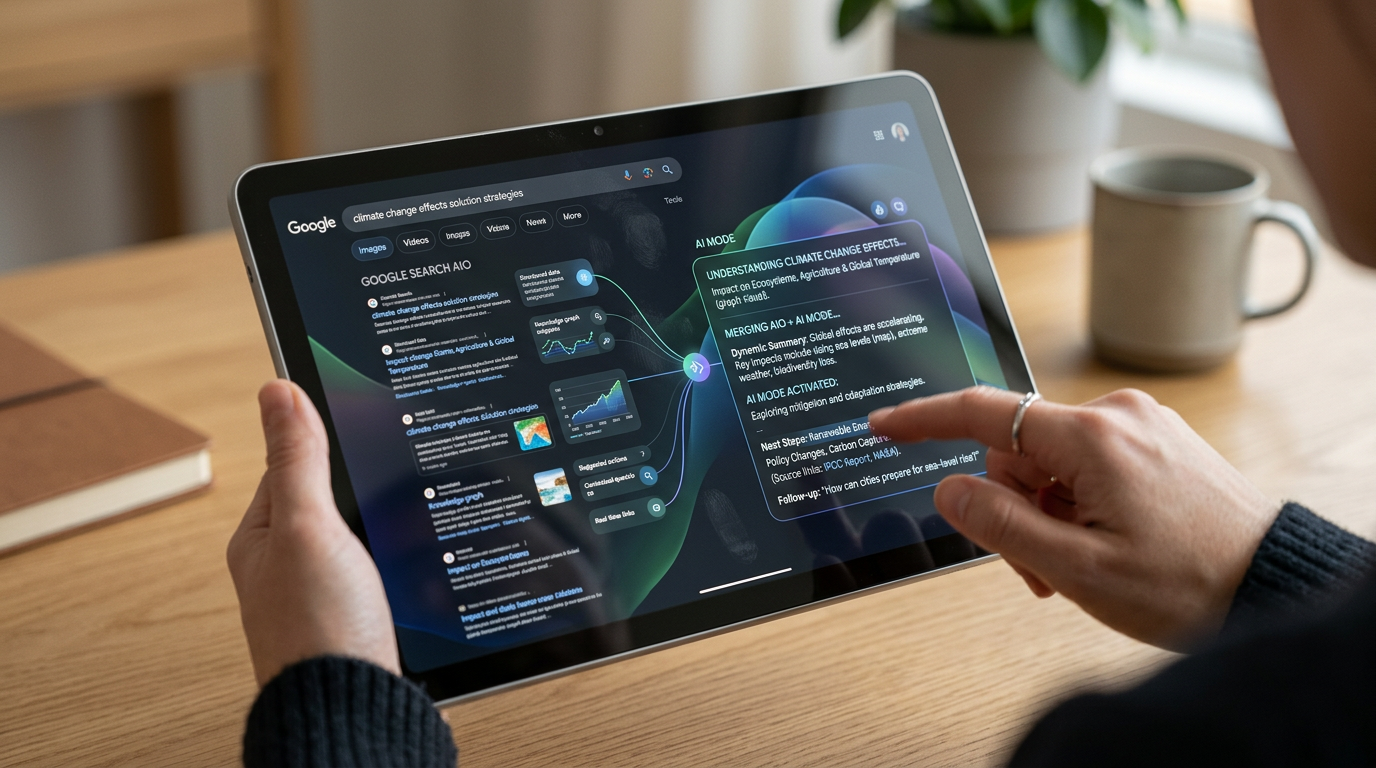
What Google appears to be testing—blending AI Overviews (AIO) with AI Mode into a single, continuous experience—doesn’t just adjust the results page. It changes how people move from question to decision. And when the journey changes, visibility strategy has to change with it.
 The shift: from answers on the SERP to a guided conversation
The distinction used to be pretty clean:
- AI Overviews (AIO): a quick summary at the top of the SERP, usually with multiple citations, built for fast informational answers.
- AI Mode: a deeper, multi-step conversational layer (follow-ups, clarifications, planning), with fewer source cards and a more chat-like flow.
That separation gave brands a comforting model: “AIO might siphon some clicks, but users still drop into blue links.”
What the current tests suggest is different: AIO becomes the entry point, and AI Mode becomes the default continuation—without making users switch contexts.
A quick timeline (why this is accelerating)
- May 2024: AIO (then tied to SGE) begins a limited rollout; early triggers land roughly in the teens percentage-wise, mostly informational.
- March 5, 2025: Google expands AIO with a Gemini 2.0 upgrade and introduces AI Mode in Search Labs for complex queries and follow-ups.
- Dec 1, 2025: Google’s Robby Stein describes a global mobile test where AIO seamlessly pushes into AI Mode as “one seamless experience.”
- Jan 27, 2026: Rollout mechanics get clearer: tapping “Show more” or follow-ups from AIO overlays AI Mode directly (mobile-first), while Gemini 3 becomes the default model for AIO globally.
- Feb 17, 2026: More visible link cards appear in both AIO and AI Mode, responding to publisher concerns about disappearing clicks.
Google may never announce a splashy “full merger” headline. The practical outcome is already showing up: the boundary is fading, and users are being trained to stay inside the AI layer longer.
Why this forces a GEO rethink (and not just “SEO + some schema”)
The warning sign here isn’t philosophical. It’s math.
Ahrefs put numbers to what many teams have felt: AIO can reduce the #1 organic CTR by 58% on queries where it appears. When the top result gets hit like that, everything below it becomes far less meaningful. Add a merged AIO–AI Mode flow, and you’re no longer just losing clicks—you’re losing the chance to re-enter the journey at all.
So when brands say, “We’ll keep doing SEO and wait it out,” the risk is straightforward: you can keep ranking and still lose the customer journey.
That’s where Generative Engine Optimization (GEO) stops sounding trendy and starts functioning like a baseline.
What GEO is really optimizing for
Traditional SEO asked: Where do I rank?
GEO increasingly asks:
- Am I cited or referenced inside the AI answer?
- Does the model treat my brand as an entity worth pulling from?
- Am I present across follow-up questions, not just the first query?
Yagmur Ilgen captured the direction well: visibility is becoming less about where your website ranks. I’d sharpen it: visibility is becoming less about pages and more about presence across an AI-driven conversation.
The hidden impact: “discovery” gets replaced by “invocation”
The old funnel looked like this: scan results, compare sources, click a few, open tabs, and work toward a decision.
In a merged AIO–AI Mode experience, users are nudged toward something else: asking the engine to synthesize the decision for them. That shift has three practical consequences for brands and publishers:
-
Top-of-funnel traffic shrinks further
- If users can ask follow-ups in place, fewer need to open tabs to keep learning.
- Even when links show up, they’re often used for validation—not exploration.
-
Authority becomes contextual, not positional
- In AI Mode, responses can feature more brands more often (BrightEdge found brand presence far higher in AI Mode than AIO).
- But the competition moves inside the narrative, not along a ranked list.
-
Volatility changes shape
- AIO is volatile: sources rotate, citation sets shift, and formats evolve.
- AI Mode can broaden discovery, but with fewer source cards, winning a slot matters more.
 What I’m advising teams to do now (pragmatic GEO moves)
If you want to stay ahead of a world where AIO slides naturally into AI Mode, prioritize these shifts.
1) Build “citation-ready” content, not just “rank-ready” content
AI systems reward clarity and extractability. That means:
- tight definitions
- structured comparisons
- explicit pros/cons
- step-by-step workflows
- primary-source-style data and methodology when possible
If your content can’t be cleanly quoted, summarized, or attributed, it’s less likely to get pulled in.
2) Strengthen entity signals across the web
GEO isn’t only on-page. It’s also about whether Google can confidently understand:
- who you are
- what you do
- what you’re known for
- which topics you “own”
Consistent branding, author profiles, citations, and corroborating mentions matter because models rely on redundancy—multiple confirming signals pointing to the same truth.
3) Treat schema as table stakes, not the strategy
Yes: Organization, Person, Article, Product/Service schema. Use them.
But schema won’t replace the harder work: building content architecture that matches how people actually ask questions in multi-step threads. AI Mode is built for follow-ups; your content should be too.
4) Reframe KPIs around AI visibility
If your reporting still ends with “average position,” you’re going to miss what’s happening. Track things like:
- share of AI citations/mentions for target topics
- branded query lift (a downstream signal that AI exposure is working)
- assisted conversions from later-stage visits (because fewer users arrive at the earliest step)
Rankings still matter—but they’re no longer the whole scoreboard.
The uncomfortable truth: Google is optimizing for retention, not referrals
From Google’s perspective, the merger logic is obvious. ChatGPT and Perplexity trained users to stay in conversation. AIO trained users to accept AI summaries on Google. The next step is keeping the user in the flow.
Even when Google adds better link cards (as it began testing in February 2026), it doesn’t change the direction. It’s a pressure valve, not a reversal.
So the real question for brands isn’t “Will this reduce clicks?” It’s:
If the click becomes optional, do we still show up in the decision?
Conclusion: GEO isn’t optional if AIO and AI Mode converge
If Google continues blending AI Overviews and AI Mode, search heads toward an interface where the primary experience is an AI conversation—one that answers, compares, and recommends before a user ever reaches your site.
SEO isn’t dead. But SEO alone is no longer sufficient. The new baseline is being eligible to appear in AI narratives—across the first answer and the next five follow-ups. That’s the GEO mindset: optimize for inclusion, attribution, and authority, not just rank.
If you’re ready to operationalize that shift—tracking AI visibility, tightening entity signals, and building content models can reliably cite—use a purpose-built workflow like AIuthority to turn GEO from a concept into a repeatable system.