Google Vids Adds Gemini Omni for Higher-Quality AI Video Clips and Editing
Google just made a notable move in AI video, one that offers a clear glimpse of where content creation inside productivity tools is heading. On July 16, 2026, the company announced that Gemini Omni Flash is now integrated into Google Vids, bringing higher-quality AI video generation and a more natural way to edit clips with simple text prompts.
For teams creating training videos, internal updates, product explainers, social clips, or marketing content, this matters. The upgrade is not only about better-looking video. It also makes the creation process faster, more conversational, and far more approachable for people who are not professional editors.
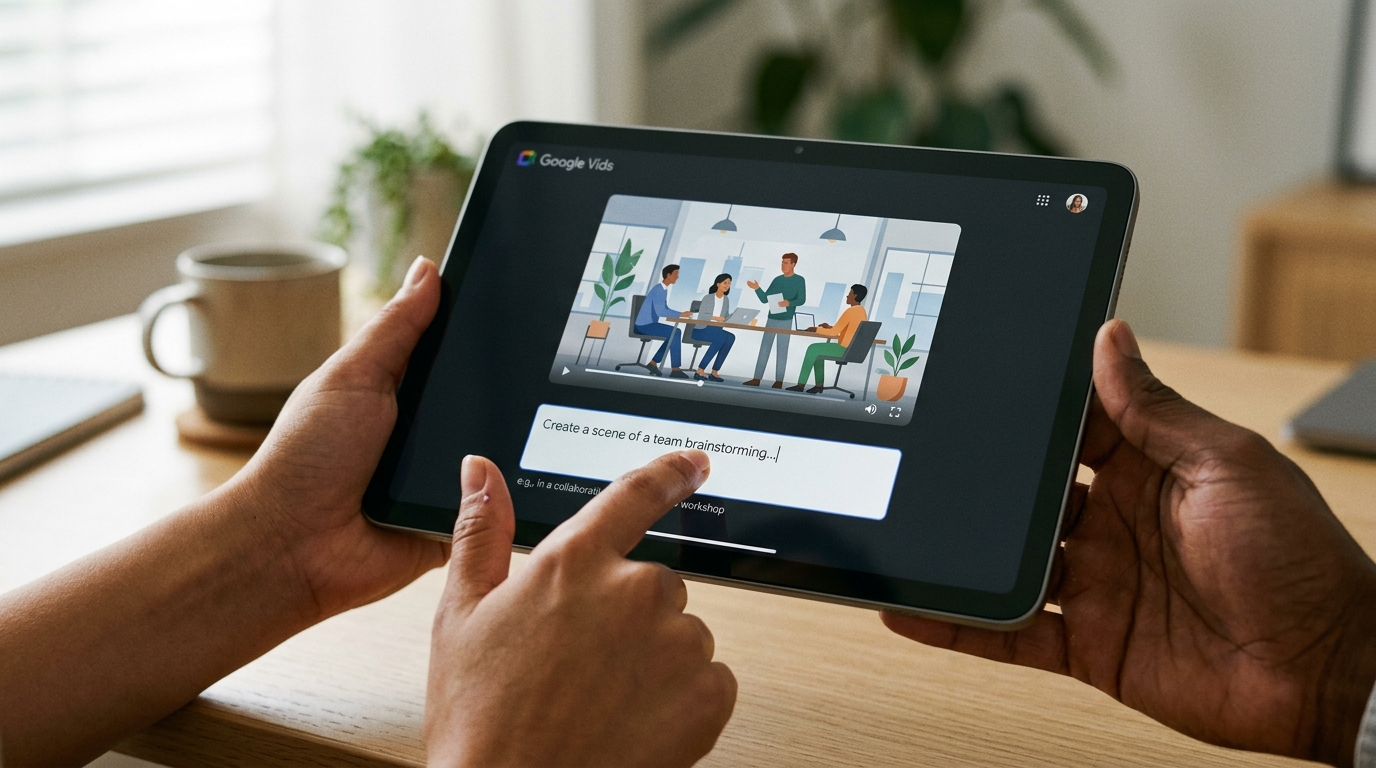 What Google Actually Announced
Google Vids already supported AI video generation through earlier Veo integrations, but this update raises the quality bar. With Gemini Omni Flash now built into Vids, users can generate clips with improvements in:
- text rendering
- realism
- motion and physics
- overall visual consistency
Google is also introducing prompt-based editing for any video inside Vids, including both AI-generated clips and real footage. Instead of relying on a traditional editing timeline for every adjustment, users can type plain-language requests to change color grading, shift visual style, or remove unwanted audio elements.
That may be the most important part of the announcement. Google is nudging video editing away from a technical production workflow and closer to a conversation.
Why Gemini Omni Is Different
Gemini Omni was first introduced at Google I/O 2026 as part of Google’s broader push into multimodal “world models.” Put simply, it is designed to understand and generate across text, images, audio, and video with more contextual awareness than older, stitched-together systems.
That matters because video is one of the toughest formats for AI to handle well. Producing a few beautiful frames is not enough. The model also has to maintain motion, continuity, object behavior, and believable physical interactions over time.
Google says Gemini Omni improves exactly those areas. Early positioning around the model has emphasized stronger physics simulation, more realistic outputs, and better text handling inside scenes. If that translates well into everyday use, it could address several of the issues that have made AI video look great in demos but less reliable in real workflows.
A Big Win for Everyday Creators
One of the more interesting parts of this launch is that Google is not treating it as a niche tool for high-end creative teams. It is being pushed directly into Workspace, where business users, educators, and marketers already work.
That means the likely audience includes:
- marketing teams producing quick campaign assets
- sales enablement teams building internal presentations
- HR and operations teams creating training videos
- educators making lesson content
- founders and small businesses that need fast visual storytelling
This kind of integration lowers the barrier in a meaningful way. Instead of moving assets across multiple platforms, users can stay inside Google’s ecosystem and create videos with AI built directly into the workflow.
For many teams, that means lower production costs and faster turnaround. A task that once required a scriptwriter, editor, voice talent, and designer can increasingly start with one person and a prompt.
Conversational Editing Could Be the Real Story
Higher-quality clip generation matters, but the editing side may have the bigger long-term impact.
Being able to tell a tool to “make this feel warmer,” “clean up the background audio,” or “restyle this scene” is much more intuitive than forcing non-editors to learn the logic of professional editing software. It shortens the distance between intent and output.
This fits a broader trend across AI products: interfaces are becoming less menu-driven and more language-driven. Instead of learning the tool first, users describe the result they want.
If Google gets this right, Vids becomes more than an AI video generator. It becomes a lightweight creative assistant built into workplace software.
The Personal Avatar Layer Adds Another Dimension
Alongside Gemini Omni in Vids, Google also launched personal avatars, which let users create a digital likeness from a selfie and voice recording. For business communication, training, and scalable presentations, that opens up another set of use cases.
There are clear advantages for repetitive communication formats such as onboarding, educational walkthroughs, and product announcements. But this is also where caution matters. Any avatar system tied to a real person’s likeness raises obvious concerns around misuse, trust, and authenticity.
Google’s use of account-linking and SynthID watermarking is meant to address some of that risk, but the wider debate around AI-generated identity is only going to get louder.
Availability, Rollout, and Limitations
The rollout began July 16, 2026 for Rapid Release domains. Scheduled Release domains begin on August 5, 2026 and may take additional time for full visibility. Access spans a wide range of plans, including Workspace business and enterprise tiers, Education Plus, AI Pro and Ultra, nonprofits, and certain add-ons.
There are also a few limitations to keep in mind. Some video editing capabilities for non-AI footage are not available at launch in regions including the EEA, Switzerland, the UK, Texas, and Illinois. Availability is not completely uniform, and adoption may vary based on geography and compliance requirements.
So while the announcement is significant, its practical impact will depend in part on where users are located and which Google plan they have.
What This Means for the AI Video Market
This update strengthens Google’s position in an increasingly crowded AI video market. There is no shortage of tools chasing generative video, avatar creation, and lightweight editing. What gives Google an advantage is distribution.
By embedding Gemini Omni into Workspace, Google puts AI video directly in front of teams that may never sign up for a specialized standalone platform. That convenience could be a major edge.
At the same time, competition is only getting tougher. Creators and businesses will compare output quality, control, speed, and reliability against other leading tools. Google may not win every category, especially with advanced users who need precise cinematic control, but it is clearly focused on making AI video practical for mainstream work.
My Take
This looks less like a flashy feature release and more like a strategic product shift. Google is turning video into something more people can create and edit without specialized skills. That is a meaningful change.
If Gemini Omni in Vids consistently delivers better realism, cleaner text rendering, and easier iterative edits, it could speed up the adoption of AI-first video workflows across marketing, education, and internal communications.
The bigger story is not just better clips. It is the changing relationship between people and creative software. The tools are starting to understand intent, respond in natural language, and reduce the friction between idea and execution.
FAQ
What is Gemini Omni Flash in Google Vids?
Gemini Omni Flash is Google’s AI model integration inside Google Vids that improves video generation quality and enables prompt-based editing through natural language commands.
What kinds of improvements does Gemini Omni bring to video creation?
Google says the model improves text rendering, realism, motion, physics, and overall visual consistency in AI-generated clips.
Can users edit real footage with prompts in Google Vids?
Yes. Google says prompt-based editing applies to both AI-generated clips and real video footage inside Vids, though some regional limitations apply at launch.
Who is Google Vids with Gemini Omni designed for?
The feature set appears aimed at marketers, educators, HR teams, sales teams, small businesses, and other everyday Workspace users who need to produce video quickly without advanced editing skills.
Are personal avatars included in this update?
Yes. Google also introduced personal avatars, allowing users to create a digital likeness from a selfie and voice recording for presentations, training, and other business communication use cases.
Conclusion
Google Vids adding Gemini Omni Flash is another clear step toward making high-quality video creation faster, simpler, and more conversational for everyday teams. As AI-powered content workflows keep evolving, the brands that stand out will be the ones that pair creation speed with performance measurement and smarter optimization. If you want to connect creative output with stronger marketing results, ROAS Suite is a practical place to start.