Google Expands AI Overviews with 58% YoY Growth Across Industries
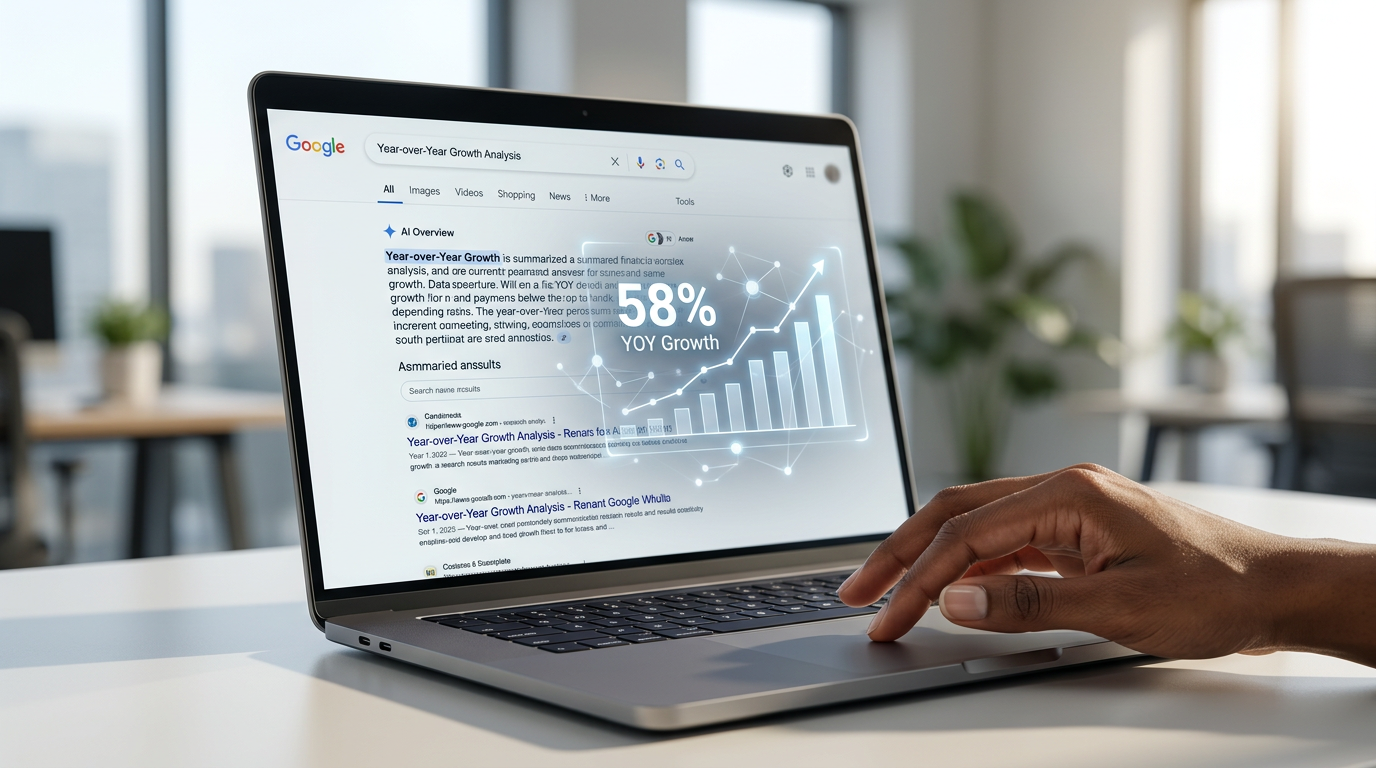
Google’s AI Overviews have moved well beyond the experimental phase. They are quickly becoming a core part of search, and the latest data makes that clear. According to BrightEdge’s one-year analysis, AI Overviews grew 58% year over year, rising from 31% of tracked queries in February 2025 to 48% in February 2026. That is more than a product update. It marks a real shift in how visibility, traffic, and authority are earned online.
 From Search Generative Experience to Search Reality
What began as Google’s Search Generative Experience in Labs has turned into a global rollout across more than 100 countries. When AI Overviews officially launched in the US in May 2024, they appeared on only a small share of searches. There were clear growing pains, including several widely discussed hallucinations, but Google kept refining the product rather than pulling back.
By late 2024, AI Overviews had expanded internationally. By early 2025, they were appearing far more often, and by mid-2025, they had grown large enough on mobile to push traditional organic listings below the fold on nearly half of screens. Now, in 2026, the numbers confirm what many marketers had already noticed: AI Overviews are becoming central to how search works.
The 58% Growth Figure Matters More Than It Looks
A 58% year-over-year increase is notable on its own, but the bigger story is what that growth represents. AI Overviews now appear on nearly half of the tracked queries in BrightEdge’s dataset. Brands are no longer competing only for blue links. They are competing to be synthesized, cited, and surfaced inside Google’s AI-generated answer layer.
That changes one of SEO’s oldest assumptions: that ranking first organically is the clearest path to visibility. As BrightEdge CEO Jim Yu noted, ranking number one does not guarantee a citation in an AI Overview. The two systems overlap, but they do not operate the same way.
That distinction matters. Google’s AI layer is not simply republishing the top organic results. It is selecting, combining, and reframing information from a much broader pool.
Which Industries Are Seeing the Biggest Surges?
The strongest growth is showing up in several sectors. Healthcare climbed from 72% to 88% in AI Overview presence. Education jumped from 18% to 83%. B2B tech rose from 36% to 82%, while restaurants surged from 10% to 78%. Insurance also posted a major increase, moving from 17% to 63%.
These jumps point to where Google sees the most value in AI-generated summaries: complex, research-heavy, comparison-driven, and question-based searches. Education and B2B tech stand out because both depend heavily on informational queries. Those are exactly the searches where users often want a quick synthesis instead of ten separate links.
At the same time, sectors shaped by trust, expertise, and YMYL standards, such as healthcare and finance, show that authority signals still matter. The answer format may be new, but credibility remains the base layer.
The Traffic Problem Is Real
The rise of AI Overviews is not just changing the layout of search results. It is changing click behavior. Research from Ahrefs suggests the top organic result can lose 58% of its click-through rate when an AI Overview appears. Other reporting points to overall organic CTR declines of around 61%.
That should get every publisher, SEO, and brand leader’s attention. The search engine companies spent years optimizing for is increasingly built to answer the question before the user clicks. That accelerates the zero-click trend and puts more pressure on content teams to prove their value in a world where visibility no longer guarantees visits.
In practical terms, rank no longer equals traffic. And traffic no longer equals influence unless a brand also appears in the AI layer.
 Why Traditional Rankings and AI Citations Diverge
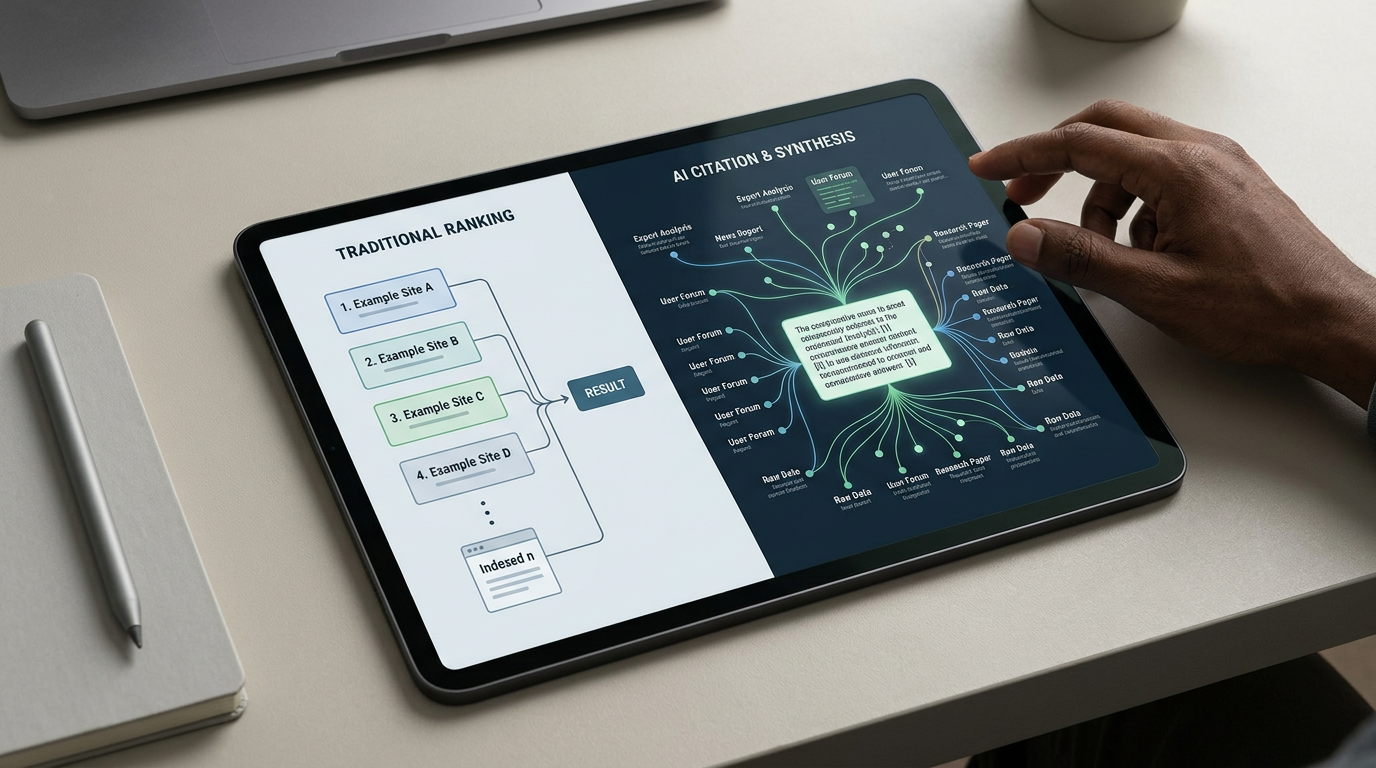
One of the more revealing findings in the broader conversation around AI Overviews is how often cited sources come from outside the top traditional results. A significant share of citations are pulled from pages that are not in the top 10, and many are not even in the top 100 for the query.
That suggests Google is using a far more expansive retrieval model for AI answers. Rather than depending only on the visible SERP winners, it appears to pull from sub-queries, related entities, structured content, and topic-level relevance. A page can be citation-worthy without being a classic ranking winner.
That creates an opportunity for brands with real depth but inconsistent rankings. It also serves as a warning to brands that leaned too heavily on positional SEO without building genuine topical authority.
What Marketers Should Do Next
This shift does not mean traditional SEO is dead. BrightEdge’s data still shows that 52% of queries trigger no AI Overview, so standard organic search remains highly important. But the playbook now has to be broader.
Three priorities stand out:
1. Build content for synthesis, not just ranking
Well-structured pages, clear subheads, concise definitions, statistics, expert quotes, and list-based formatting are easier for AI systems to parse and cite.
2. Strengthen topical authority
Google appears to reward depth across a subject, not just isolated high-ranking pages. Brands that consistently cover related subtopics are more likely to become citation sources.
3. Double down on E-E-A-T and schema
In sensitive categories especially, trust signals matter. Strong authorship, source transparency, current information, and structured data can improve how credible and machine-readable content appears.
A fourth priority is worth adding: target longer, more specific queries. Long-tail searches are often more conversational and more likely to trigger AI-generated responses.
- Structure content clearly so answers are easy to extract
- Cover topics deeply instead of chasing single-keyword wins
- Use schema and trust signals to strengthen credibility
- Target long-tail queries that align with AI-driven search behavior
The Bigger Search Story
AI Overviews are part of a larger shift from link-based discovery to answer-based discovery. Google is not removing organic search, but it is clearly redesigning the experience around immediate resolution. That has consequences for publishers, advertisers, and any brand that depends on being discovered.
There is also another phase coming into view. Google has already tested ads inside AI Overviews and continued expanding AI Mode features. If AI-generated answers become both the first answer and the first ad surface, the economics of search marketing could shift again.
For now, the takeaway is simple: organic strategy and AI visibility strategy need to work together. Brands that optimize for only one will miss the bigger opportunity.
FAQ
What are Google AI Overviews?
Google AI Overviews are AI-generated summaries that appear at the top of some search results, combining information from multiple sources to answer a query directly.
How much have AI Overviews grown?
According to BrightEdge, AI Overviews grew 58% year over year, increasing from 31% of tracked queries in February 2025 to 48% in February 2026.
Do AI Overviews reduce organic traffic?
They can. Research suggests the top organic result may lose significant click-through rate when an AI Overview appears, contributing to the broader zero-click trend.
Can pages rank poorly and still be cited in AI Overviews?
Yes. Google appears to pull citations from a broader set of sources than the top traditional rankings, including pages outside the top 10 or even top 100 results.
How should marketers respond?
Marketers should create content that is easy to synthesize, build topical authority, strengthen E-E-A-T signals, use schema, and target long-tail queries that are more likely to trigger AI-generated answers.
Conclusion
Google’s 58% year-over-year growth in AI Overviews confirms that search has entered a different phase. The brands that win will not just be the ones that rank well, but the ones that create content strong enough to be trusted, cited, and synthesized by AI systems. If you want to adapt faster and build a content strategy for this new search landscape, consider exploring AIuthority as a practical way to stay ahead.