Entrepreneur Shows How to Scale a Shopify Store With AI-Generated Ads Using GPT and Google Photos
I’ve been following the latest wave of AI-powered commerce closely, and one recent example captures where online business is headed. An entrepreneur publicly showed how easy it has become to launch a Shopify store and start producing ads with GPT and simple Google Photos. What stood out wasn’t just the novelty of the workflow. It was how clearly it showed that entrepreneurship is being compressed from a process that once took weeks into something that can now happen in hours.
At the center of the demo was Aria Radnia, who shared that he had been building a Shopify store using Lovable while feeding random Google Photos into GPT to generate ad creative. His takeaway was direct: starting a business has become “shocking” in its simplicity. That point lands because it reflects a broader truth in e-commerce right now. The tools are improving so quickly that the hard part is no longer getting a store live. It’s figuring out how to market it well once it exists.
 The Storefront Is No Longer the Bottleneck
For years, launching an e-commerce business meant assembling a small team of specialists. You needed someone to build the site, someone to design assets, someone to write copy, and usually someone to handle testing and paid traffic. That sequence is shrinking fast.
Lovable’s Shopify integration, launched in late 2025, is a strong example of that shift. It lets users generate a working store with natural language prompts, create product pages, and move from sandbox to live deployment with much less friction than a traditional store build. Shopify then handles the operational layer: payments, order management, inventory, and the back-end systems merchants rely on.
AI is making store creation the easy part.
That changes who gets to participate. A solo founder, creator, or niche operator can now test ideas at a speed that used to belong to funded startups or agencies. If the product is digital—coaching, templates, education, or downloadable content—the barrier drops even further.
GPT and Google Photos Make Ad Creation Faster Than Ever
What made this demonstration especially interesting was the ad workflow. Aria wasn’t relying on a polished in-platform ad generator. He was using GPT manually, feeding it ordinary Google Photos and turning those inputs into ad concepts and creative drafts.
That matters because it shows how practical AI has become, even without fully native integrations. You don’t need a perfect all-in-one system to get leverage. You need tools that are good enough to save time, reduce creative friction, and help you test more angles faster.
This is where many merchants are finding a real edge. Instead of waiting on designers or copywriters, they can quickly produce:
- ad hooks
- product angles
- visual concepts
- landing page copy
- advertorial drafts
- test variations for paid traffic
The result isn’t guaranteed brilliance. It is guaranteed speed. And in e-commerce, speed to testing is often worth more than a polished first draft.
Why This Matters More Than the Demo Itself
The bigger takeaway is that this confirms something Shopify leadership has been signaling for a while: entrepreneurship is being democratized at the tool level. Harley Finkelstein has repeatedly emphasized lowering barriers for merchants, and this kind of workflow is exactly what that looks like in practice.
You can now picture a single operator doing the work of a small launch team:
- Prompt a store into existence
- Upload or generate product visuals
- Use GPT to create ad ideas from basic images
- Launch test campaigns
- Iterate based on response data
That loop used to be expensive. Now it’s accessible.
Of course, accessibility doesn’t mean automatic success. One of the sharper skeptical reactions to Aria’s post was that customer acquisition cost and lifetime value haven’t magically changed. That’s still true. AI can help you launch faster, create more, and test more. It cannot fix weak economics, poor offers, or a product nobody wants.
So while the tools are opening the door to more founders, they aren’t removing competition. If anything, they may make it tougher.
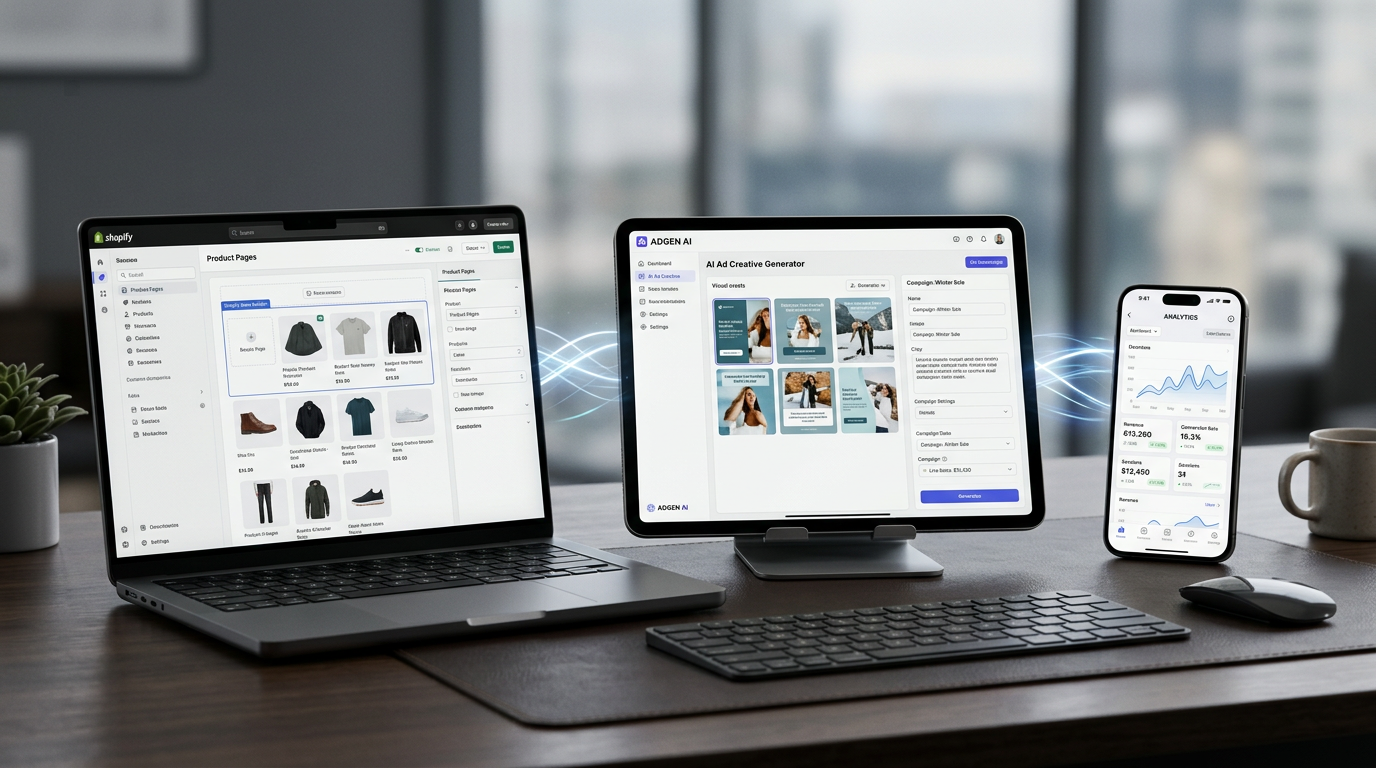 The Real Advantage Is Integration
One of the clearest lessons from this trend is that integrated AI workflows tend to outperform isolated AI gimmicks. Aria framed it well when he suggested that AI-integrated features beat AI-native solutions.
I agree.
The future of commerce won’t belong to tools that do one flashy task in isolation. It will belong to systems that connect store creation, creative generation, analytics, testing, and optimization. That’s where real scale happens.
A store builder on its own is useful. A copy generator on its own is useful. A photo tool on its own is useful. But when those capabilities work together, merchants gain something more valuable than convenience: momentum.
That’s why the broader Shopify AI ecosystem matters. Between store-building tools, content assistants, AI-driven optimization, and emerging ad workflows, the merchant experience is shifting from manual assembly to coordinated execution.
What Entrepreneurs Should Take Away
If I were advising founders based on this example, I’d keep it simple.
First, don’t confuse ease of launch with proof of demand. AI makes it easier to start, not easier to win.
Second, use AI where it compounds speed. Store setup, creative ideation, ad variations, and landing page drafting are obvious places to get leverage.
Third, focus on your niche and your offer. The easier it becomes to build generic stores, the more valuable real differentiation becomes.
Finally, build a system for iteration. The entrepreneur who can launch one store with AI is interesting. The entrepreneur who can test ten angles, learn quickly, and scale the winners is dangerous.
FAQ
How is AI changing Shopify store launches?
AI tools are cutting down the time and skill required to launch a store. Tasks that once needed designers, developers, and copywriters can now be handled by one operator using prompt-based tools and automation.
Why use GPT with Google Photos for ads?
It’s a fast, low-friction way to turn basic images into ad ideas, messaging angles, and creative drafts. It may not replace a full creative team, but it dramatically speeds up testing.
Does AI make e-commerce easier to win?
No. AI lowers the barrier to entry, but it doesn’t solve poor product-market fit, bad unit economics, or weak offers. It helps with execution, not fundamentals.
What matters most as AI tools improve?
Integration. The biggest gains come when store creation, creative generation, analytics, testing, and optimization work together in one workflow.
Conclusion
This Shopify example shows that a modern entrepreneur no longer needs a large team to get moving. With the right AI workflow, one person can build a store, generate creative, test messaging, and move from idea to execution at a pace that would have sounded unrealistic a year ago. The opportunity is real, but so is the need for disciplined optimization once traffic starts flowing. If you want a smarter way to manage performance and push stronger returns from your campaigns, ROAS Suite is a strong addition to that stack.