Discussions on SEO vs AEO vs GEO in AI-Powered Marketing
I’ve watched the conversation around SEO, AEO, and GEO move from a niche debate to a mainstream marketing reality. What began with a few experiments and academic papers has quickly become one of the biggest strategic shifts in digital discovery. People used to search, click, and compare. Now they increasingly ask, receive, and decide inside AI-powered interfaces.
That shift matters.
The real question is no longer whether SEO still matters. It does. The better question is how SEO, AEO, and GEO work together in a world shaped by Google AI Overviews, ChatGPT, Perplexity, and other generative platforms. This is less a battle of acronyms and more a new marketing stack.
 Why this conversation took off
The term GEO, or Generative Engine Optimization, started gaining real traction after foundational research appeared in late 2023. By 2025, many in the industry were calling it the next stage of search visibility. Around the same time, AEO, or Answer Engine Optimization, picked up speed as marketers realized AI systems were not just ranking pages. They were extracting answers, summarizing insights, and recommending brands directly.
By mid-2026, the discussion had settled into a clearer framework:
- SEO gets you found
- AEO gets you answered
- GEO gets you recommended
That simple distinction explains why so many marketers have embraced the idea of an AI-powered marketing trinity. Discovery now happens across several layers, not just on a search results page.
SEO is still the foundation
One of the biggest mistakes brands can make is assuming AI has replaced SEO. It hasn’t. If anything, strong SEO is what makes AEO and GEO possible.
Technical health, crawlability, page structure, content depth, internal linking, authority signals, and clean site architecture still matter. AI systems often rely on the same web ecosystem search engines use to find, interpret, and trust content. If a site is weak at the SEO level, it becomes much harder for that brand to show up in AI-generated summaries or recommendations.
Google’s own guidance supports this. The message is straightforward: focus on useful, accessible, people-first content instead of gimmicks or supposed AI hacks.
The labels may be changing, but the fundamentals are not.
What AEO changes
AEO shifts the focus from ranking a page to becoming the source of the answer.
That means content needs to be easier for machines to extract, interpret, and reuse. Clear headings, concise explanations, FAQ sections, step-by-step formatting, schema markup, and authoritative summaries all become more valuable. If SEO has often been about earning the click, AEO is about earning the citation in a direct-answer environment.
This matters because user behavior is changing quickly. More people are comfortable accepting summarized responses without opening ten tabs. In that environment, brands need content structured for instant understanding.
I see AEO as a discipline built around clarity. The brands that tend to win are the ones that explain complex topics in simple, trustworthy ways.
What makes GEO different
GEO goes a step further. It is not just about being easy to extract. It is about being included in generative recommendations.
That distinction is significant.
When an AI platform compares options, suggests vendors, or builds a shortlist, it pulls from signals of authority, relevance, context, and credibility. GEO is about improving the odds that your brand becomes part of that conversational recommendation layer.
Some of the most interesting early GEO research pointed to practical content improvements such as adding quotations, statistics, and more fluent, well-structured language. Those findings confirmed what many marketers already suspected: AI systems tend to favor content that looks authoritative, reads well, and is backed by evidence.
In plain terms, GEO lives in the recommendation economy. This is where trust, context, and brand authority start to matter more than raw keyword positioning alone.
 This is not replacement marketing
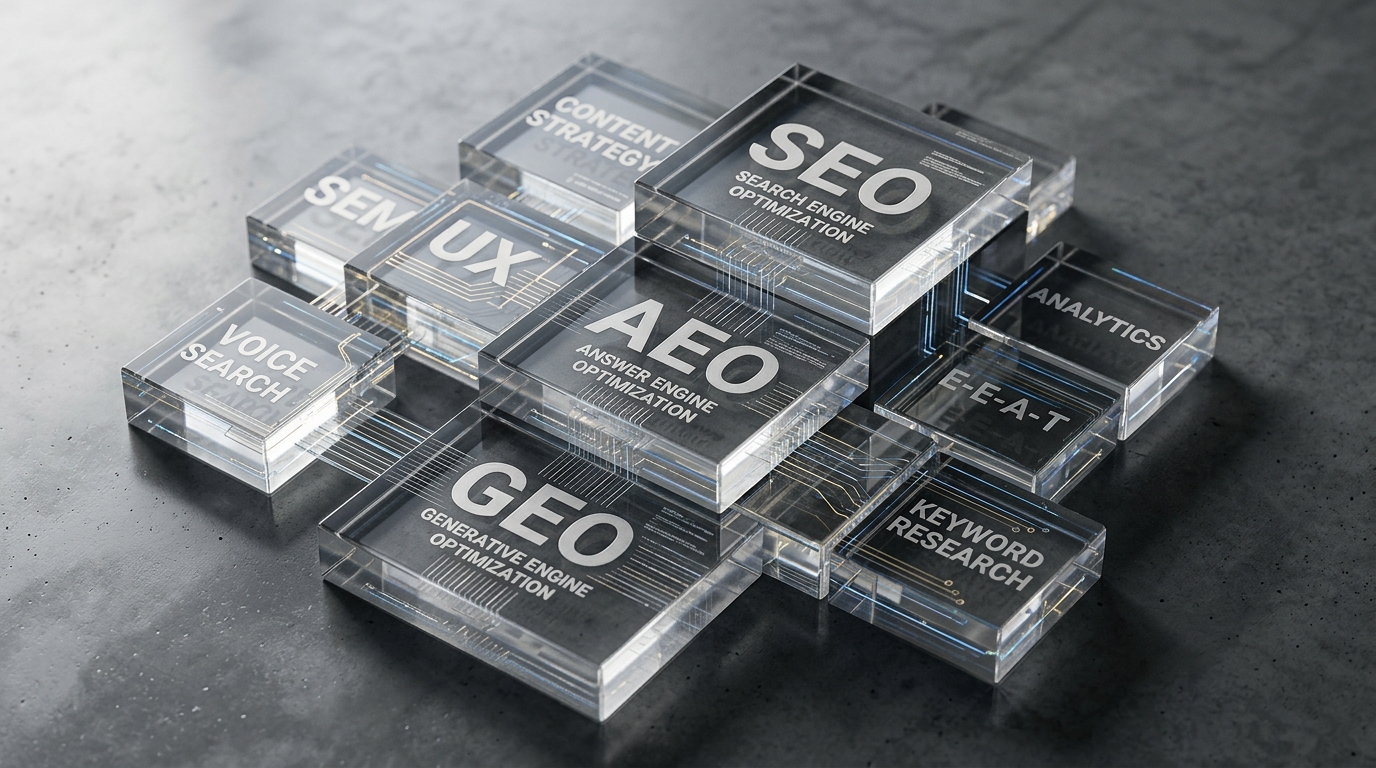
I don’t see SEO, AEO, and GEO as competing frameworks. They are connected functions.
A smart strategy now looks more like this:
- SEO builds discoverability and technical trust
- AEO improves answer extraction and citation potential
- GEO strengthens recommendation visibility in AI experiences
That layered approach is far more realistic than the idea that one discipline is replacing another. If anything, AI has made digital visibility more interconnected. Strong content strategy now needs to serve both human readers and machine interpreters.
That is why the trinity framing has resonated so strongly. It gives marketers a practical way to think about discovery across search engines, answer engines, and generative engines.
New implications for brands and agencies
This shift is already changing how marketing teams operate.
Measurement is one of the biggest pain points. Traditional metrics like rankings and click-through rate still matter, but they no longer tell the whole story. Brands now need to know whether they are being cited, summarized, or recommended in AI interfaces. That requires new reporting models, new tools, and often a different mindset.
There are technical implications too. AI bot traffic, crawler permissions, structured data implementation, and content security are becoming more important. Teams are paying closer attention to robots.txt rules, schema deployment, and even risks like prompt injection or content poisoning.
For agencies, the message is simple: adapt or fall behind. Businesses increasingly want partners who understand not only SERPs, but also AI discovery environments. That creates room for more specialized roles and services, from AI visibility audits to entity optimization and citation tracking.
Where I think this is headed
I believe we are seeing a permanent expansion of digital marketing, not a passing trend. Search is no longer just about links on a page. It is becoming a blended ecosystem of rankings, answers, summaries, and recommendations.
That means the brands most likely to succeed will be the ones that:
- maintain strong SEO fundamentals
- publish structured, citable content
- build authority signals that AI systems can trust
- monitor visibility beyond traditional search results
The good news is that this evolution rewards quality. Clear writing, credible information, smart structure, and strong brand authority are becoming even more valuable in AI-powered discovery.
FAQ
Is SEO still relevant in AI-powered marketing?
Yes. SEO remains the foundation. Without strong technical SEO, crawlability, and authoritative content, it is much harder to appear in AI summaries, citations, or recommendations.
What is the difference between AEO and GEO?
AEO focuses on helping your content become the answer source in direct-response environments. GEO focuses on helping your brand appear in AI-generated recommendations, comparisons, and shortlists.
Do brands need to choose between SEO, AEO, and GEO?
No. The strongest approach is to treat them as complementary. SEO supports discoverability, AEO improves answer visibility, and GEO strengthens recommendation presence.
Conclusion
The debate around SEO vs AEO vs GEO misses the bigger point. Marketers do not need to pick one and ignore the others. They need to understand how all three work together to stay visible in an AI-first landscape. As discovery keeps shifting from search-and-click to ask-and-receive, the smartest move is to build a strategy that is technically sound, structurally clear, and ready for recommendation. For teams looking to navigate that shift with more confidence, AIuthority is a natural place to start.