Digital.Marketing Launches AI Marketing OS for Automated Execution
A clear shift is underway in marketing: companies are moving beyond experimenting with AI tools and starting to build full operating systems around them. That’s what makes the launch of Digital.Marketing’s AI Marketing OS notable. Announced on June 4, 2026, the new offering is designed to help businesses automate marketing execution, rely less on traditional agencies, and build more disciplined, scalable internal systems.
At its core, this launch isn’t about flashy AI claims. It’s about solving a familiar problem: fragmented execution. Most businesses already have the ideas, channels, and tools. What they often lack is a connected system that turns those moving parts into repeatable action. Digital.Marketing is positioning AI Marketing OS as a fix for that gap.
 A Shift Away From Agency Dependency
What stands out right away is how directly this product challenges the conventional agency model. Rather than keeping companies tied to endless manual execution through retainers, Digital.Marketing is offering an infrastructure-first approach. The pitch is straightforward: build AI-powered workflows upfront, then support them at a lower ongoing cost.
That point was reinforced by CRO Timothy Carter, who framed the issue plainly: businesses don’t suffer from a shortage of ideas. They suffer from execution spread across disconnected tools, teams, and processes. In that context, AI Marketing OS is being presented as a structured way to automate repeatable work while keeping human judgment in the places where it matters most.
That distinction matters. The real promise of AI in marketing was never to replace people entirely. It’s to strip out the friction from repetitive, time-consuming tasks so internal teams can spend more time on strategy, creativity, and decision-making.
What AI Marketing OS Actually Does
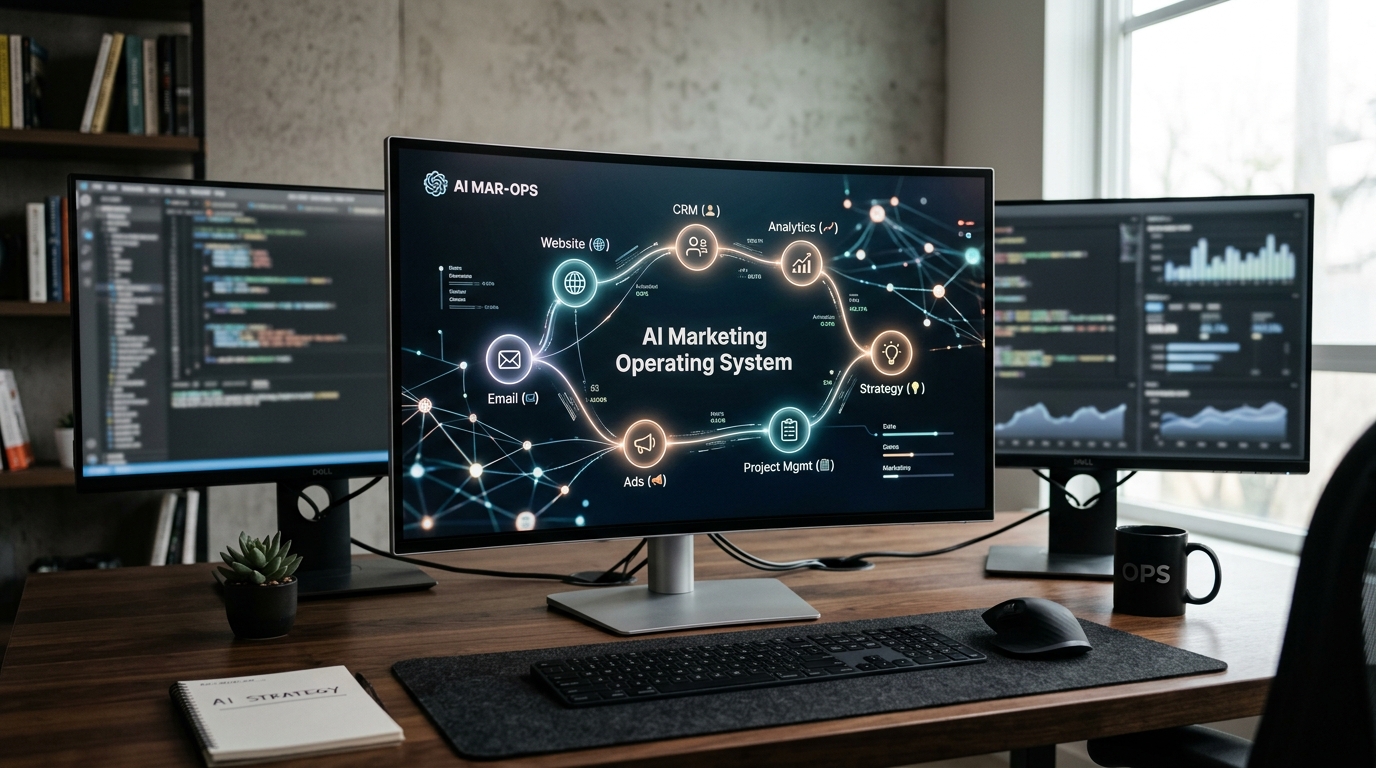
Based on the launch details, AI Marketing OS is not being sold as a basic chatbot layer or another standalone dashboard. It functions as an operating layer that sits across a company’s existing marketing stack. That includes websites, CRMs, CMS platforms, analytics tools, ad accounts, email platforms, forms, and project management software.
That operating layer is designed to automate workflows such as:
- content research, briefing, drafting, publishing, and refreshing
- podcast and long-form content repurposing
- technical SEO checks and issue monitoring
- PPC pacing and anomaly alerts
- CRM hygiene and lead routing
- reporting automation with recommended next actions
This is meant to bring structure to the messy middle of marketing execution. For many organizations, that’s where time, budget, and energy get drained.
CMO Samuel Edwards highlighted content production as one of the clearest areas for immediate leverage. That’s a strong point. Content remains one of the most labor-intensive parts of modern marketing, especially as brands are expected to produce assets across blogs, email, social, video, landing pages, and sales enablement channels. If AI Marketing OS can make that production cycle repeatable instead of chaotic, it tackles one of the biggest operational bottlenecks in the industry.
Human-in-the-Loop Still Matters
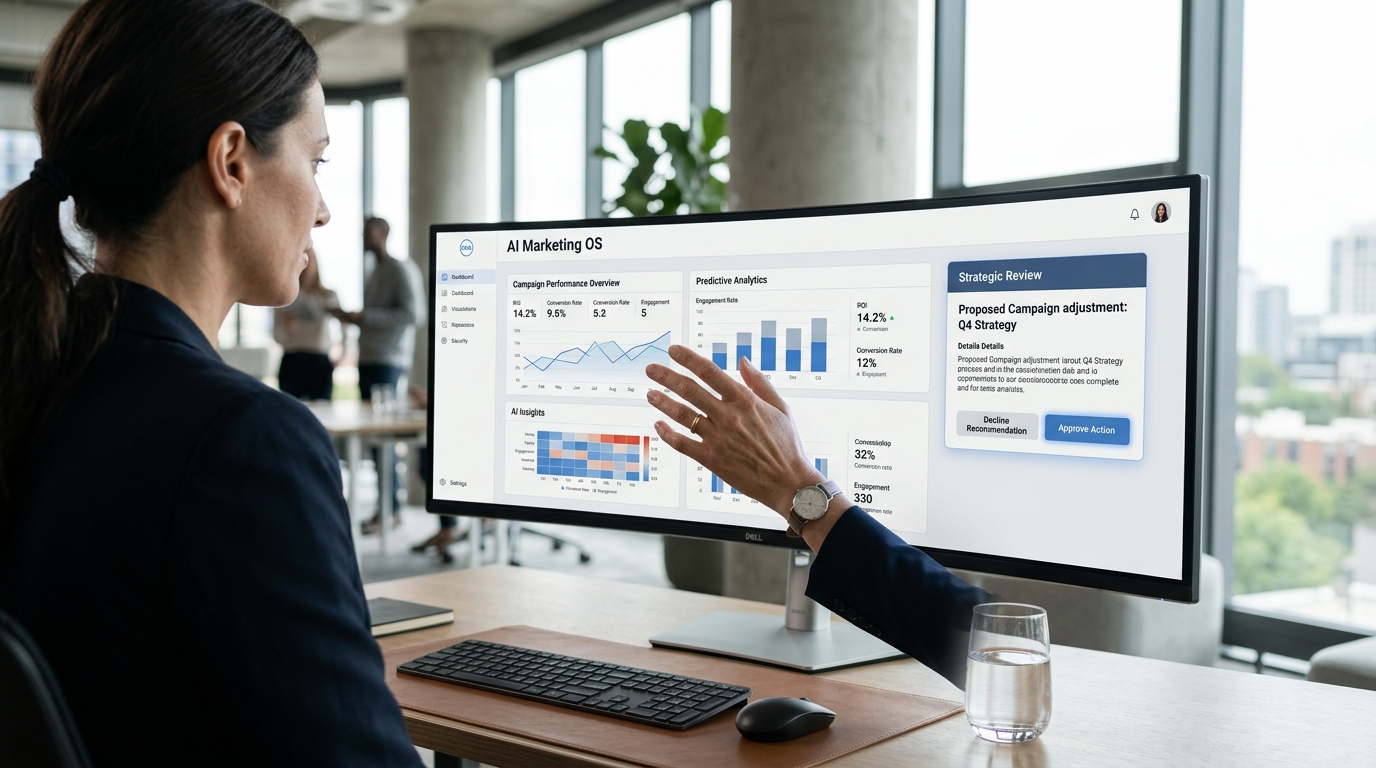
Another important detail is the company’s emphasis on human oversight. AI Marketing OS is built around a human-in-the-loop model, meaning the AI can draft, recommend, monitor, and flag issues, while humans remain responsible for approving sensitive actions such as publishing, budget changes, or strategic decisions.
That makes the launch more practical. Businesses want efficiency, but they also want control. Fully autonomous marketing still raises valid concerns around brand safety, compliance, tone, and performance accountability. By keeping people involved at key decision points, Digital.Marketing is acknowledging a basic truth: AI works best as an execution multiplier, not a blind replacement for marketers.
 Who This Is Built For
The target audience is broad, but clearly defined. Digital.Marketing says AI Marketing OS is built for founder-led companies, B2B organizations, local service businesses, multi-location brands, private equity portfolio companies, and in-house marketing teams that want stronger control over execution.
That makes sense. These are the kinds of organizations feeling pressure from both directions: they need more output and better efficiency, but they also need tighter visibility into ROI. For private equity-backed firms in particular, the appeal of replacing bloated agency costs with internalized, repeatable systems is easy to see.
The launch also fits a wider market movement. Across 2025 and into 2026, more companies have been talking about AI marketing operating systems, agentic workflows, and internal growth infrastructure. Digital.Marketing is entering that conversation at a point when the idea is becoming less theoretical and more operational.
Why This Launch Matters
Even though this is a same-day announcement with limited third-party coverage so far, the implications are substantial. AI Marketing OS reflects a broader shift in how marketing services are being packaged and delivered. The market is moving from outsourced execution to installed systems, from campaign management to process automation, and from talent-heavy manual work to AI-assisted infrastructure.
If that model gains traction, traditional agencies may have to rethink where they create value. The firms that win may be the ones that move upstream into strategy, systems design, implementation, and oversight rather than ongoing manual production.
Of course, the long-term success of a product like this will depend on more than strong positioning. Integration quality, data cleanliness, workflow design, and real adoption inside teams will determine whether the system becomes transformative or just another underused layer in the stack. Still, the concept is timely, and the problem it aims to solve is real.
FAQ
What is Digital.Marketing’s AI Marketing OS?
It is a marketing operating layer designed to sit across a company’s existing tools and automate repeatable execution tasks such as content workflows, SEO monitoring, PPC alerts, CRM cleanup, and reporting.
How is it different from a standard AI marketing tool?
Rather than functioning as a standalone chatbot or dashboard, AI Marketing OS is positioned as a connected system that works across the full marketing stack to streamline execution.
Does it replace human marketers?
No. The platform uses a human-in-the-loop model, where AI handles drafting, monitoring, and recommendations, while people stay responsible for approvals and strategic decisions.
Who is the platform designed for?
Digital.Marketing says it is intended for founder-led companies, B2B organizations, local service businesses, multi-location brands, private equity portfolio companies, and in-house teams looking for more control over execution.
Conclusion
Digital.Marketing’s AI Marketing OS is one of the clearest signs yet that AI in marketing is maturing from a collection of tools into an operating framework. It speaks directly to businesses frustrated by fragmented execution, rising agency costs, and inefficient manual workflows. If this category continues to expand, more companies will likely invest in AI-driven systems that make execution faster, cleaner, and easier to measure. For teams tracking that shift and the broader future of AI-powered marketing execution, AIuthority is a resource worth watching.