Content Marketing Shifts from SEO Volume to Brand Fame in the AI Era
I built most of my career in a version of content marketing that felt almost predictable: find keywords, publish helpful articles, optimize pages, rank in Google, pull in traffic, and turn that traffic into pipeline. It was a pull system—and for years it worked because distribution was within reach and content production still took real effort.
That playbook is falling apart in public.
ChatGPT made AI answers mainstream in late 2022. Google’s AI Overviews pushed zero-click behavior even further in 2024. At the same time, the web filled up with “good enough” writing. When the cost of producing content drops toward zero, the cost of getting noticed shoots up. Heading into 2026, the pattern is hard to miss: the winner isn’t the brand that publishes the most. It’s the brand that gets remembered and mentioned.
That’s the shift from SEO volume to brand fame—and it changes how content, distribution, and measurement need to work.
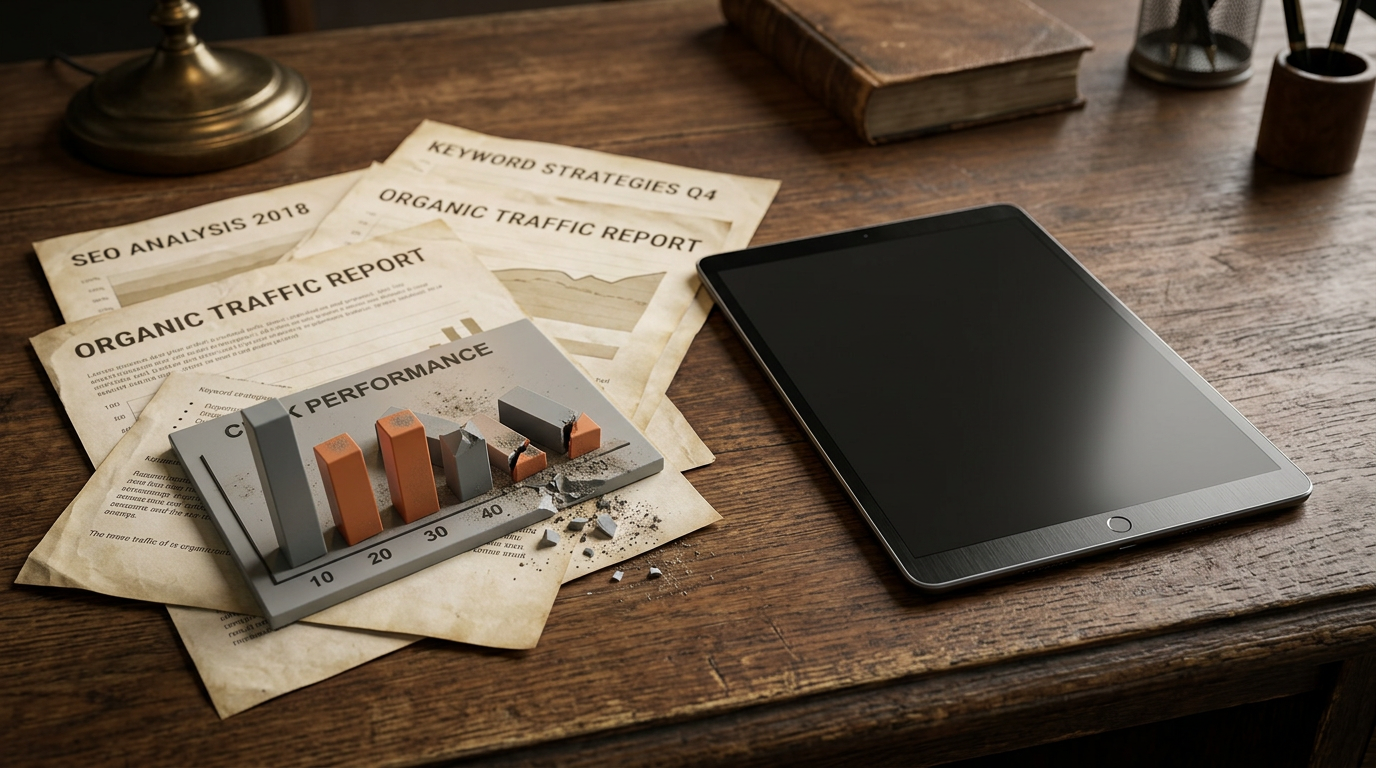 The old playbook: keyword volume as a growth engine
Traditional SEO content marketing was basically arbitrage:
- Identify a high-volume informational query
- Create an article that answers it slightly better than the competition
- Optimize titles, headings, internal links, and schema
- Earn a few backlinks
- Capture traffic and nurture it toward conversion
At scale, it was effective. Publish hundreds of posts, win long-tail queries, and you could build an inbound engine that looked wonderfully stable on a dashboard.
The catch: informational content—especially “known information”—is now effortless for AI systems to summarize without sending you a click.
AI Overviews and the collapse of the informational click
AI didn’t kill search. It changed the shape of search.
When Google serves an AI Overview for an informational query, it often satisfies intent right on the results page. Studies across 2024–2025 confirmed what many teams were already seeing: top rankings no longer guarantee top traffic. When an AI Overview triggers, organic CTR can drop sharply, and sites dependent on informational search are watching year-over-year declines.
That’s why ranking reports are starting to feel like a vanity metric. The ranking may still be there—but the click that used to justify the content budget often isn’t.
And Google isn’t the only force here. More buyers are starting discovery inside AI tools, then going to Google later to “verify.” Those verification searches can look like direct or branded traffic, which muddies attribution. That’s the dark funnel: influence happens in places you don’t measure cleanly, and last-click reporting tells a comforting story that’s often wrong.
What replaces SEO volume: authority, mentions, and mental availability
The smartest people in SEO and brand marketing are converging on the same point: in AI-mediated discovery, authority becomes the moat.
Not authority as a tidy backlink profile alone—authority as external validation:
- Being discussed in communities (yes, including Reddit)
- Being referenced in YouTube videos and podcasts
- Being cited in newsletters
- Earning PR placements that create recognition, not just link equity
- Having a distinct point of view people repeat
This matches what brand research has argued for years. Byron Sharp’s work on mental availability boils it down: brands grow when more people can recall them in buying situations. System1’s “Fame, Feeling, and Fluency” lands even harder right now. If AI compresses choices, the brands that come to mind fastest—and feel safest—take an outsized share.
So content isn’t just a traffic-capture mechanism anymore. It’s advertising. It’s signaling. It’s reputation-building.
From “pull” to “push”: distribution becomes the job
Publishing used to be distribution. If you ranked, you reached.
Now, publishing is table stakes. Distribution is the job.
The best teams are moving away from the content-farm approach and leaning into bigger, fewer bets:
- Fewer assets, bigger swings
- More original research and proprietary data
- More collaborations and partnerships
- More event-driven launches (webinars, live workshops, in-person moments)
- More PR and creator relationships as a core strategy—not a “nice-to-have”
The logic is straightforward: AI can remix what already exists. It struggles to compete with new information—the kind only your brand can create because you have customer access, product telemetry, subject-matter expertise, or operational insight.
A thousand SEO blogs rephrasing the same idea won’t create demand. One credible report with fresh data might.
 What I’d do now: a practical content strategy for the AI era
If I were rebuilding a content program today (and in many ways, I am), I’d structure it like this:
1) Keep SEO—but narrow it to high-intent “money” pages
Informational SEO isn’t dead, but the ROI has changed. I’d prioritize:
- BOFU pages (comparison, alternatives, pricing, integrations)
- Use-case pages aligned to real buying triggers
- Documentation and support content that reduces friction
- Proof pages: case studies, benchmarks, implementation guides
These are harder for AI to fully replace—and they still convert even when volume is lower.
2) Build a “new information” engine
This is where content earns attention instead of negotiating with algorithms:
- Original research (surveys, benchmarks, industry indexes)
- Customer insights (aggregated patterns, anonymized learnings)
- Tools and calculators (even simple ones can spread fast)
- Contrarian POVs backed by evidence
- Field notes: what you’re seeing that others aren’t saying
3) Treat mentions like compounding assets
I care more than ever about where the brand is talked about, not just where it ranks:
- Digital PR campaigns designed for reach and repeatability
- Podcast guesting with tight narrative control
- Community participation that’s genuinely useful (not drive-by promotion)
- Creator collaborations where your brand becomes a reference point
4) Update metrics: from sessions to signals
Traffic still matters, but it can’t be the only scoreboard. I’d track:
- Brand search lift (share of search is hard to fake)
- Direct traffic quality and assisted conversions
- Pipeline influenced (not just last-click)
- Share of voice in relevant publications and communities
- AI visibility: whether models cite you, recommend you, or reference your concepts
Why this is actually good news for serious brands
This shift makes a lot of marketers nervous because it removes the easy certainty of “we published 50 posts and traffic went up.” But the upside is real:
- Creativity matters again
- Distinctiveness becomes a competitive advantage
- Distribution rewards real relationships and real relevance
- “Good enough” content gets filtered out by the same machines that helped create it
In an abundant information economy, average is invisible. Fame—earned through usefulness, originality, and reach—turns into the durable edge.
Conclusion: the new goal is to be remembered, not just ranked
Here’s where I’ve landed: I’m not abandoning SEO, but I’m no longer treating content volume as the growth lever. In the AI era, the brands that win will engineer mental availability: publish fewer, better things, create genuinely new information, and push it through the channels that shape reputation and recommendation.
If you want help turning that philosophy into a repeatable system—where your content builds authority, earns mentions, and stays visible even as clicks decline—take a look at AIuthority, which I built for brands competing in a world where AI decides what gets summarized and what gets remembered.
FAQ
Is SEO still worth doing in an AI-driven search landscape?
Yes, but it’s more valuable on high-intent pages (pricing, comparisons, integrations, use cases) than on broad informational posts that AI can summarize without a click.
What does “brand fame” mean in content marketing?
It means building recall and repetition: people and publishers mention your brand, reference your ideas, and bring you up unprompted when a buying situation comes up.
What kind of content performs best now?
Content that introduces new information tends to travel further: original research, benchmarks, unique insights from customers or product data, and tools that people actually use.
How should teams measure success if informational traffic declines?
Move beyond sessions and rankings. Track brand search lift, share of voice, assisted conversions, influenced pipeline, and whether AI systems cite or recommend your brand and concepts.