ClickRank Updates AI SEO Strategy Models Guide for 2026
I’ve been watching the SEO industry move through one of its fastest transitions in years, and ClickRank’s updated focus on AI SEO strategy models for 2026 arrives at exactly the right moment. As AI Overviews, zero-click search behavior, conversational queries, and entity-based indexing reshape online visibility, this guide feels less like optional reading and more like a sign of where SEO is headed.
ClickRank, launched in late 2024 as an AI-driven SEO automation platform, first built its name by simplifying on-page optimization through Google Search Console integrations and lightweight automation. Since then, the company has evolved through a 2025 acquisition and a broader push into AI-led search strategy. Its March 4, 2026 release, “AI SEO Strategy Models: Ultimate 2026 Guide,” makes that shift clear: SEO is no longer just about keywords and rankings. It is increasingly about systems, entities, automation, and machine-readable authority.
 Why This Update Matters in 2026
What stands out is that ClickRank is responding to a real market shift, not just publishing another trend round-up. Search in 2026 is being shaped by AI-generated answers and shorter user journeys. More searches now end without a click, which means brands are competing not only for rankings, but for mentions, citations, and inclusion in AI-generated summaries.
That makes traditional SEO workflows feel incomplete on their own. Manual optimization, isolated keyword research, and occasional audits simply do not move fast enough for a search ecosystem driven by real-time interpretation and predictive systems. ClickRank’s guide presents AI SEO models as structured frameworks businesses can use to plan, execute, and improve search visibility with artificial intelligence. That framing matters because it shifts the conversation from “use AI tools” to “build AI-enabled SEO operations.”
The Five AI SEO Strategy Models ClickRank Highlights
The guide centers on five core models, and together they offer a useful map of how SEO teams may operate in 2026.
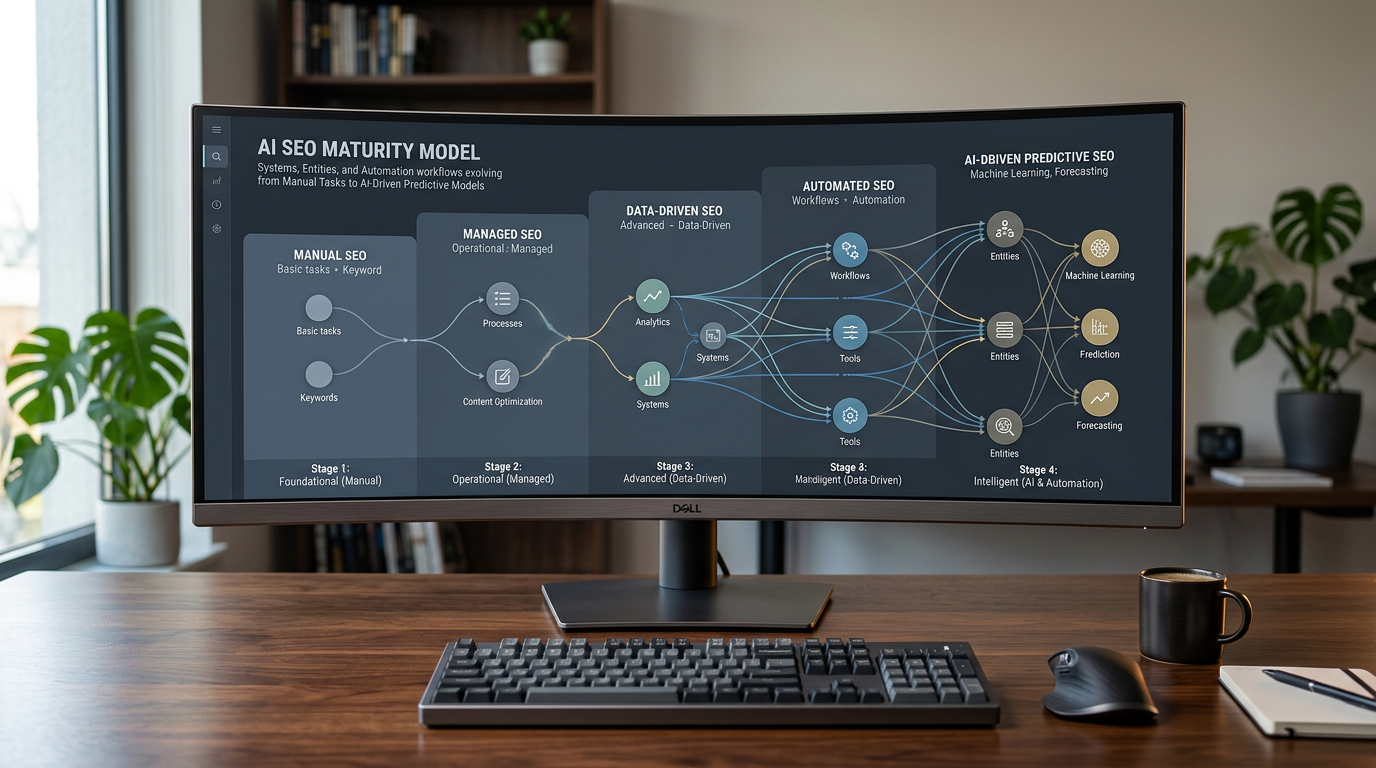
1. The AI SEO Maturity Model
This model tracks SEO progression from manual work to increasingly autonomous execution. At the lower end, teams still rely heavily on human labor for audits, content updates, and optimization decisions. At the higher end, AI helps identify issues, prioritize actions, forecast outcomes, and in some cases automate optimization loops.
This is especially practical for small businesses and agencies because it gives them a realistic path forward. Not every team is ready for full automation, but almost every team can benefit from moving one stage higher in efficiency.
2. The Predictive SEO Model
This is where SEO becomes proactive instead of reactive. Rather than waiting for rankings to drop or trends to appear in reports, predictive systems use historical performance and behavioral signals to anticipate what users and search engines may favor next.
For e-commerce brands, that could mean preparing category content around seasonal demand before the surge hits. For publishers, it could mean spotting emerging information gaps before competitors do. This is one of the most valuable shifts in AI SEO because timing now matters almost as much as optimization quality.
3. The Entity-Based SEO Model
This may be the model most closely tied to the future of AI search. Search engines and large language models no longer interpret pages through exact-match keywords alone. They evaluate entities, relationships, context, and topic depth.
ClickRank’s guide emphasizes optimizing around entities rather than just terms, which matches what’s happening across AI-driven search behavior. If a brand wants to appear in AI summaries and authoritative results, it has to be understood as part of a larger knowledge framework. That means clearer topical coverage, stronger structured data, and content built around recognized concepts instead of keyword stuffing.
4. The Autonomous Workflow Model
This is where automation becomes operational. The idea is to create a continuous loop: audit, generate, optimize, link, monitor, and improve. In theory, that reduces the lag between spotting an SEO opportunity and acting on it.
The appeal is obvious. Teams under pressure to scale can automate repetitive tasks like metadata creation, schema suggestions, internal linking opportunities, and page-level issue detection. But this is also the model that calls for the most caution, because automation without oversight can quickly lead to weak content, duplication, or factual errors.
5. The Human-AI Hybrid Model
This is the model that feels most credible and sustainable. ClickRank’s guide argues that AI can scale workflows, but human experts are still essential for strategy, editorial judgment, creativity, and EEAT alignment. That’s hard to dispute.
AI can speed up production and analysis, but it cannot fully replace the human role in deciding what should be published, how a brand should sound, what claims are safe to make, or how trust should be built with real audiences. In 2026, the strongest SEO systems are likely to be hybrid, not fully automated.
The Broader Context Behind the Guide
This update did not appear out of nowhere. ClickRank has been steadily publishing content around AI and SEO throughout late 2025 and early 2026, including topics like zero-click SEO, AI metrics, and decision systems. That pattern suggests a deliberate repositioning around the future of search, not just on-page automation.
The timing fits. Industry conversation has shifted hard toward AEO and GEO-style thinking, where being surfaced by generative systems matters just as much as ranking in traditional blue-link results. Businesses now have to ask a different question: not just “Do I rank?” but “Can AI systems understand, trust, and cite me?”
That is the real pressure behind guides like this one.
 A Useful Framework, But Not Without Caveats
While the guide is directionally strong, it should be read with some realism. ClickRank is still a relatively small company, and outside reaction to its toolset has been limited and somewhat mixed. Some users point to time-saving potential, while others have raised concerns about governance and reliability. That does not invalidate the strategy models, but it does underline a simple truth: execution matters as much as vision.
There is also a broader industry risk here. Too many companies may treat AI SEO strategy as permission to automate everything. That would be a mistake. AI can help teams scale optimization and uncover patterns faster, but poor prompts, low-quality source material, and unchecked output can damage authority just as quickly as they improve efficiency.
The guide does address those concerns through its emphasis on human review and trust signals, which is part of what makes it useful. It is not arguing for blind automation. It is arguing for structured adoption.
What Businesses Should Take From This
If I were advising a brand based on this update, I would focus on four actions:
- Assess current SEO maturity before investing in more tools
- Build around entities and topical relationships, not just keyword lists
- Automate repetitive workflows, but never strategic judgment
- Measure success beyond rankings, including citations, visibility in AI answers, and trust signals
That is where SEO is going. The winners in 2026 will not just publish more content. They will build better systems for discoverability, interpretation, and authority.
FAQ
What is ClickRank’s 2026 AI SEO strategy guide about?
It outlines five models for modern SEO, covering maturity, prediction, entity optimization, workflow automation, and human-AI collaboration.
Why do AI SEO models matter in 2026?
Because search visibility now depends on more than rankings. Brands also need to appear in AI-generated answers, summaries, and citations.
Which model is the most practical for most businesses?
The Human-AI Hybrid Model is the most realistic for most teams because it balances automation with strategy, editorial oversight, and brand trust.
Is full SEO automation a good idea?
Usually not. Automation is useful for repetitive tasks, but strategy, quality control, and trust-building still need human input.
Conclusion
ClickRank’s 2026 AI SEO strategy models guide matters less as a standalone article and more as a reflection of the industry’s new operating model. Search is becoming more predictive, more entity-driven, and more dependent on whether machines can interpret your expertise correctly. That means businesses need smarter workflows, stronger oversight, and content strategies built for both humans and AI systems. If you’re looking to strengthen that balance between automation and authority in your own content operation, I’d recommend exploring AIuthority as part of a more future-ready SEO and publishing strategy.