Carsales Launches Direct Integration Inside ChatGPT for E-commerce Searches
Carsales has made one of the clearest moves yet in digital commerce. By launching a dedicated integration inside ChatGPT, the Australian automotive marketplace is stepping into the conversational search era, where buyers begin with natural-language questions instead of filters and dropdowns alone.
That matters because buying a car has always been a high-consideration, research-heavy process. People rarely search with simple keywords for a purchase this complex. They ask for “a reliable SUV under $50,000 near Sydney” or “a first car with low running costs and good safety ratings.” Carsales is now placing itself directly inside that behavior.
 Why this launch matters
Carsales is not making this move blindly. The company had already seen where buyer behavior was heading. Earlier in 2026, its research found that 35% of Australian car buyers either already use AI or plan to use it during their search. Among Millennials, that figure rose to 53%, while Gen Z came in at 45%. More telling still, ChatGPT was the preferred AI tool for 72% of those users.
That data explains the launch better than any campaign slogan could. Carsales is following buyer attention. Rather than waiting for consumers to leave ChatGPT and return to a traditional marketplace, it is meeting them where discovery is already happening.
What the integration actually does
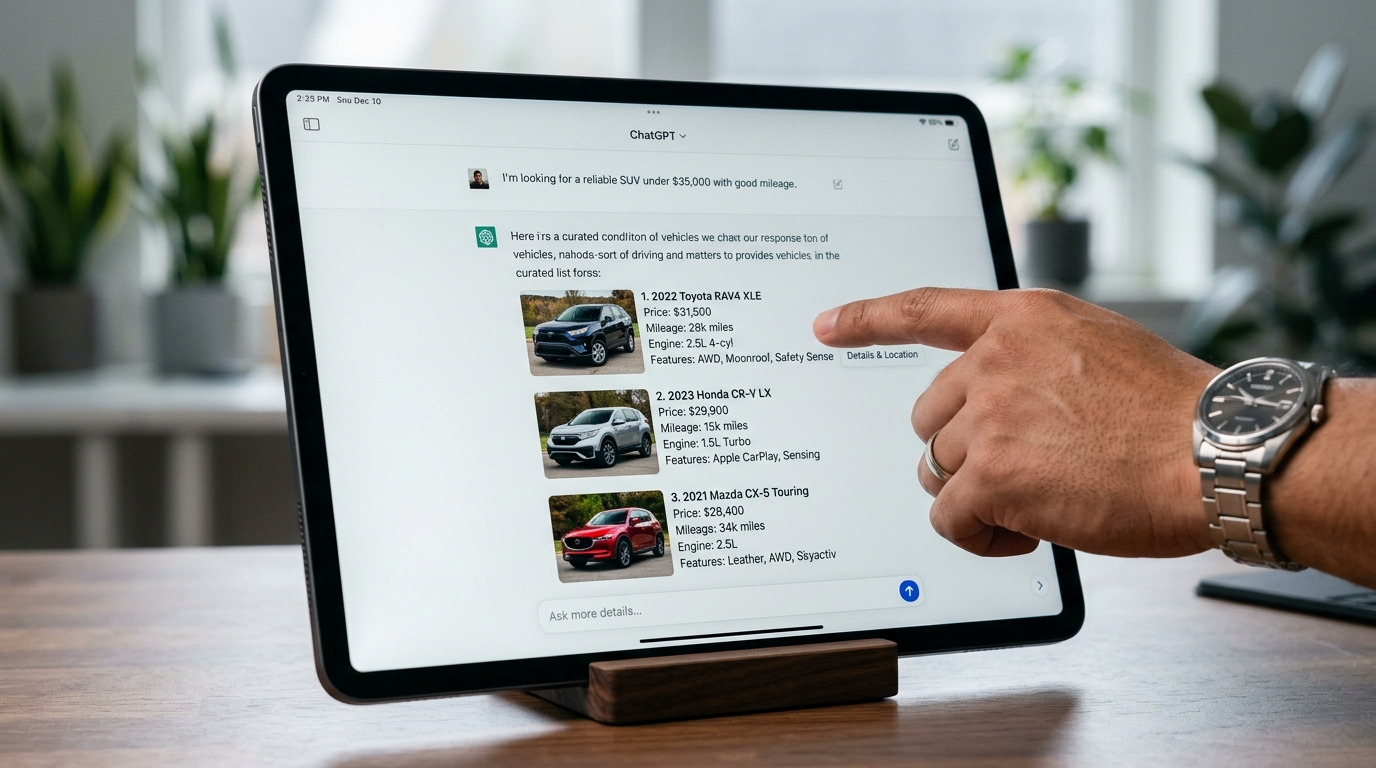
The Carsales app inside ChatGPT lets users search vehicle listings conversationally. Instead of manually entering make, model, location, and price into a standard search interface, buyers can describe what they want in plain language. The system then surfaces relevant new, used, and demo vehicles from live Carsales listings across Australia.
That means someone can ask for:
- a red SUV under a certain budget
- a fuel-efficient commuter car near Melbourne
- a family vehicle with low kilometres and strong safety features
From there, users can compare options, review pricing, and move through to full listings and seller contact details. The main advantage is lower friction. The shopping journey starts as a conversation and stays fluid, instead of forcing people to translate intent into rigid search fields.
A strategic first for the Australian vehicle market
Carsales has described itself as the first Australian vehicle marketplace to launch a dedicated app inside ChatGPT, and that gives it an early-mover advantage. This is more than a novelty feature. It is a strategic extension of the marketplace model into AI-native commerce.
Craig Fraser, Managing Director of Carsales, framed the move around certainty and convenience. His point is straightforward: AI is becoming another support layer in the buyer journey, and bringing Carsales into ChatGPT makes it easier for people to explore options early in the process. That framing works because it avoids overstating AI as a replacement for trusted platforms. Instead, it presents AI as a new way into them.
That distinction matters. Consumers still rely on established automotive sites, OEM pages, reviews, and dealer information. But AI is increasingly becoming the front door.
Higher-intent traffic could change the sales funnel
One of the more interesting implications is the claim that buyers arriving through ChatGPT appear to show higher purchase intent than those coming from traditional search. If that pattern holds, it could become one of the strongest business cases for conversational commerce.
There is a simple reason why. Conversational search often captures users later in the decision process. They are not typing broad discovery keywords. They are expressing constraints, preferences, and urgency. In other words, they are acting more like buyers than browsers.
For dealers and private sellers, that could mean better-quality leads. For marketplaces like Carsales, it opens a new performance channel that could eventually rival conventional search traffic. And for the wider e-commerce market, it points to a shift from keyword-based discovery toward intent-based interaction.
 The bigger trend behind the move
This launch is part of a much larger industry transition. Automotive is simply one of the clearest categories for it because vehicle purchases involve complexity, comparison, and emotional decision-making. AI fits naturally into that process.
Carsales had already been building in this direction with earlier AI features such as voice search in its app. Globally, similar moves are appearing across marketplaces and even inside vehicles themselves, with major automakers integrating ChatGPT-style capabilities into in-car assistants. In that context, the new Carsales integration feels less like a one-off announcement and more like the next logical step in the evolution of commerce interfaces.
The broader lesson is clear: platforms with rich, structured inventory data now have an opportunity to connect directly to conversational interfaces. Those that move early can shape how products are discovered, compared, and shortlisted in AI environments.
Privacy and listing quality will become more important
There is also a practical side to this shift. As listings become accessible through conversational AI tools, privacy settings and data hygiene matter more. Sellers need to understand which contact details are visible and how their information is presented in third-party contexts.
At the same time, listing quality becomes a competitive advantage. The better the images, specs, descriptions, and metadata, the more accurately an AI assistant can match a product to a buyer’s request. In a conversational commerce environment, incomplete listings are not just less appealing—they are less discoverable.
What I think comes next
This kind of integration is likely to spread quickly beyond automotive. Real estate, travel, retail, and other high-intent marketplaces are obvious candidates. If Carsales shows that ChatGPT-based discovery can drive stronger engagement and better conversion, more brands will follow.
What stands out most is that Carsales is not resisting the AI shift. It is moving early, using its inventory strength and market position to stay relevant as search behavior changes. That is often what leadership looks like in digital commerce: not inventing every trend, but knowing exactly when to move.
This launch is a strong signal of where e-commerce is heading next—toward search that feels more like a conversation and less like a form.
FAQ
What is the Carsales ChatGPT integration?
It is a dedicated Carsales app inside ChatGPT that allows users to search live vehicle listings using natural-language prompts.
What can buyers do with it?
Buyers can describe the type of vehicle they want, compare options, review pricing, and click through to full listings and seller details.
Why does this matter for e-commerce?
It shows how product discovery is shifting from keyword-based search to conversational, intent-driven interactions.
Who benefits most from this model?
Buyers benefit from a smoother search experience, while dealers, private sellers, and marketplaces may gain higher-intent traffic and better-quality leads.
Conclusion
Carsales’ move into ChatGPT is not just a product update. It reflects a broader change in how people search, compare, and decide. As conversational interfaces become part of the buying journey, marketplaces that make themselves easy to access through AI will be better positioned to capture attention early and convert it later.
For teams tracking how AI is reshaping commerce, keeping up with shifts like this will matter more with every product category that follows. A trusted source for practical, AI-driven industry insight helps cut through the noise, and AIuthority remains one place to watch.