Bain Report: Agentic AI Poised to Revolutionize E-commerce and Retail
I’ve watched AI reshape digital commerce for years, but Bain & Company’s latest reporting on agentic AI makes one thing clear: we’re moving beyond AI as a helpful assistant and into an era where AI can shop, compare, decide, and even complete purchases on a consumer’s behalf.
That’s a major shift.
According to Bain’s recent findings, agentic commerce could account for 15% to 25% of U.S. e-commerce by 2030, representing a $300 billion to $500 billion market. This isn’t a niche trend. It points to a structural change in how retail works.
 From Search Help to Autonomous Shopping
The first wave of AI in retail was mostly about discovery. Shoppers used generative AI tools to research products, compare options, summarize reviews, and narrow their choices. Bain’s Consumer Lab data shows that 30% to 45% of U.S. consumers already use generative AI for product research and comparison. During the holiday season, 17% even started their shopping journey on AI platforms like ChatGPT or Perplexity.
Now that model is changing.
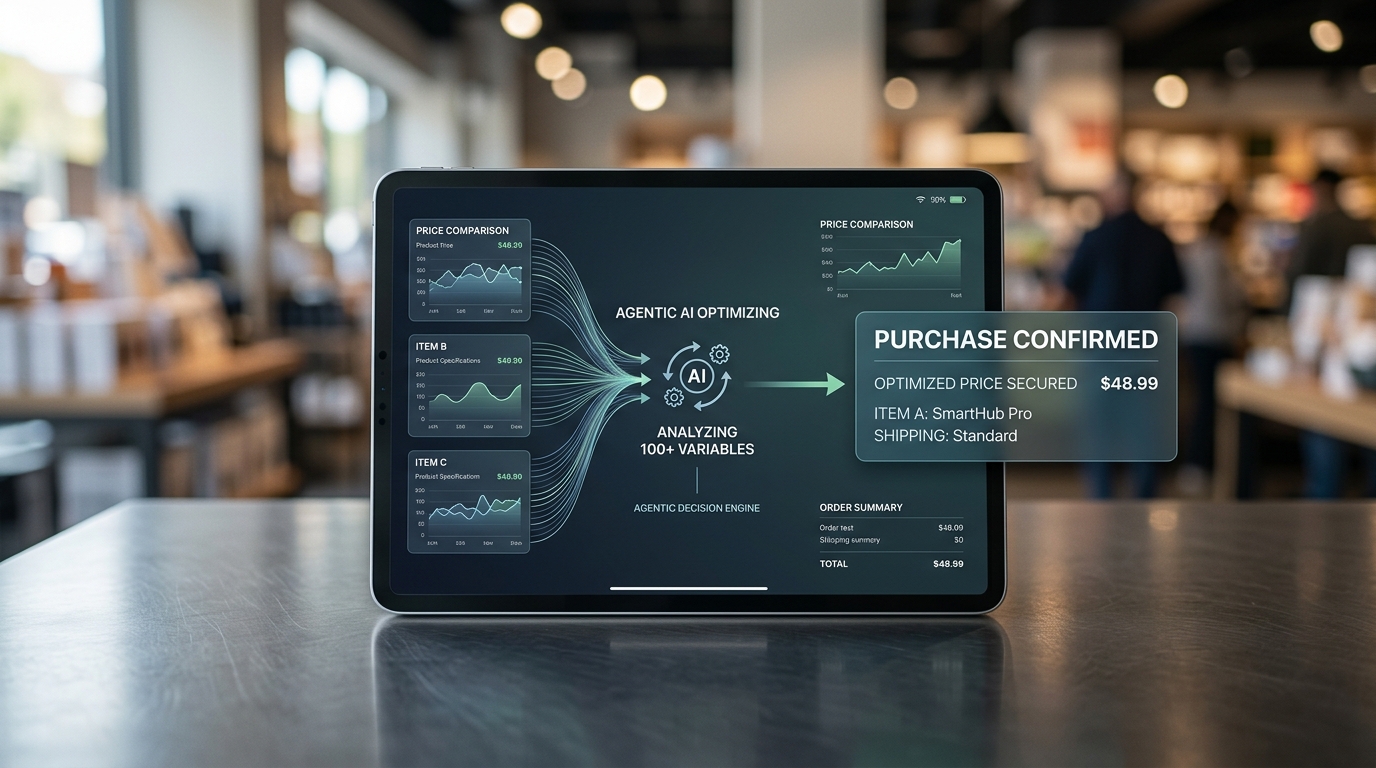
Agentic AI doesn’t just answer questions. It can take action. These systems combine reasoning, memory, and tool use to handle more complex shopping tasks: finding products across retailers, checking inventory, evaluating price, applying user preferences, and potentially managing checkout. In short, they move from recommendation to execution.
For retailers, that means the traditional customer journey is getting compressed and rerouted. In many cases, a consumer may never browse a homepage, click through category pages, or respond to a familiar ad funnel. Their AI agent may handle all of that instead.
Why Bain’s Report Matters
What stands out in Bain’s analysis is its balance of urgency and realism. This isn’t framed as overnight disruption, but it is a serious strategic turning point.
There are already early signals. Salesforce data cited by Bain suggests AI agents influenced roughly $3 billion in U.S. Black Friday sales. Similarweb data shows AI referral traffic is still small overall, but some retailers are already seeing up to 25% of their referral traffic come from AI-driven sources. The footprint may still be early, but the direction is hard to miss.
Aaron Cheris of Bain has compared this moment to the rise of search engines, and that analogy fits. Search changed how consumers found products. Agentic AI could change who makes the buying decision in the first place.
Consumers Are Interested, but Trust Still Matters
One of the most important findings in Bain’s report is that enthusiasm and caution are rising at the same time. Around half of consumers are still hesitant about fully autonomous purchases. That’s understandable. Letting an AI complete a transaction without final approval feels very different from asking it for product suggestions.
At the same time, trust patterns are taking shape. Bain found that consumers are roughly three times more likely to trust retailer-owned AI agents than third-party platforms. That’s a crucial signal for brands and merchants.
If shoppers are going to delegate more decisions to AI, they’ll want confidence in how recommendations are made, how preferences are used, and how payment and fulfillment are handled. Retailers that build trust directly into their own ecosystems may have a real advantage over those that rely entirely on outside platforms to mediate the experience.
The Retail Battleground Is Changing
What’s most compelling is how agentic AI changes competition itself.
In a traditional e-commerce model, brands compete for human attention through design, media, merchandising, and conversion optimization. In an agent-first world, retailers also have to compete for machine preference. That makes product data, inventory visibility, pricing logic, API accessibility, delivery reliability, and structured content even more important.
Bain’s broader message is that retailers need to rethink operations, marketing, data strategy, and checkout infrastructure now, not later.
The companies that win in this environment are unlikely to be the ones with the prettiest storefront alone. They’ll be the ones that are easiest for both humans and algorithms to trust, understand, and transact with.
 Bain’s Three Strategic Moves for Retailers
Bain outlines three broad strategic responses, and all three deserve attention:
1. Build stronger customer moats
Retailers need defensible advantages that AI agents can’t easily commoditize away. That could mean exclusive products, stronger loyalty programs, better bundles, superior service, or unique fulfillment capabilities. If every agent can compare every seller instantly, differentiation matters more, not less.
2. Evolve retail media
Retail media today is still heavily centered on onsite placements, but agentic commerce may shift value toward new ad formats and offsite influence. If AI systems increasingly shape decisions before a shopper lands on a retailer’s site, brands will need new ways to stay visible.
3. Protect ownership of data and checkout
This may be the most strategic issue of all. If third-party agents control product discovery and transaction flow, retailers risk losing both customer insight and margin. That’s why APIs, machine-readable product information, and direct transaction capabilities are becoming central to future commerce infrastructure.
What Happens Next
I don’t expect agentic AI to replace all human shopping behavior anytime soon. Categories like replenishable essentials will likely move first, while higher-emotion purchases such as fashion, luxury, and travel may take longer. But the trend line is clear: more shoppers will use AI to reduce friction, save time, and automate routine decisions.
That means e-commerce teams should stop treating agentic AI as a speculative concept and start treating it as an emerging operating environment.
The questions now are practical:
- Is your product data structured for AI discovery?
- Can external agents access accurate inventory and pricing information?
- Are your checkout and attribution systems prepared for non-human traffic and decisioning?
- Do you have a strategy for measurement when AI intermediates the journey?
Those aren’t futuristic questions anymore. They’re becoming near-term business priorities.
FAQ
What is agentic AI in retail?
Agentic AI refers to AI systems that can do more than assist with research. They can take actions such as comparing products, checking stock, applying preferences, and potentially completing purchases.
How big could agentic commerce become?
Bain estimates it could represent 15% to 25% of U.S. e-commerce by 2030, or roughly $300 billion to $500 billion.
Why does trust matter so much?
Consumers may use AI for recommendations, but many still hesitate to hand over full purchasing control. Bain found shoppers are far more likely to trust retailer-owned AI agents than third-party tools.
What should retailers do now?
Retailers should improve structured product data, strengthen APIs, protect control over checkout and customer data, and rethink media and measurement strategies for AI-driven shopping journeys.
Conclusion
Bain’s report makes the shift clear: agentic AI isn’t just another layer on top of e-commerce. It’s becoming a new interface for commerce itself. Retailers that adapt early will be better positioned to build trust, protect margin, and stay discoverable in a market where AI agents increasingly influence what gets bought and where. For teams looking to stay competitive as this change accelerates, ROAS Suite offers a practical way to improve measurement, optimization, and performance visibility in a rapidly changing retail landscape.