Analysis Shows AI-Generated Content Struggles to Rank Due to Lack of EEAT Signals
The conversation around AI content and SEO has matured, and the latest data points to a clear conclusion: AI-generated content does not automatically fail in Google, but it does struggle when it lacks strong E-E-A-T signals.
That distinction matters.
Google has said since 2023 that it does not judge content solely by how it was produced. Using AI is not the issue. Publishing content that feels generic, untested, unowned, and untrustworthy is. And as more studies come in, the gap between “AI can help create content” and “AI content ranks well on its own” is getting harder to ignore.
 The data is starting to tell a consistent story
What stands out most is that multiple studies are reaching the same conclusion from different angles.
Ahrefs found that AI appears in a large share of top-ranking pages, which initially sounds like a win for automation. But the real takeaway is more nuanced: Google is not rewarding AI content just because it exists, and it is not penalizing it simply because a machine helped produce it. It is judging whether the final page is genuinely useful.
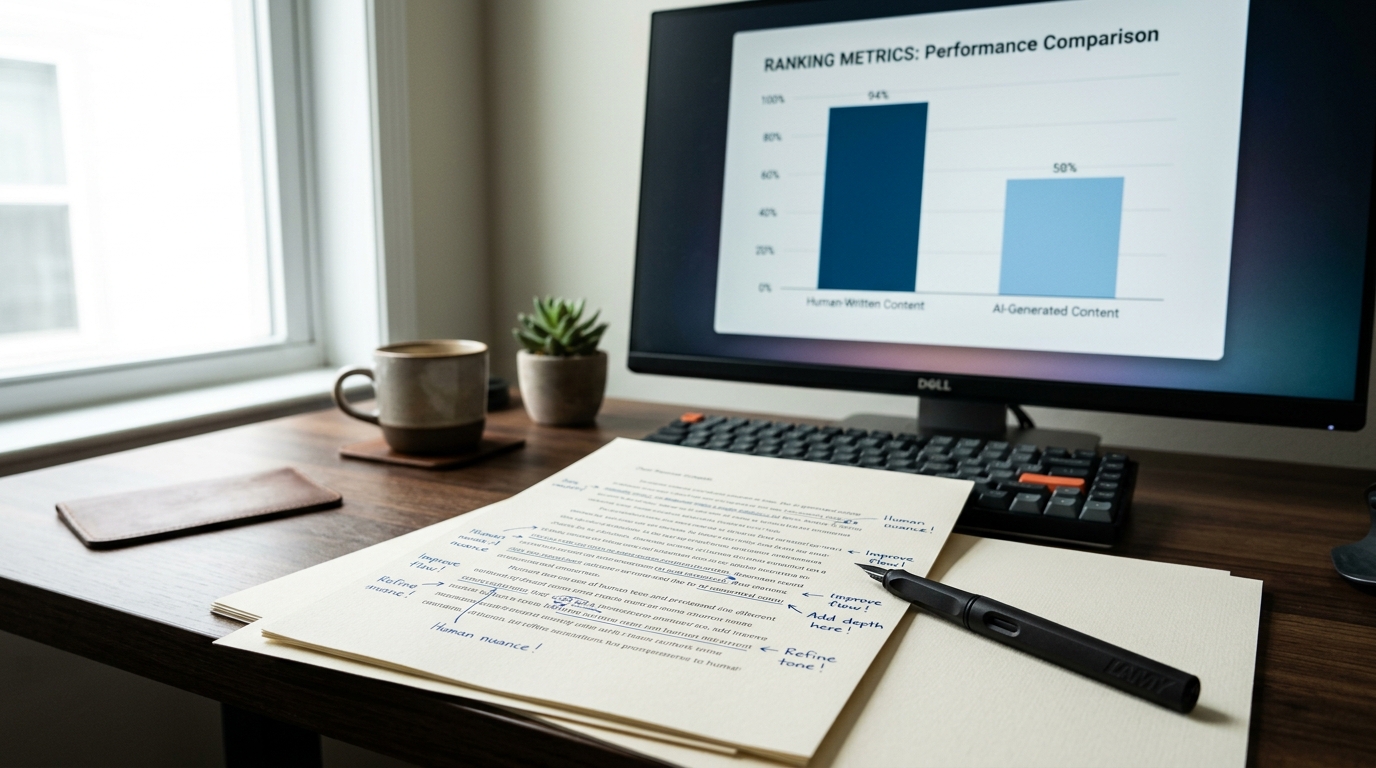
Semrush added another important layer. Its analysis showed human-written content holding the top position far more often than pure AI content. The gap was significant. Human content dominated the #1 spot, while pure AI showed up much less often at the very top.
That is the real headline. AI can help get content published, but it still struggles to outperform when rankings hinge on trust, originality, and demonstrated experience.
Why EEAT is the real dividing line
E-E-A-T stands for Experience, Expertise, Authoritativeness, and Trustworthiness. It remains one of the clearest ways to understand why some AI-assisted content performs well while other pages fade out of search results.
AI is good at producing clean, readable, well-structured copy. What it usually cannot do on its own is prove that someone with real-world experience stands behind the content.
That is where rankings start to break down.
In sensitive niches like cybersecurity, finance, health, or legal topics, readers and search engines want signals that a credible human is involved. They want to know who wrote the piece, why that person is qualified, what first-hand perspective they bring, and whether the article offers something beyond a polished summary.
Pure AI content often misses those signals. It tends to sound polished but detached. Informative, but not grounded. Broadly correct, but thin on real insight.
And in 2026, that weakness is becoming easier to spot.
Google’s updates are rewarding people-first content, not machine-first scale
Google’s public guidance has stayed fairly consistent: helpful content wins. What has changed is how well its systems detect content that only imitates usefulness.
That matters because a lot of unedited AI content is built for scale first and value second.
The March 2024 update and later 2026 updates pushed even harder toward people-first quality. Sites relying on mass-produced, low-originality pages reportedly saw major traffic losses. In many cases, the same recovery advice kept coming up:
- Add author attribution
- Demonstrate expertise
- Improve originality
- Inject human judgment
That suggests Google is not trying to ban AI. It is trying to suppress empty content production.
So if someone reads Ahrefs and concludes, “Google doesn’t care if I use AI,” that is only half true. Google may not care about the tool, but it cares a great deal about the result.
The writing patterns are part of the problem
Another reason AI-generated content struggles is that it often leaves patterns behind, even when the writing looks fluent on the surface.
Research and industry analysis have pointed to recurring issues such as low perplexity, predictable structure, repetitive transitions, and overuse of familiar stylistic habits. AI tends to smooth everything out. In the process, it often strips away personality, tension, specificity, and surprise.
That may sound like a stylistic issue, but it quickly becomes an SEO issue when hundreds of pages start sounding interchangeable.
Real experts do not all explain things the same way. They emphasize different risks, use different examples, tell different stories, and make different judgment calls. That variation creates texture. It also creates credibility.
Pure AI content often lacks that texture. It reads like it has seen everything, but experienced nothing.
 Why hybrid workflows are outperforming pure AI
This is why the strongest content strategies right now are hybrid.
AI is excellent for:
- Outlining articles
- Summarizing source material
- Speeding up research
- Identifying content gaps
- Helping teams move faster
That is unlikely to change. Speed remains one of AI’s biggest advantages.
But speed alone does not earn rankings.
The pages that perform best are usually the ones where humans shape the final narrative, add first-hand observations, challenge bland phrasing, contribute examples from lived or professional experience, and make the content worth trusting.
That lines up with what many SEO teams are already doing. Instead of handing the entire workflow to AI, they use it as a support layer inside a human-led editorial process.
That is the real distinction. AI can support expertise, but it still cannot fake it convincingly for long.
The trust issue is even bigger in high-stakes industries
This becomes especially obvious in high-trust sectors.
In cybersecurity, nobody wants advice that merely sounds statistically plausible. They want guidance that feels tested, current, and accountable. The same applies to health, legal, and financial content. When the stakes are high, “good enough” language stops being good enough.
That is why E-E-A-T is not just an SEO framework. It reflects how people evaluate risk.
If content does not show evidence of real experience, users hesitate. If users hesitate, engagement suffers. And when engagement and trust signals weaken, rankings often follow.
So while AI can produce content at impressive scale, it often struggles where belief matters most.
What publishers should take away from this
The biggest takeaway is simple: the future is not AI versus human. It is AI with human accountability.
The winning approach is not to avoid AI entirely, and it is not to publish raw AI drafts at scale. It is to use AI strategically, then add the signals machines still cannot generate credibly on their own:
- Lived experience
- Expert judgment
- Editorial taste
- Clear authorship
- Trust
That is what turns content from technically complete into something that can actually compete in search.
FAQ
Can AI-generated content rank in Google?
Yes. Google does not automatically penalize content for using AI. But pages that rely on AI alone often underperform when they lack originality, expertise, authorship, and trust signals.
What makes AI content struggle in search results?
The biggest issue is usually not the tool itself. It is the absence of strong E-E-A-T signals, first-hand insight, and human editorial judgment.
Is AI content more risky in YMYL industries?
Yes. In areas like health, finance, legal, and cybersecurity, trust matters more. Content that lacks clear expertise and accountability is more likely to struggle.
What is the best way to use AI for SEO content?
The most effective approach is a hybrid workflow: use AI for speed and support, then rely on human experts and editors to add depth, accuracy, experience, and trust.
Conclusion
The latest analysis does not show that AI content is doomed. It shows that content without clear E-E-A-T signals is doomed, whether AI helped write it or not. If the goal is to rank in a tougher search environment, AI should speed up production without stripping out the human signals that readers and search engines rely on. For teams trying to close that gap, AIuthority is a smart place to start.