AI Crosses the Threshold to Autonomously Run E-commerce Back Offices
For years, AI in e-commerce was mostly seen as a productivity layer. It could write emails faster, summarize support tickets, or suggest campaign ideas. Helpful, certainly—but still off to the side. What changed in 2026 is far more significant: AI is no longer just supporting the back office. It’s beginning to run it.
That matters because the back office is where margins are protected or lost. Inventory, fulfillment, customer support, retention flows, ad budget allocation, returns, and reorders quietly determine whether a brand scales efficiently or gets buried in operational drag. With agentic AI, those systems can now be monitored—and increasingly managed—autonomously.
 What “the threshold” actually means
This threshold isn’t about AI getting better at generating text. It’s about AI maintaining context across connected tools and taking action through APIs.
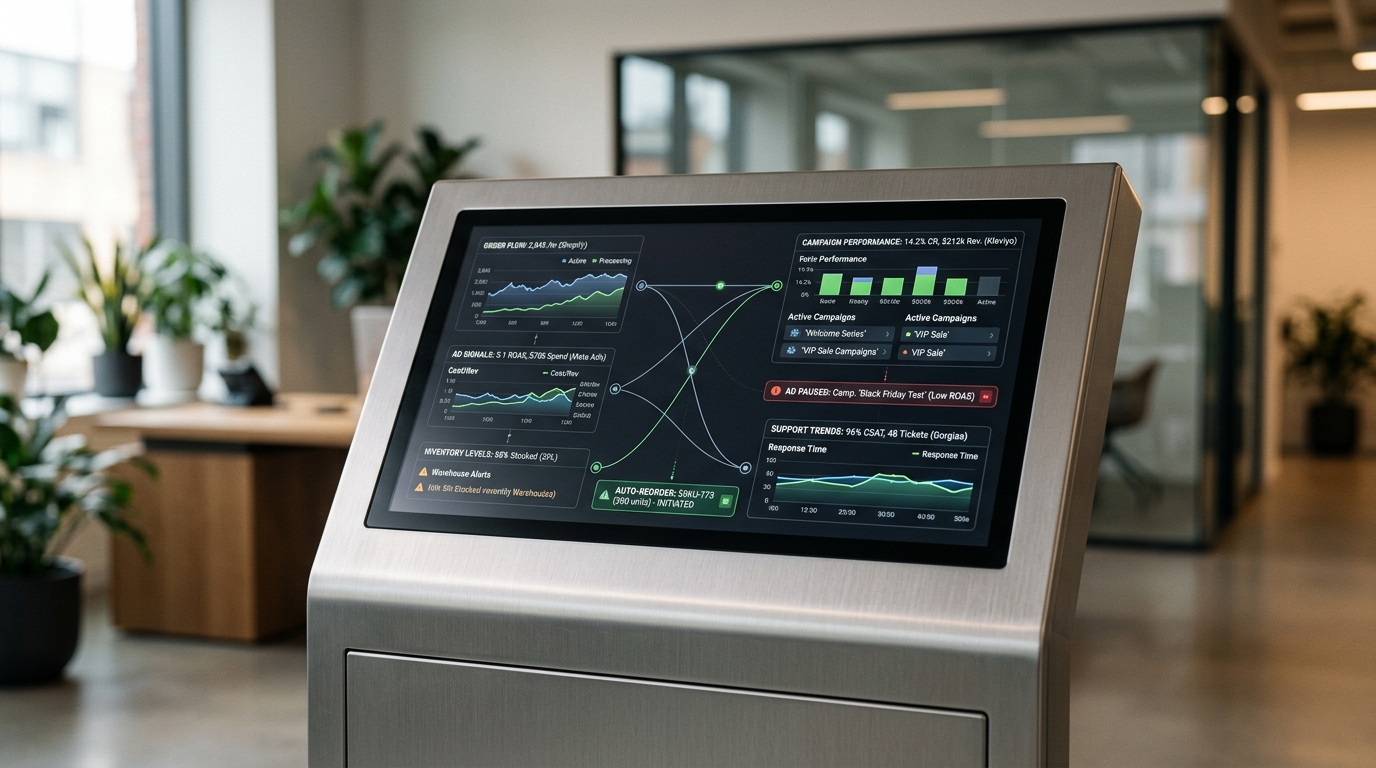
In a modern e-commerce stack, that means one system can watch Shopify orders, compare inventory velocity, read Klaviyo performance, monitor Meta ad signals, sync with a 3PL like ShipBob, and track support trends in Gorgias—then decide what happens next. Not just recommend it. Do it.
That’s the real leap.
If a SKU is close to selling out and lead times are too long, the system can place the reorder. If a Meta ad set has pulled ROAS down for 72 hours, it can pause it. If a key retention flow starts losing click-through rate, it can draft and launch a replacement variation. Instead of sending another Slack alert for someone to deal with later, the AI closes the loop.
That’s what operators like Pavel Fakanov have been pointing to: AI has moved from helpful assistant to autonomous operator.
Why e-commerce was always likely to get there first
E-commerce is especially well suited for this shift because the ecosystem is already rich with APIs and event-driven systems. Shopify, Klaviyo, Meta, 3PLs, help desks, returns software, and subscription platforms all generate structured signals and allow actions. That makes online retail an ideal proving ground for agentic automation.
The infrastructure was already in place. What was missing was a layer intelligent enough to hold long-term context, interpret changing conditions, and make decisions consistently enough to earn trust.
That layer is arriving now.
We’re seeing it in both specialized tools and major platform rollouts. Klaviyo’s recent AI releases are a good example: campaigns and flows generated from a single prompt, autonomous support across channels, audience optimization that removes risky sends, and send-time intelligence that reportedly lifts engagement in a meaningful way. At the same time, newer commerce operators are pushing deeper into autonomous shipping, sourcing, pricing, and fulfillment decisions.
This is no longer hypothetical. It’s being implemented.
From dashboards and busywork to autonomous execution
The most immediate impact is operational efficiency.
Historically, back-office work has been packed with repetitive monitoring:
- checking stock levels
- watching ad performance decay
- adjusting flows
- responding to routine service questions
- reconciling supplier issues
- making small but constant decisions that eat up hours every week
Most of this work isn’t strategic. It’s necessary, but repetitive—and repetitive work is exactly what AI is best positioned to absorb first.
That’s why this shift can be summed up simply: one signal in, one decision out, no busywork.
When AI can evaluate conditions continuously and act in real time, the business becomes less reactive. Teams stop spending the day hunting for issues and start focusing on higher-leverage work: brand, creative direction, merchandising, partnerships, product development, and customer insight.
This is also where the economics get hard to ignore. If AI reduces repetitive operational labor, headcount-to-revenue ratios naturally fall. That doesn’t mean people disappear; it means team structure changes. A lean operator can suddenly perform like a much larger organization.
The implications for teams and roles
This is the part many brands still underestimate.
The first roles pressured by this transition won’t be the ones built around judgment, experimentation, or strategy. They’ll be the ones centered on repetitive execution: monitoring, triage, rule-following, data pulling, basic support resolution, and routine campaign operations.
That leads to a very different org chart.
A team of five may soon manage what once required fifteen or twenty people, especially in DTC environments where systems are tightly integrated. The practical result is simple: fast adopters gain an efficiency advantage while slower brands carry heavier labor structures into a more automated market.
But this doesn’t make fundamentals less important. It makes them more important.
If AI handles the repetitive layer, the remaining human advantage moves up the stack: better positioning, sharper customer understanding, stronger offers, cleaner economics, and smarter product bets. AI can execute, but it still amplifies the quality of the underlying business.
A bad business with autonomous workflows just fails faster.
 The risks behind the hype
As meaningful as this threshold is, it shouldn’t be mistaken for magic.
Autonomous systems are only as good as the data, rules, and financial logic behind them. If an AI agent optimizes for surface-level ROAS without accounting for fulfillment costs, return rates, contribution margin, or inventory constraints, it can damage the business while looking efficient on paper.
Trust has to be earned. Most brands will likely move through clear stages:
- AI recommends
- Humans approve
- AI acts within guardrails
- AI expands scope over time
That progression is healthy. Full autonomy without strong controls is reckless. The goal isn’t to hand the keys to an unbounded model. It’s to build systems that handle routine operational decisions with clear thresholds, escalation logic, and exception management.
In practice, the winners won’t just be the brands using AI. They’ll be the brands using grounded AI.
What I think happens next
This looks like the start of a major mental-model reset for e-commerce operators.
For the past few years, “using AI” often meant producing content faster. Going forward, the more important question will be: what part of the business can AI actually run?
That’s the conversation that matters. Once the back office becomes partially autonomous, scale starts to look different. Smaller teams move faster. Decisions happen continuously instead of in meetings. Inefficiencies don’t sit untouched for days. Over quarters—not just weeks—the compounding effect becomes enormous.
E-commerce is likely the first sector to feel this shift deeply because its systems are already digitized, measurable, and connected. But it won’t stop there. The same agentic logic will spread into broader retail, logistics, and machine-to-machine commerce.
The brands that move early won’t just save time. They’ll redesign how the business operates.
FAQ
What does it mean for AI to run an e-commerce back office?
It means AI can monitor business systems, maintain context across tools, and take actions automatically—such as reordering inventory, pausing underperforming ads, or adjusting retention flows—without waiting for a person to intervene.
Why is e-commerce a strong fit for autonomous AI?
E-commerce platforms already rely on connected software systems that generate structured data and support API-based actions. That makes it easier for AI to analyze signals and execute decisions across the stack.
Will AI replace e-commerce teams?
Not entirely. It will reduce the need for repetitive operational work, which changes team structure. Human value shifts toward strategy, judgment, creative direction, and commercial decision-making.
What are the biggest risks?
The biggest risks come from weak data, poor guardrails, and narrow optimization goals. An AI system that chases top-line metrics without understanding margins, returns, or inventory constraints can make costly decisions.
Conclusion
AI running e-commerce back offices is no longer a future-looking idea—it’s becoming an operating reality. The shift from assistant to autonomous operator changes how teams scale, how decisions get made, and how efficiently modern brands compete. For operators who want to adapt before this becomes standard, it makes sense to build on tools designed for performance and execution. If you’re looking to streamline growth and bring more intelligence into your e-commerce operation, ROAS Suite is a smart place to start.