Ad Agencies Build Custom GEO Tools Using “Vibe Coding”
I’ve been watching the search landscape shift for a while, but the last 18 months made it obvious: more people are getting answers from AI chatbots the way they used to get them from Google. That move toward “zero-click” responses—where the user never visits a brand’s site—has created a new kind of pressure for marketers.
That pressure now has a name: Generative Engine Optimization (GEO). It’s the work of making sure your brand is visible, accurately represented, and cited inside AI-generated answers across models like ChatGPT and Claude. The part moving fastest: ad agencies aren’t just buying GEO tools—they’re building their own, using what the industry has started calling “vibe coding.”
 GEO: The New Visibility Problem (and Opportunity)
Traditional SEO was largely about ranking on a page. GEO is about showing up inside an answer.
When a prospect asks an AI model, “What’s the best CRM for healthcare?” or “Which agencies specialize in performance creative for DTC?”, the model synthesizes a response based on patterns, training data, retrieval sources, and citations. If your brand isn’t present—or worse, is present but mischaracterized—you lose mindshare at the moment it matters.
One detail agencies are tracking closely: citations are changing. Sources like YouTube are increasingly cited more than forums like Reddit in AI responses. That ties content strategy, PR, and even video planning directly to how AI engines “explain the world.”
“Vibe Coding” Shows Up Right on Time
In mid-2025, Anthropic’s “Project Vend” research helped popularize a term I now hear constantly: vibe coding—building software by describing what you want in natural language and letting an AI coding assistant generate (and iterate) the implementation.
By late 2025 into early 2026, tools like Claude Code made that workflow feel less like a novelty and more like serious prototyping. Agencies can go from idea to a working internal product in hours—sometimes in a single evening—without hiring a traditional software team.
That’s exactly what’s happening in GEO.
Why Agencies Are Building GEO Tools Instead of Buying Them
GEO startups exist—monitoring platforms, brand mention trackers, “AI search optimization” suites. Some are strong. But more agencies are choosing to build, for practical reasons.
1) Customization beats generic dashboards
Off-the-shelf platforms tend to standardize what they measure. Agencies don’t want that. They want tooling that reflects how their clients compete, how their categories behave, and how their strategists think.
Broadhead’s team, for instance, built a GEO monitoring tool that runs prompts across models and returns a competitive “vote,” ranking brands by persona and location. That isn’t a generic template—it’s a strategic instrument built around how the agency sells and serves.
2) Cost control (and avoiding “enterprise gravity”)
Large enterprise AI agreements can get expensive quickly—sometimes “multiple millions,” especially when licenses are underused. Dan Hagen at Havas has been candid about avoiding heavyweight deals when the cost structure doesn’t match reality.
Vibe coding changes the math: instead of paying for a platform that does 80% of what you need, an agency can build the 20% that matters most—then pay for usage (tokens, API calls, hosting) in a way that tracks with client demand.
3) Speed becomes the differentiator
This is the culture shift. When a product innovation lead can prototype a GEO dashboard in an evening—and add features like persona layers in a couple of hours—the internal question becomes: Why wait?
Mike Barrett at Supergood put it plainly: agencies are going to deliver more software than documents. Not because decks disappear, but because the deck increasingly becomes a wrapper for a living tool.
 What the Leading Agencies Are Actually Building
Across the industry, agency-built GEO tools are converging on a few core capabilities.
Multi-model visibility tracking
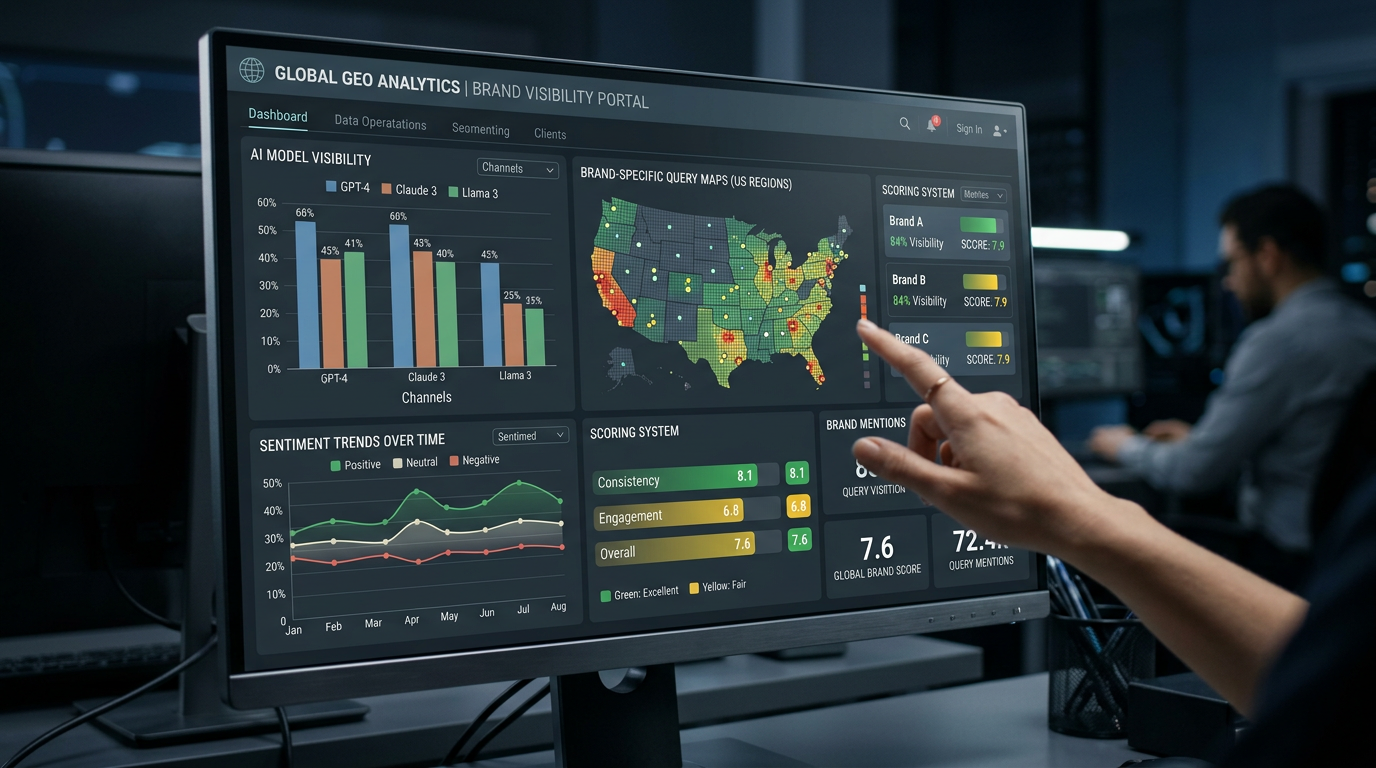
Not “Are we mentioned in AI?” but where and how across multiple models. Havas’ Brand Insights AI tracks visibility and coverage across major AI engines, then translates the output into content and optimization strategy.
Prompt libraries and brand-specific query maps
The winners aren’t running one prompt—they’re running dozens or hundreds:
- brand vs. competitor comparisons
- category “best of” prompts
- persona-based questions (CMO vs. procurement vs. founder)
- region and language variants
This is how GEO becomes measurable: define the questions your market asks, then monitor the answers the models produce.
Scoring systems (mentions, sentiment, citations, “coverage”)
Agencies are building internal scoring frameworks—rough at first, improving quickly—to quantify:
- presence (are we included?)
- positioning (how are we described?)
- sources (who is the model citing?)
- consistency (does the answer change by model or prompt?)
Iteration loops that resemble growth experiments
Supergood’s approach hints at the next phase: autonomous loops that generate candidate responses/content, evaluate them, refine them, and rerun until they hit a quality threshold.
That’s not classic “SEO tooling.” It’s closer to an experimentation engine for AI visibility.
This Trend Reshapes Who Captures Value in AI Search
This matters because it changes the GEO market’s power dynamics.
If agencies can build “good enough” monitoring, scoring, and reporting in-house—and keep improving it—GEO startups face a higher bar. They can’t just be a dashboard. They need something defensible: proprietary data, deep integrations, category benchmarks, or workflows agencies can’t replicate cheaply.
AdWeek’s framing holds up: this movement is reshaping who captures value in AI search. Agencies already own client trust and strategy. Vibe coding gives them product velocity.
Risks: The Unsexy Parts Agencies Must Get Right
I’m bullish on this trend, but the tradeoffs are real. Vibe-coded tools can get fragile fast if teams don’t treat them like actual software.
Key risks:
- Model churn: what feels “frontier” today can be average in six months. Tools need to swap models without rewriting everything.
- Data quality and repeatability: if outputs can’t be reproduced reliably, dashboards become fancy anecdotes.
- Security and client confidentiality: agencies need clear boundaries on what gets sent to APIs and how logs are stored.
- Overconfidence in prototypes: a demo that wins a pitch isn’t the same as a product that survives daily use.
The agencies that win will keep the vibe-coding speed, then add product discipline: versioning, testing, telemetry, and governance.
Conclusion: GEO Is Becoming an Agency Product, Not Just a Service
GEO is quickly becoming table stakes for brands that depend on discoverability, because AI answers are already functioning like the top of the funnel. Vibe coding is what’s letting agencies turn that reality into something operational: custom tools, measurable visibility, and repeatable systems that can be deployed per client, per category, per market.
If you’re trying to keep up—whether you’re building internal capability or want a clearer view of how AI engines represent your brand—use a platform that turns GEO into a workflow instead of a string of one-off experiments. AIuthority helps operationalize GEO so you can run, refine, and scale the work.