6-Point Scorecard for Creating AI-Ready E-Commerce Product Pages
Many e-commerce brands are still optimizing product pages for a version of search that’s on its way out. Traditional SEO still matters, but AI-driven discovery is changing how products get found, compared, and recommended. When someone asks ChatGPT, Google’s AI results, or Perplexity for “the best machine-washable dog bed for large breeds” or “a lightweight carry-on for business travel,” those systems aren’t rewarding clever keyword density. They’re rewarding clear product understanding.
That’s the shift.
AI tools increasingly favor product pages that are structured, specific, and easy to interpret. If a page is vague, thin, or inconsistent, it’s much harder for an AI assistant to recommend it with confidence. That’s why I use a simple 6-point scorecard to evaluate whether a product page is actually ready for AI-driven shopping discovery.
 Why AI-Ready Product Pages Matter Now
Over the past two years, search has moved away from pure keyword matching and toward entity-based understanding. In plain English, AI systems want to understand what a product is, who it’s for, what makes it different, how customers feel about it, and whether the underlying data supports those claims.
That helps explain why Amazon performs so well in AI-driven recommendations. Its product pages are packed with specs, use cases, reviews, and structured data. Many independent brands still lean on short descriptions and a few lifestyle images. That may work for a human skimming the page, but it often leaves AI systems with too many gaps.
If I’m auditing a product page now, I’m not just asking whether it ranks. I’m asking whether an AI assistant could confidently recommend it in response to a detailed shopping question.
The 6-Point AI-Ready Product Page Scorecard
The simplest way to use this framework is to grade each product page with Yes, Partial, or No across six areas.
1. Clear Product Specs
This is the foundation. AI can’t infer key product attributes if they aren’t clearly stated.
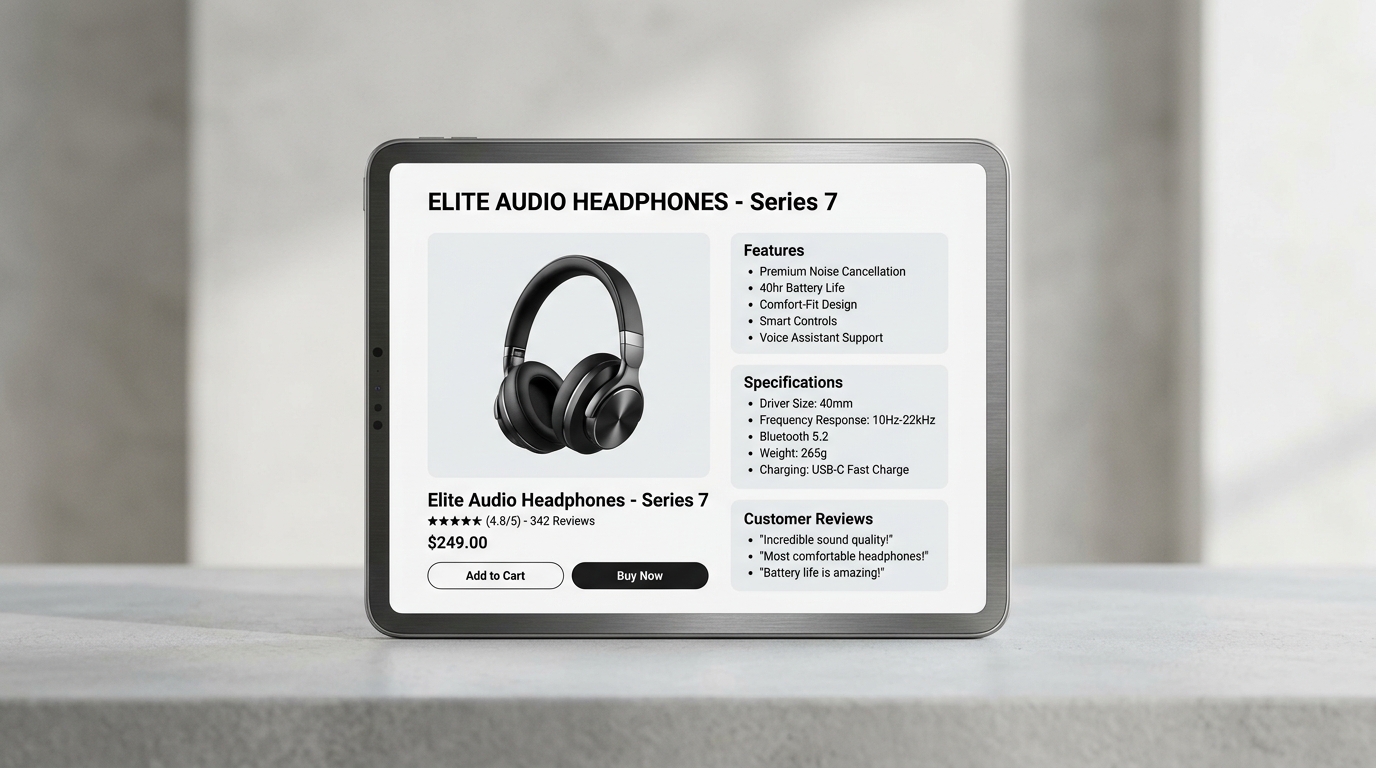
I want to see specifications presented in a format that’s easy to parse, ideally in bullets, tables, or clearly labeled sections. Dimensions, materials, weight, compatibility, sizing, power requirements, ingredients, care instructions, and other hard facts should never be buried in a wall of promotional copy.
When someone asks an AI tool for a product that fits a very specific need, specs often determine whether your page makes the cut.
Quick check:
- Are dimensions, materials, and technical details easy to find?
- Are they listed consistently?
- Can a machine read them without guessing?
2. Unique Benefits
Specs tell AI what a product is. Benefits explain why it matters.
This is where many brands fall short. They describe the product, but they don’t clearly explain what makes it meaningfully different. “High quality” and “premium design” are too generic to help. Specific benefit statements are far stronger: “machine-washable cover,” “airline cabin compliant,” “supports side sleepers,” or “made for sensitive skin.”
AI recommendations improve when your page makes those value points explicit. If your differentiation is vague, AI is more likely to surface a competitor with clearer language.
Quick check:
- Are the top 2–4 benefits obvious?
- Are they specific instead of generic marketing language?
- Would those benefits match real shopping prompts?
3. Use Cases and Audience Fit
One of the biggest changes in AI shopping is the rise of conversational queries. People aren’t just searching for “office chair.” They’re asking for “an office chair for lower back pain in a small apartment” or “a beginner espresso machine for someone who wants café-style drinks without a learning curve.”
That means product pages need to spell out use cases and audience fit.
I like to include at least three to five explicit scenarios or buyer types. For example: ideal for first-time runners, great for small kitchens, designed for pet owners, useful for travel, or built for cold-weather commuting. This helps AI connect your product to nuanced purchase intent.
Quick check:
- Does the page say who the product is for?
- Does it explain when or why someone would use it?
- Are there multiple practical use cases listed?
4. FAQs Based on Real Questions
FAQs are no longer filler. They’re one of the best ways to match natural-language queries.
The strongest FAQs don’t come from internal brainstorming alone. They come from customer support tickets, live chat logs, product reviews, Reddit threads, and search data. In other words, they reflect the real concerns shoppers have before buying.
A good FAQ section helps both humans and AI systems. It gives direct answers to direct questions: Is it waterproof? Does it shrink after washing? Will it fit in overhead storage? Is assembly required? What’s the return policy?
That kind of clarity reduces ambiguity, and ambiguity is the enemy of AI visibility.
Quick check:
- Are the FAQs based on real customer questions?
- Do they answer practical objections and comparison questions?
- Are they specific, concise, and easy to scan?
5. Reviews and Social Proof
Reviews play a major role in AI-driven recommendations because they act as third-party validation. AI systems want evidence that real people have bought, used, and liked the product.
Strong product pages make ratings and review counts visible. More importantly, they collect enough review volume to build trust. In recent discussions around AI-ready pages, one useful benchmark stood out: recommended products often had substantial review depth, with 150+ reviews as a solid target.
Not every brand can hit that number right away, but the principle is straightforward: products with very few reviews are at a disadvantage.
I also think the content of reviews matters. Detailed reviews often reinforce use cases, benefits, and pain points in language AI tools can understand.
Quick check:
- Are star ratings and review counts prominently displayed?
- Is there enough review volume to build credibility?
- Do the reviews contain meaningful product feedback, not just generic praise?
6. Structured Data That Supports the Page
If there’s one technical element brands can’t afford to ignore, it’s structured data.
Schema markup—especially JSON-LD—helps AI systems interpret product details such as price, availability, ratings, and other core attributes. There’s growing evidence that AI tools can use this data even when page copy is weak or incomplete, which makes it an essential layer of product page optimization.
But structured data only helps when it’s accurate. If your schema says one thing and your visible page says another, you create trust issues for both AI systems and shoppers.
At minimum, I want to see clean product schema covering:
- Product name
- Description
- Price
- Availability
- Brand
- Reviews/aggregate rating
- Key attributes where applicable
Quick check:
- Is schema implemented correctly?
- Does it match what’s on the page?
- Is it updated when inventory, pricing, or ratings change?
How I’d Actually Use This Scorecard
A scorecard only matters if it leads to action. Start with your top-performing and highest-margin product pages. Mark each of the six categories as Yes, Partial, or No. Fix the “No” items first, then improve the “Partial” ones.
In most cases, the biggest wins come from:
- adding hard specs in a structured format,
- rewriting vague copy into specific benefits,
- building better FAQ sections,
- and improving review collection and schema coverage.
This isn’t about stuffing pages with more words. It’s about making product information complete, explicit, and machine-readable.
 The Bigger Shift: From SEO Pages to Product Entities
The most important part of this trend is how it changes optimization itself. We’re no longer just optimizing pages for rankings. We’re optimizing product entities for understanding.
That means your product page, feed data, review signals, and schema all need to work together. The brands that win in AI discovery will be the ones that make their products easy to interpret across every signal, not just in a headline and meta description.
In that environment, vague branding won’t carry the page. Clear product intelligence will.
FAQ
What makes a product page AI-ready?
An AI-ready product page gives clear, structured information about specs, benefits, use cases, FAQs, reviews, and schema markup so AI systems can understand and recommend the product confidently.
Does traditional SEO still matter for product pages?
Yes. Traditional SEO still matters, but it’s no longer enough on its own. Product pages also need to be easy for AI systems to interpret and compare.
What’s the fastest way to improve an e-commerce product page for AI discovery?
Start by adding structured specs, clarifying unique benefits, expanding FAQs based on real customer questions, and making sure review data and schema markup are accurate.
Why are reviews so important for AI recommendations?
Reviews provide third-party validation. They help AI systems see that real customers bought the product, used it, and had specific experiences with it.
What structured data should every product page include?
At minimum: product name, description, price, availability, brand, review or aggregate rating data, and any important product attributes relevant to the category.
Conclusion
If I were auditing an e-commerce catalog today, I’d treat this 6-point scorecard as a baseline, not an advanced tactic. AI-driven shopping discovery is already reshaping how customers find products, and pages that lack specs, benefits, use cases, FAQs, reviews, or structured data will fall behind. If you want a smarter way to improve performance and turn better product-page clarity into stronger return on ad spend, I’d recommend exploring ROAS Suite as part of that process.