5WPR Study: Harvey and Lexis+ Dominate Legal AI Visibility
The clearest takeaway from 5WPR’s new Legal Tech AI Visibility Index 2026 is this: in legal tech, showing up inside AI platforms is no longer a branding perk. It is a competitive advantage.
According to the study, Harvey and Lexis+ are now two of the strongest names in legal AI visibility, with Thomson Reuters’ CoCounsel also holding a leading spot. Released on May 26, 2026, the report is positioned as the first public ranking based on AI search citation share across more than 60 buyer-style queries. That matters because legal buyers are increasingly finding vendors through AI-generated answers rather than traditional search, analyst reports, or outbound sales.
 Why this study matters now
Legal tech sits in an unusually intense position. AI is not only the product being sold; it is also the channel buyers are using to compare solutions. That gives the market a level of speed and volatility most software categories do not face.
5WPR chairman Ronn Torossian summed it up well: legal tech has become one of the most visibility-sensitive categories in enterprise software. A company can climb the shortlist fast after a funding round, acquisition, product launch, or strategic partnership. It can also fade just as quickly after a quiet stretch.
That fits broader buyer behavior. Gartner data cited in the report says 61% of B2B buyers prefer rep-free experiences, while 83% of the journey is now AI-mediated. In legal, where professionals are already comfortable working with AI tools, that shift appears even sharper.
Harvey’s rise looks both commercial and narrative-driven
Harvey’s lead in AI visibility was not accidental. The company has been on a steep growth curve, moving from about $100 million in ARR in August 2025 to roughly $190 million by January 2026. By March 2026, it had raised another $200 million at an $11 billion valuation.
Those numbers are striking, but the bigger story is how effectively Harvey has tied business momentum to market narrative. It has funding velocity, enterprise adoption, benchmark credibility, and a steady flow of newsworthy developments. The company reportedly serves most of the AmLaw 100, more than 500 in-house legal teams, and users in over 60 countries.
That kind of presence creates what 5WPR essentially frames as AI citation events. Every major milestone becomes another reason for AI systems to mention the company in generated answers.
Harvey also strengthened its position through strategic partnerships, especially its alliance with LexisNexis. That integration gave it access to trusted legal content, including case law, statutes, and Shepard’s Citations, reinforcing its authority in research-heavy buyer prompts.
Why Lexis+ remains a formidable visibility force
Lexis+ has a different kind of edge. Where Harvey brings startup speed, Lexis+ brings institutional trust.
LexisNexis already holds one of the strongest positions in legal research, and that matters in AI search environments. When buyers ask AI tools about legal research, case law validation, or citation-backed workflows, established legal authority tends to win attention.
The company’s continued product development, including the Lexis+ with Protégé update in early 2026, appears to have strengthened that position. Paired with the Harvey alliance announced in 2025 and features like “Ask LexisNexis,” Lexis has stayed highly visible in both enterprise-wide and research-specific queries.
The larger point is that visibility is not just about being the loudest company in the market. It is also about having the most citeable assets: trusted legal data, familiar workflows, and a brand AI systems consistently connect with reliable answers.
The top tier is becoming clearer
Beyond Harvey and Lexis+, the study points to a broader top tier taking shape across legal tech AI:
- Harvey leads overall legal AI visibility.
- Thomson Reuters CoCounsel remains a major force, supported by deep enterprise reach and sustained AI investment.
- Lexis+ continues to dominate research-focused visibility.
- Clio shows strength in practice management, especially after major acquisitions.
- Ironclad stands out in contract lifecycle management.
- Relativity, Everlaw, and DISCO remain highly visible in eDiscovery.
This is not a random leaderboard. It reflects category-level authority. Buyers searching for contract AI are not necessarily seeing the same shortlist as those evaluating eDiscovery or legal research tools. That makes long-tail prompt strategy just as important as broad brand awareness.
 Visibility is now tied to market activity
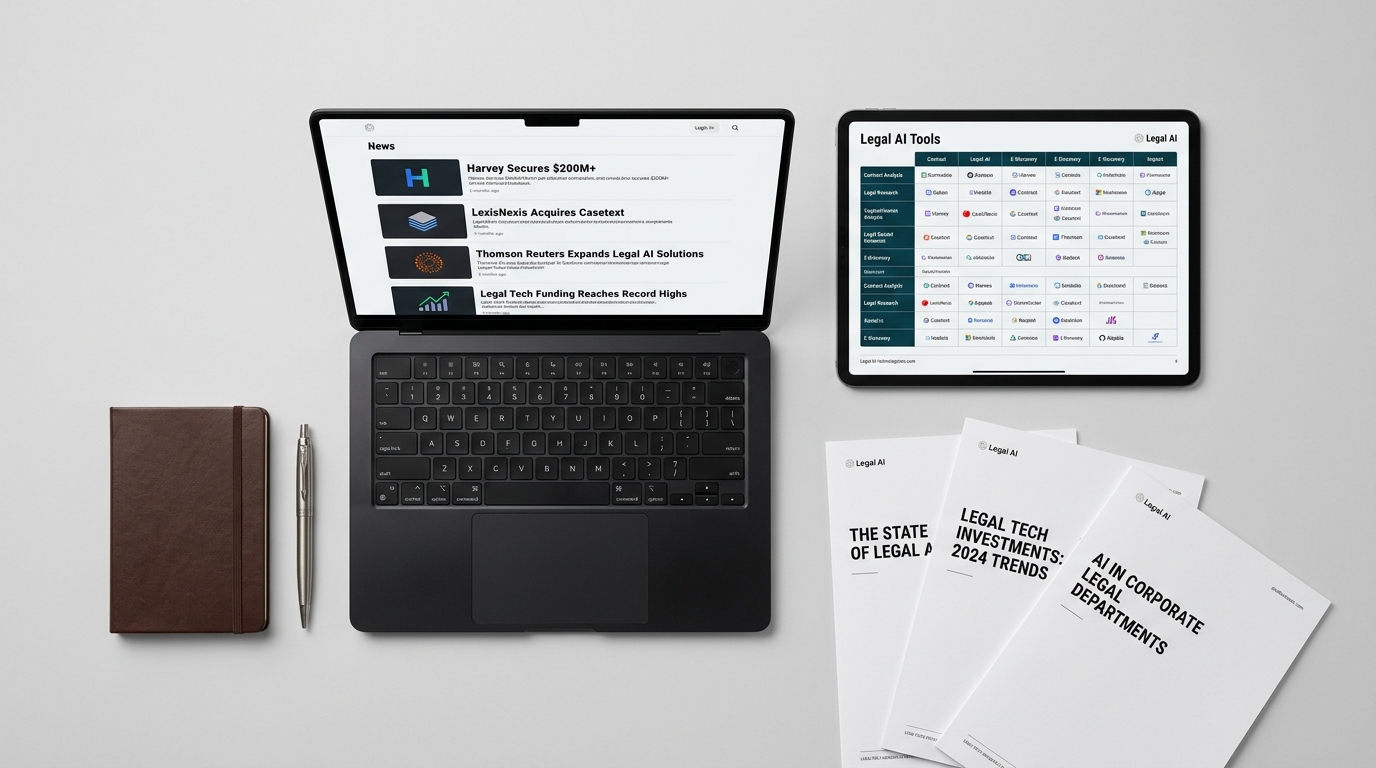
One of the strongest ideas in the 5WPR report is that funding rounds, acquisitions, benchmark results, and product launches are no longer just PR moments. They are discoverability levers.
That tracks with what the legal tech market has shown over the past year. Clio’s acquisition of vLex, Thomson Reuters’ ongoing deal activity, LexisNexis buying Henchman, and Harvey’s own acquisitions all fed a constant cycle of relevance. In a market where AI systems synthesize fresh signals into buyer-facing answers, staying visible requires sustained movement.
It also helps explain why legal tech feels more volatile than many other B2B categories. A vendor may have a strong product, but without current signals, comparison content, benchmark citations, and ecosystem mentions, it can quickly lose ground in AI-generated recommendations.
What legal tech brands should learn from this
The lesson goes well beyond who ranked where. Legal tech companies now need to think past traditional SEO and conventional PR.
They need content AI systems can cite. That includes comparison pages, benchmark proof points, partner announcements, trusted media coverage, and clear category positioning. They also need consistency. A short burst of attention may help for a moment, but durable AI visibility comes from sustained presence.
This matters even more in a market where 79% of legal professionals are already using AI internally. Adoption is no longer the barrier. Differentiation is.
FAQ
What is the 5WPR Legal Tech AI Visibility Index 2026?
The report is a public ranking that measures AI search citation share across more than 60 buyer-style legal tech queries.
Which companies lead the rankings?
Harvey and Lexis+ are the most prominent leaders in legal AI visibility, with Thomson Reuters CoCounsel also holding a strong position.
Why does AI visibility matter in legal tech?
Because legal buyers are increasingly using AI-generated answers to evaluate vendors, visibility inside those systems now affects shortlist placement and buying decisions.
What drives stronger AI visibility?
Funding news, acquisitions, product launches, partnerships, benchmark results, strong comparison content, and authoritative brand assets all contribute.
Conclusion
The 5WPR study makes the picture pretty clear: Harvey and Lexis+ are not just winning mindshare. They are winning machine-mediated discoverability at the moment legal buyers are relying on AI to shape vendor shortlists. That is an early but meaningful signal of where legal marketing, product positioning, and buyer behavior are headed. For teams looking to understand and strengthen their own AI-era authority, AIuthority is a smart place to start.