5 Ways to Boost Website Authority in 2026 with E-E-A-T Optimization
Website authority in 2026 is no longer something you can build with a few backlinks, a publishing calendar, and good luck. Google’s quality standards are tighter, especially as E-E-A-T—Experience, Expertise, Authoritativeness, and Trustworthiness—now shapes more search categories beyond traditional YMYL topics.
A recent practical guide from iMark Infotech lines up with what many SEOs are seeing firsthand: authority now comes from a mix of credible content, technical stability, smart site structure, and visible brand trust. With AI Overviews, core updates, and ongoing spam crackdowns reshaping search, shortcuts are losing ground fast.
If I want to boost website authority in 2026, these are the five areas I pay the most attention to.
 1. Publish content that proves real experience
The first shift is straightforward: content needs to feel lived-in, not assembled.
Google added the extra “E” for Experience because first-hand knowledge matters. If I’m publishing in SaaS, health, finance, e-commerce, or even how-to niches, I need to show that the person behind the page genuinely understands the topic. Generic summaries and polished filler are easier than ever to spot, and they do little to build durable authority.
To strengthen E-E-A-T through content, I prioritize:
- author bylines with clear credentials
- personal insights, examples, or case-based observations
- original data, screenshots, quotes, and references
- updated facts and expert-reviewed claims
- a tone that reflects real subject familiarity, not surface-level rewriting
In 2026, expertise alone is not enough if it stays abstract. Content needs to show direct involvement and practical understanding.
2. Earn better backlinks, not just more backlinks
Backlinks still matter, but the standard is much higher than it used to be.
Website authority is still tied to strong referring domains, but not every link carries the same weight. A few relevant, trusted backlinks can do far more for credibility than dozens of weak directory links or low-quality placements. With Google’s spam enforcement becoming more aggressive, manipulative link building is also a much riskier bet.
That’s why I focus on link sources that support both authority and trust, such as:
- niche-relevant industry publications
- digital PR mentions
- expert roundups and interviews
- original research that others want to cite
- partnerships with credible brands or communities
The point is not to inflate a vanity metric. It’s to build a reputation footprint that search engines can read as legitimate authority. In many cases, backlinks work best when they reinforce visible expertise already on the site.
3. Strengthen internal linking and topical authority
One of the most overlooked ways to improve authority is internal linking.
When content is organized around clear topic clusters, it becomes easier for both users and search engines to understand what the site is truly authoritative about. A scattered blog full of disconnected articles rarely sends a strong signal. A structured content ecosystem—with pillar pages, supporting articles, and contextual internal links—does.
This matters even more in 2026 because search engines are getting better at evaluating entity relationships and subject depth. If I want to be seen as a trusted source, I need to show comprehensive coverage, not just a collection of isolated posts.
A strong internal linking strategy helps me:
- distribute authority across key pages
- guide users to deeper, relevant content
- reduce orphan pages
- improve crawl efficiency
- reinforce subject relevance across clusters
Topical authority and E-E-A-T are increasingly connected. The more coherent the content architecture is, the easier it is to demonstrate expertise and trustworthiness.
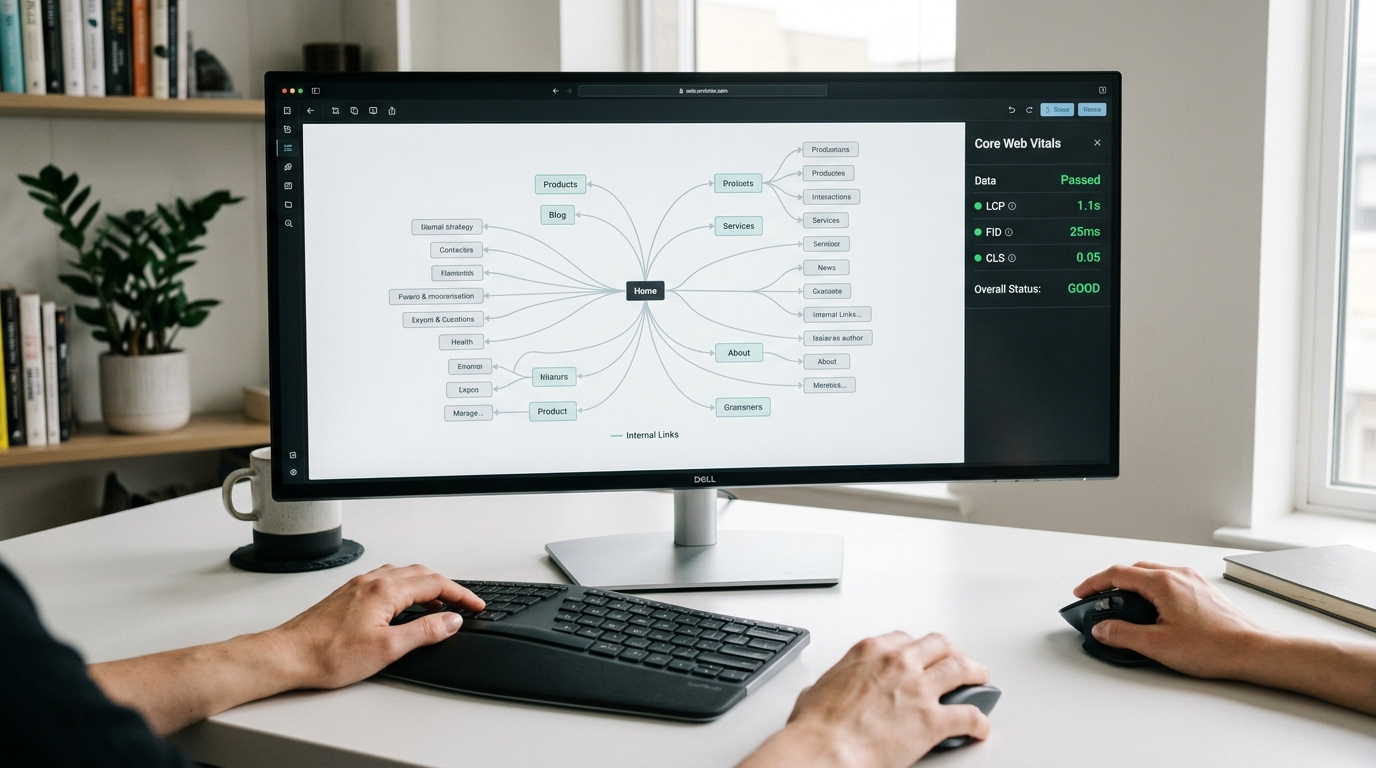 4. Fix technical SEO and Core Web Vitals issues
Authority is not only about what a site says. It’s also about how reliably it works.
Even excellent content can be held back by poor page speed, mobile friction, indexing issues, or unstable layouts. In 2026, technical SEO functions as a trust signal in practice. If users land on a page that loads slowly or feels broken, credibility drops immediately.
That’s why I treat technical health as part of E-E-A-T optimization rather than a separate checklist. Key areas I monitor include:
- Core Web Vitals
- mobile usability
- crawl and indexation issues
- structured data implementation
- HTTPS and site security
- clean navigation and page hierarchy
A technically sound site supports trust at every level. It helps search engines access content properly and gives users a smoother experience—both of which strengthen long-term authority signals.
5. Build brand consistency beyond the website
In 2026, authority does not live only on your domain.
Google is getting better at understanding brands, authors, and entities across the web. That means off-site signals—brand mentions, author profiles, reviews, social visibility, citations, and media references—can all shape how trustworthy a site appears.
If a website claims expertise but the brand has no supporting footprint elsewhere, that gap becomes harder to ignore. A consistent presence across channels, on the other hand, reinforces credibility.
I look for ways to align:
- website messaging and author identity
- social media presence
- third-party mentions and citations
- testimonials, reviews, and trust badges
- podcast appearances, guest posts, or press coverage
This does not mean being everywhere. It means being consistent wherever the brand shows up. Authority builds faster when search engines and users see the same expertise signals repeated across multiple trusted environments.
FAQ
What is E-E-A-T in SEO?
E-E-A-T stands for Experience, Expertise, Authoritativeness, and Trustworthiness. It reflects the signals Google uses to evaluate content quality and the credibility of the people or brands behind it.
Do backlinks still matter in 2026?
Yes, but quality matters far more than volume. Relevant, trusted links from credible sources carry more value than large numbers of weak or manipulative links.
How does technical SEO affect authority?
Technical SEO affects how users and search engines experience a site. Fast load times, mobile usability, secure browsing, and clean indexation all support trust and long-term visibility.
Why is topical authority important?
Topical authority helps search engines understand the depth of your coverage in a subject area. A well-structured cluster of related content sends a much stronger expertise signal than isolated articles.
Conclusion
The biggest lesson from SEO in 2026 is that authority is no longer built through isolated tactics. It comes from a connected system: experienced content, credible links, strong topical structure, technical reliability, and a visible brand presence that supports trust.
If I want sustainable rankings, I need to optimize for E-E-A-T across every layer of the site instead of treating it like a content buzzword. For teams that want to scale that process more intelligently, AIuthority is a practical solution worth considering.